


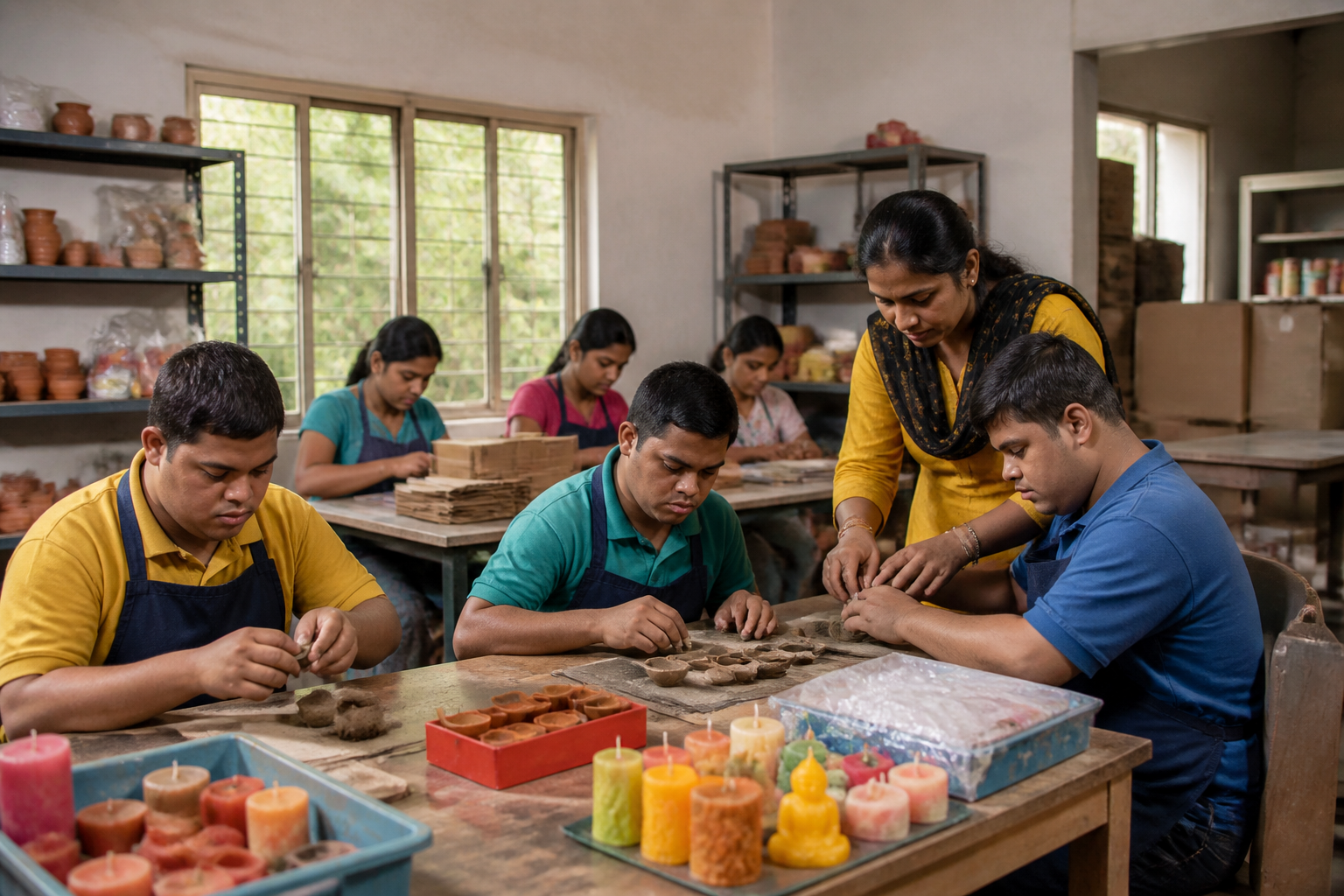
For many children with intellectual disabilities, multiple disabilities or other special needs, the end of school at 18 can mark not independence but uncertainty. In Thane, the Ubhari vocational training workshop run by Jivhala Trust has spent two decades trying to make that transition more purposeful by linking practical training with work, sales and the possibility of regular income.
The workshop was started from the home of Jayashree Ruke and Rajesh Ruke on 3 July 2006, with two students. According to a report by Loksatta – Thane, Jayashree Ruke’s experience as a teacher in a school for special children had brought her close to the uncertainty that families face once the formal school structure ends. Ubhari was created in response to that gap, with a focus on training, self-reliance and social acceptance.
The institutional problem it addresses is straightforward but often overlooked. School provides a defined routine, a place of learning and an organised support system. After the age of 18, however, families may have to find a new arrangement for training, daily activity, social participation and income. The Ubhari model, as described in the report, does not treat vocational preparation as separate from confidence-building. It combines production, basic learning, health guidance and public interaction.
The work is organised according to the abilities of the students. They receive training to make scented incense sticks, wax and clay lamps, ubtan, wax flowers, paper and cloth bags, leaf plates, doormats, wallets and rakhis. The range of products reflects a practical approach: the workshop uses activities that can be divided into manageable tasks and that can be taken to local buyers through exhibitions and housing societies.
The workshop also teaches accounting, numeracy, understanding time and calendars, personal hygiene, yoga and health-related guidance. These activities broaden the meaning of vocational training. The objective is not only to produce an item that can be sold, but also to help students manage routines, understand transactions and participate in a social setting.
That distinction matters because employment-related capability is not limited to a single technical skill. A person working with packaging, counting, sorting or sales may also need to follow a schedule, communicate with others, handle materials and understand a basic exchange. The details in the Loksatta report show that Ubhari’s training combines these elements, although the report does not provide figures on the number of students currently enrolled, the number who have completed training or the income generated through sales.
The route from production to the customer is an important part of the model. Ubhari’s products are sold at different exhibitions and in housing societies. Students participate in the selling process instead of remaining only in the production space. When they hand an item they have made to a customer, the interaction becomes part of their training. The report describes the resulting happiness and confidence as an indicator of growing self-reliance.
For a city, this places the issue beyond the boundaries of a special school or a charitable workshop. Housing societies, exhibitions, businesses and families all become part of the environment in which inclusion either happens or fails to happen. A product sale in a housing society is a small transaction, but it also creates a public setting where a person with a disability is seen as a maker, seller and participant rather than only as a recipient of care.
The institutional gap remains visible in the initiative’s next ambition. The Rukes want to establish a shelter workshop so that students do not have to return to the four walls of their homes after completing training. The proposed model would provide regular work and income through tasks such as packaging, wrapping, box folding, counting and classification, assigned according to individual ability.
This proposed shelter workshop is significant because training alone does not guarantee continuity. If a student learns a task but has no place to practise it or earn from it, the transition from education to adult life remains incomplete. Ubhari’s stated aim is therefore to create a work setting where capability can be used repeatedly, and where labour can receive recognition and compensation.
The proposal also reveals the importance of institutional links outside the non-profit sector. The Rukes have appealed for industries, traders and companies to send packaging and related work to Ubhari. Such arrangements could connect a local training centre with ordinary commercial activity. The source does not establish whether any formal contracts or procurement arrangements currently exist, so the proposed partnership should be understood as an aspiration rather than an operating system already in place.
That distinction is central to assessing the initiative. The available account documents the workshop’s origin, activities and proposed direction, but it does not provide a citywide assessment of how many special children in Thane leave school each year, how many have access to vocational training or how many move into paid work. It also does not state the workshop’s current capacity, operating costs or the volume of products sold. Those gaps do not diminish the importance of the example, but they limit what can be concluded about the scale of the wider problem.
The evidence does establish a more immediate point: a transition after school requires more than an educational endpoint. Ubhari’s programme brings together productive activity, basic financial and time-related understanding, health practices, social interaction and market access. In that sense, the workshop treats independence as a set of connected capabilities rather than as a single employment outcome.
The role of the city is present in each of these connections. Training takes place in a local setting. Sales occur through exhibitions and housing societies. Potential work comes from companies, traders and industries. Families provide the immediate support system. The success of such an arrangement depends on whether these different parts of the urban economy are willing and able to participate.
Housing societies, for example, are not only residential spaces in this account. They are also potential marketplaces and sites of public interaction. Businesses are not merely employers in the conventional sense; they may also generate task-based work such as packing, sorting and folding. For special children and their families, these everyday urban institutions can determine whether training remains isolated or leads to participation.
The story also raises a question about how social infrastructure is understood. Infrastructure is commonly associated with roads, transport, buildings and utilities, but adult support systems are part of the infrastructure that allows residents to live with dignity and continuity. A vocational workshop may be modest in physical scale, yet its function connects education, livelihood, household care and community participation.
Ubhari’s two-decade history further shows that such support often develops through local initiative. The centre began with two students in a private home and has continued its work under the Jivhala Trust. The report does not describe a government programme, municipal partnership or public funding arrangement. As a result, the account also points to the dependence of families and organisations on local institutional initiative when formal pathways after school are unclear or unavailable.
The next test is whether the proposed shelter workshop can convert training into sustained work. That would require a continuing supply of suitable tasks, a system for assigning work according to ability, a reliable route to payment and a setting that can support students beyond the training phase. The supplied report does not say whether these arrangements have been finalised.
What the Ubhari example confirms is that the transition to adulthood for special children cannot be addressed only by extending classroom education. It requires places where skills can be practised, products can reach customers and participation can continue after school. What remains unclear is the scale of demand in Thane and the institutional capacity available to meet it. The proposed shelter workshop, along with the response of companies, traders and industries, will determine whether the initiative can move from vocational preparation to a more durable local work network.
