


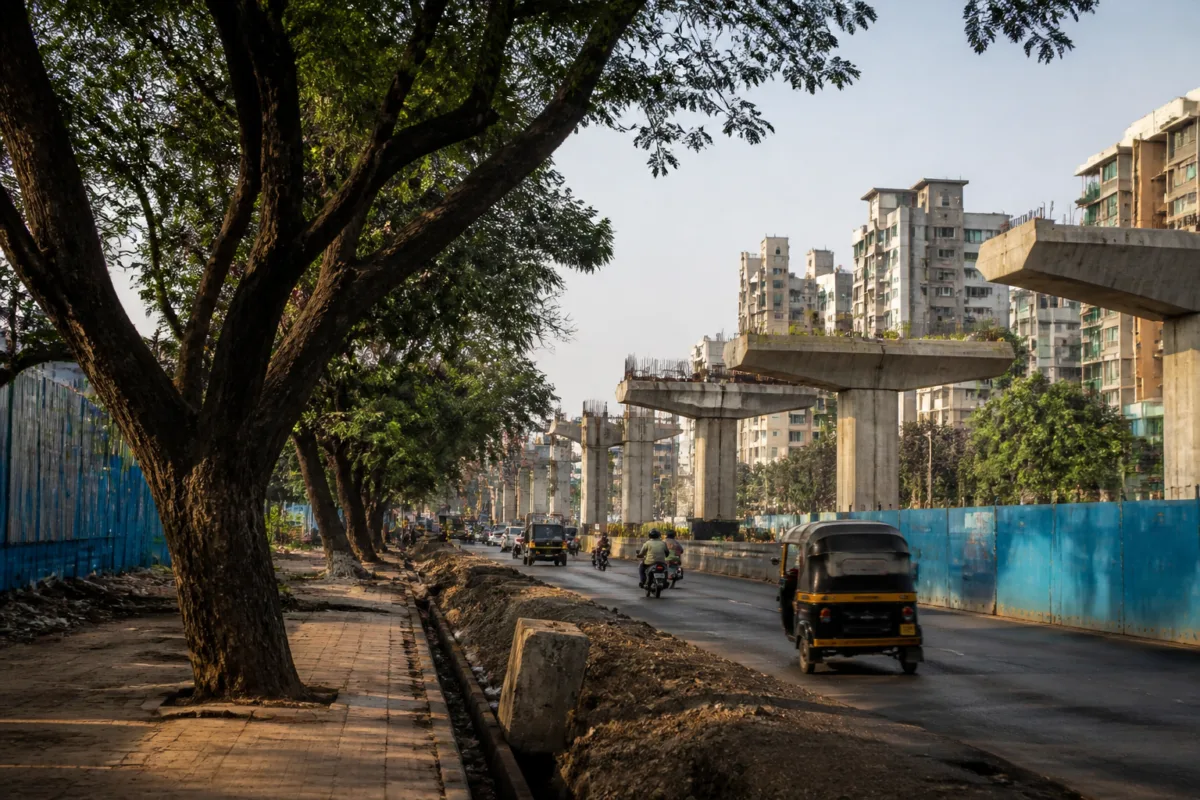
The Bombay High Court has directed the Thane Municipal Corporation (TMC) to formally constitute its statutory Tree Authority within three weeks, after questioning why the body had not been established despite the process having reportedly begun.
The direction came during the hearing of a Public Interest Litigation filed by environmental activist and advocate Rohit Joshi. The petition challenges permissions issued for tree felling and transplantation for the Thane Ring Metro project, particularly along the Rayladevi Lake-to-Balkum stretch.
According to the report, the permissions cover 519 trees for felling and 2,613 trees for transplantation, affecting 3,132 trees in total. Joshi has alleged that the permissions were granted arbitrarily and has sought their cancellation. The validity of the permissions already issued remains open for consideration by the court.
A division bench comprising Chief Justice Mahesh Chandra Tripathi and Justice Advait Sethna questioned the delay in constituting the Tree Authority and directed the civic body to submit a detailed compliance report. The court also cautioned the Municipal Commissioner against granting tree-felling permissions beyond the prescribed jurisdiction.
The petition has raised questions about the authority available to the Municipal Commissioner under the Maharashtra (Urban Areas) Protection and Preservation of Trees Act, 1975. Joshi argued that the Commissioner can independently grant permission for the felling of up to 25 trees, while proposals involving more than 25 trees must be placed before the Tree Authority for approval.
The petition further questioned a resolution dated June 17, 2026, appointing the Municipal Commissioner as chairperson of the Tree Authority, followed by permissions granted on August 24 under Section 8(3) of the state tree-protection law. The court has adjourned the matter until December 21.
The court proceedings have brought renewed attention to the environmental governance of infrastructure projects in Thane. The Ring Metro permissions are at the centre of the legal challenge, while the broader issue is whether the statutory process for reviewing large-scale tree-felling proposals was properly followed.
Environmental activists and residents gathered at Waghbil Naka to welcome the court’s intervention. Participants said they were concerned about tree loss associated with infrastructure development and called for greater accountability in permissions affecting the city’s green cover.
Bhushan Chauhan, who attended the gathering, said residents were not opposed to development but objected to what he described as real estate-driven and unplanned development. Advocate Radhika Prakash Rane said residents had repeatedly protested against the Ring Metro project under the banner of Thanekar Against Ring Metro.
Other participants linked the dispute to wider concerns about air quality and transport planning. Senior citizen Aruna Nayak said deteriorating air quality required a stronger civic response. Namrata Sharma called for an assessment of existing transport infrastructure and commuting patterns before major projects such as the Ring Metro proceed.
The court’s three-week deadline now places the formal constitution of the Tree Authority at the centre of the next phase of the dispute. The compliance report and the hearing scheduled for December 21 are expected to clarify how the civic body addresses the court’s concerns, while the legality of the existing tree-felling and transplantation permissions remains unresolved.

