


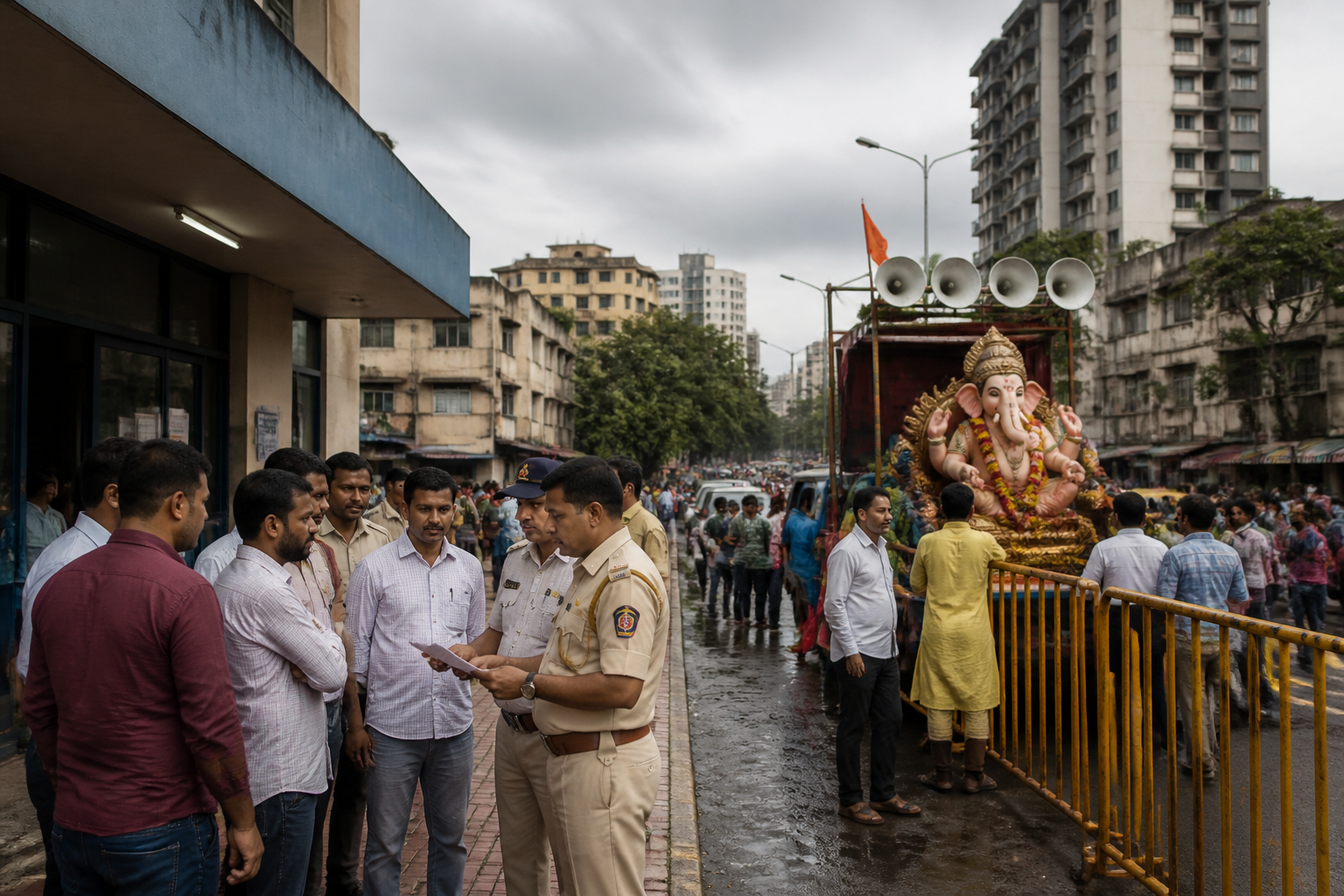
Thane Ganeshotsav noise pollution rules are facing a fresh enforcement test as public festival committees begin seeking police permission for loudspeakers, arrival processions, immersion processions and programmes at mandaps. Police in the Thane Commissionerate area are instructing organisers to comply with noise-control regulations, but questions remain over whether those rules will be enforced during the festival itself.
With Ganeshotsav only a few days away, representatives of public Ganesh committees have started visiting police stations to obtain permission for loudspeakers and related events. The permission process covers the use of sound systems during idol arrival and immersion processions as well as activities conducted at festival mandaps, according to a report by Loksatta – Thane.
The Thane Commissionerate area is expected to host 1,076 public Ganesh idols this year. More than 150,000 household idols are also expected to be installed. The scale of participation means that sound systems will be used across multiple neighbourhoods, especially during processions and public programmes.
Police are informing committees about the applicable noise-pollution rules while processing their requests. The report, however, raises the question of whether issuing instructions will be followed by consistent action against violations during the festival period. Complaints about excessive noise and the use of loudspeakers have emerged during festivals in previous years, keeping enforcement at the centre of the debate.
The issue also has a legal dimension. A petition filed by Thane-based social activist Dr Mahesh Bedekar led the Bombay High Court to issue important directions concerning noise pollution, according to the report. The Supreme Court has also held that the right to live in an environment free from noise pollution forms part of the right to life under Article 21 of the Constitution.
Despite these legal principles, complaints of noise-rule violations continue to surface during festivals. The wider debate intensified in Maharashtra after citizen-led opposition to excessive DJ use in Pune brought renewed attention to the enforcement of noise regulations. The Thane report notes that citizens have questioned whether authorities will take action against committees that violate the rules or whether the administration’s role will end with issuing warnings.
The immediate process in Thane is the grant of permissions to festival committees. Police instructions on noise compliance will apply as organisers prepare for public events, processions and immersion activities. The effectiveness of enforcement will become clearer during the festival period, when the expected 1,076 public idols and large number of household celebrations generate concentrated activity across the commissionerate area.
