


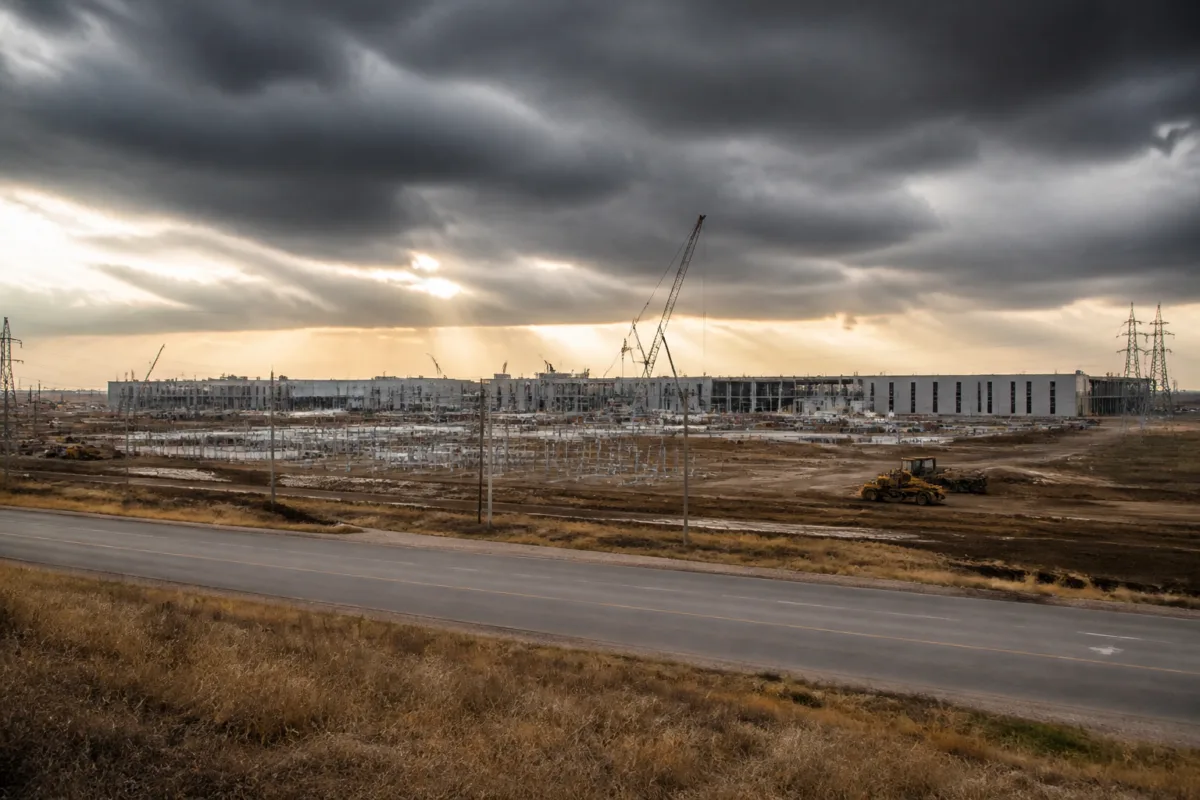
The sharp fall in shares of companies building artificial-intelligence infrastructure after a Democratic sweep in the US midterm elections is more than a market reaction to changing political loyalties. It exposes the dependence of data-centre construction on land, power, financing and regulatory permission, with Texas at the centre of that uncertainty.
The report by Bloomberg, published by Hindustan Times, said cryptocurrency-linked investments and companies converting Bitcoin-mining facilities into AI campuses lost value after Gina Hinojosa defeated Greg Abbott to become Texas’ first Democratic governor in more than 30 years. Hinojosa campaigned against unrestricted data-centre development and advocated an imminent moratorium.
The immediate losses were visible across companies with exposure to digital assets and computing infrastructure. World Liberty Financial tokens, co-founded by Donald Trump, fell by about 6% in 24 hours, while his namesake memecoin declined by about 19%, according to CoinGecko data cited in the report. Trump Media & Technology Group shares fell 25%, and the leveraged exchange-traded fund DJTU declined almost 50%.
The more important urban-infrastructure story, however, concerns companies that have moved from cryptocurrency mining into data-centre development. Galaxy Digital lost nearly 17%, Hut 8 fell 23% and MARA Holdings declined about 4%. Cipher Digital, Core Scientific and IREN each fell at least 10%, according to the report.
These companies are not simply technology firms. Their valuations are tied to physical sites, electricity connections, buildings, cooling systems and the ability to secure long-term financing. The market reaction therefore reflects concerns about whether planned computing campuses can be built on schedule and whether their power-intensive operations will receive political and regulatory approval.
### Why Texas matters to data-centre construction
Texas has become a particularly important location in the US data-centre pipeline. The report, citing research firm Semi Analysis, said the state accounts for nearly 30% of US data-centre capacity scheduled to come online in 2028, the largest share of any state.
That concentration gives local political decisions an importance beyond one state’s borders. If projects are delayed, restricted or subjected to additional conditions, the impact could extend to companies that depend on Texas sites for future computing capacity. The issue is not only whether a facility eventually opens, but whether developers can maintain the timetable assumed by lenders and investors.
Brian Dobson, managing director of disruptive technology equity research at Clear Street, said a change in political control could produce additional data-centre regulations. He said such rules would favour established companies with strong records as “good corporate citizens”. The statement points to a possible shift in how projects are evaluated: from the speed of construction and availability of power towards the quality of the developer’s local operating record.
That distinction matters for cities and regions competing to attract large infrastructure projects. Data centres can bring investment and specialised demand for power and land, but they also create local questions about electricity use, construction impacts and the distribution of economic benefits. The supplied report does not establish what regulations a Hinojosa administration would introduce, but her campaign position has already changed the risk calculation for investors.
### The financing problem behind the political reaction
The market concern is intensified by the structure of data-centre development. Companies spend heavily before a facility generates revenue, taking on financing costs during land acquisition, construction, equipment installation and grid connection. A delay can therefore affect the project even if the underlying demand for computing remains strong.
Matthew Hougan, chief investment officer at Bitwise Asset Management, said a slower buildout could place significant stress on AI-focused “neoclouds” because financing costs would continue while revenue was pushed back. He compared the situation to constructing an apartment building that encounters delays: the borrowing costs continue, but the expected income does not arrive.
The comparison is useful because it shows why construction policy is also financial policy. A moratorium or stricter approval process does not merely affect a developer’s schedule. It can alter the cost of capital, the value of partially completed infrastructure and the ability of a company to meet commitments to customers and lenders.
For local authorities, this creates a difficult administrative balance. A data-centre project may be presented as a technology investment, but the authority must also process the physical consequences of the project: site development, electricity demand and the wider infrastructure required to support it. The report does not provide details of Texas’ approval system or the specific powers available to the incoming governor, so the precise route from campaign promise to construction restriction remains unclear.
### Repurposing mining facilities is not automatically risk-free
The companies affected by the selloff have an additional strategic argument. Many already possess sites and infrastructure developed for cryptocurrency mining and are seeking to repurpose those assets for AI computing. Adam McCarthy, head of research at trading firm LO:TECH, said the market reaction could be an overreaction because stricter rules on new AI construction might increase the value of existing infrastructure.
This argument rests on a distinction between new construction and conversion. If policymakers limit new data-centre development, facilities that already have buildings, electrical connections or other supporting infrastructure could become more valuable. Existing sites may offer developers a way to avoid some of the delays associated with securing entirely new locations.
But the report also makes clear that conversion is not a complete answer to the construction challenge. AI workloads can require different technical systems from cryptocurrency mining, and the article does not establish how many existing sites can be converted, what upgrades they require or whether their power capacity is sufficient. The physical existence of a mining facility does not, by itself, confirm that it can operate as an AI campus.
This is where the infrastructure story becomes more complex than the stock-market story. The value of an existing site depends on its location, power access, equipment, permissions and ability to support the technical requirements of AI workloads. Investors may therefore be reassessing not only political exposure but also the practical quality of the assets held by these companies.
### A new test for urban and energy governance
The Texas case illustrates how data-centre expansion is moving into the territory traditionally occupied by urban planning and public-utility administration. Large computing campuses require land and buildings, but their most consequential relationship with a region may be with the electricity system. Decisions about where such facilities are placed can affect grid planning, local development and the timing of other infrastructure investments.
The report does not provide electricity-consumption figures, local employment numbers or details of public subsidies connected to the Texas projects. Those omissions limit what can be concluded about the direct benefits and costs for residents. What is established is the scale of the planned pipeline and the dependence of developers on a favourable regulatory environment.
The political change also shows that the social licence for data-centre construction cannot be treated as a purely commercial matter. Hinojosa’s campaign position against unrestricted development indicates that data-centre growth has become an issue in electoral politics. The debate is therefore moving beyond whether companies can find suitable land and financing to whether communities and governments will accept the pace and conditions of expansion.
For investors, the immediate question is whether the new administration will impose a moratorium, introduce additional rules or distinguish between new projects and existing facilities. For cities and infrastructure agencies, the larger question is how to assess projects whose benefits may be national or global while their demands on land, power and public administration are local.
The evidence currently confirms a political risk to Texas’ data-centre pipeline, not a completed policy change. Companies are facing higher uncertainty over construction schedules and financing, while firms with existing mining infrastructure are arguing that their assets could gain value if new development becomes more difficult. The next significant developments will be the incoming administration’s specific regulatory proposals and whether they apply differently to new campuses, expansions and conversions.

