


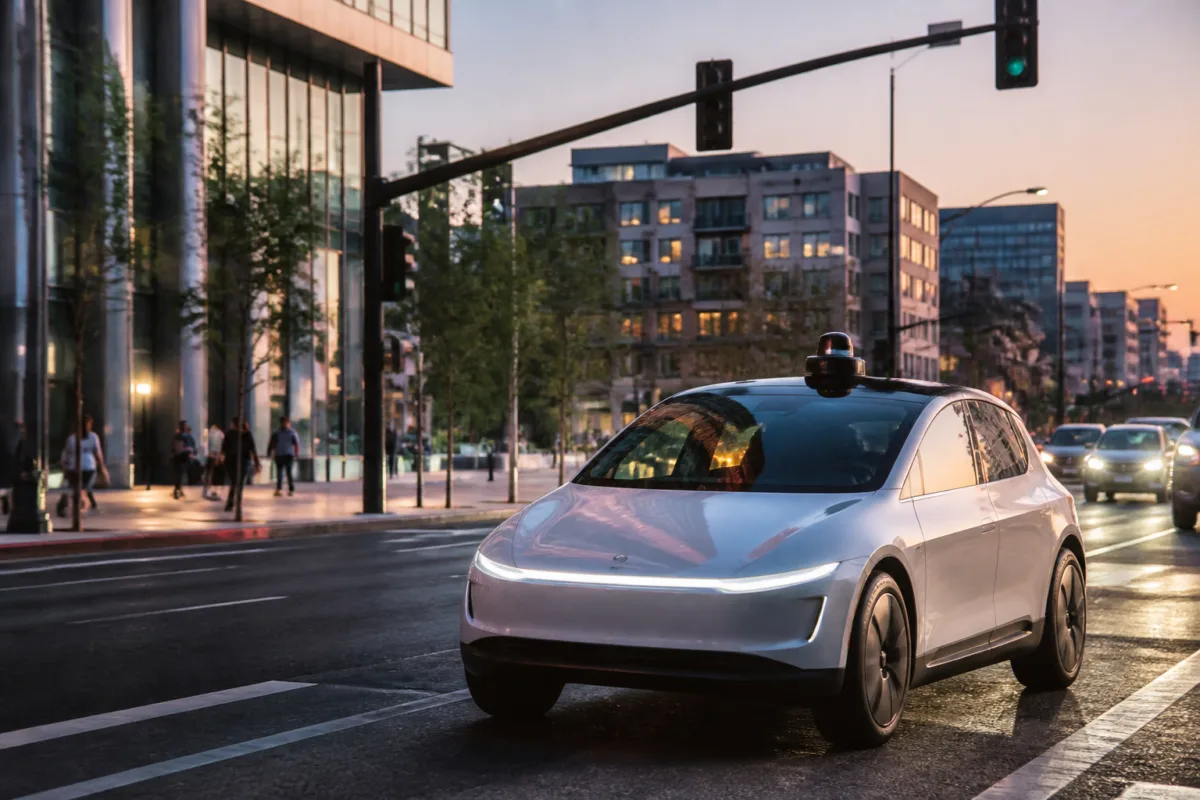
Tesla’s latest quarterly results offer the company financial breathing room, but its robotaxi expansion points to a more difficult urban-mobility challenge: autonomous vehicles must scale not only as software, but as regulated, supplied and operationally reliable fleets. The company expanded its robotaxi fleet size and operating hours during the quarter, yet it did not add new cities after July and continues to face battery-availability limits.
The results reported by Tesla show adjusted earnings per share of 48 cents, above the average analyst estimate cited in the company’s statement. Revenue was slightly below estimates, while free cash flow reached $1.5 billion, compared with market expectations of cash burn of nearly $5 billion. Gross margin was 19.6%, also above estimates. Tesla’s shares rose 1.5% in extended trading after the results.
For the built environment and mobility systems, however, the more consequential development is the company’s effort to move autonomous vehicles from demonstration to networked urban service. Tesla has been integrating its Cybercab into its Austin robotaxi fleet and expanded the fleet’s size and operating hours during the quarter. The company has also said that its robotaxi service will expand soon to Phoenix, Las Vegas, Jacksonville in Florida and San Antonio in Texas, without providing a concrete timeline.
That absence of a firm timetable is significant. Operating a robotaxi service across cities requires more than a vehicle capable of autonomous movement. It requires regulatory permission, fleet availability, charging or battery capacity, operating zones, safety oversight and a system capable of functioning across different street environments. The information in Tesla’s results does not establish how quickly the proposed expansion will occur, how many vehicles will be deployed in each city or what operating conditions will apply.
Tesla’s recent regulatory progress shows how central government approval remains to the company’s urban strategy. The company cleared one of its last regulatory hurdles in Arizona to start its service in the state. Separately, it was approved to operate a fleet of up to 5,000 autonomous vehicles in parts of Clark County, where Las Vegas is located. These approvals create room for expansion, but they do not themselves confirm that a full-scale service has begun or that the approved fleet size will be reached.
This distinction between permission and operation is important in emerging mobility systems. A regulatory approval defines what a company may do within specified conditions; it does not demonstrate that the service can be delivered at scale. Tesla’s own statement that the expansion will happen “soon”, without a concrete timeline, leaves the implementation stage unresolved. The company also has a long-standing goal of adding service in Las Vegas and Phoenix, but the supplied report does not confirm a launch date for either city.
The battery constraint adds another layer to the urban question. Tesla ended the quarter with what it described as its largest passenger-vehicle backlog in four years, citing battery availability as a limiting factor. A robotaxi network intensifies this supply challenge because vehicles used commercially may spend longer hours on the road than privately owned cars. The report does not provide a separate battery allocation for robotaxis, nor does it state how the autonomous fleet will be supplied while Tesla is also increasing production of cars and batteries.
Tesla’s product and investment strategy is therefore operating across several demands at once. Its current product lineup consists of the Model Y, Model 3 and Cybertruck, while the company is investing in new areas including artificial intelligence, humanoid robots and self-driving cars. It has also opened its first factory for the Semi freight truck, a product first unveiled in 2017. The company has lined up $30 billion in new loans and credit lines to support its growth.
The quarterly cash-flow result gives Tesla greater room to pursue these initiatives, but it does not resolve the question of how capital will be prioritised between them. Free cash flow was $1.5 billion in the period, while the report noted that the figure called into question an earlier pledge to increase capital expenditure to more than $25 billion this year. For autonomous urban mobility, the relevant issue is not simply whether Tesla can fund development, but whether investment can translate into dependable services in multiple cities.
The company’s Cybercab launch illustrates the same gap between product unveiling and urban deployment. Tesla launched the long-anticipated two-seater Cybercab in September and has been integrating it into its Austin robotaxi fleet. The event drew scrutiny from the US National Highway Traffic Safety Administration. The supplied report does not detail the regulator’s concerns or state whether the scrutiny has resulted in a formal restriction, but it confirms that Tesla’s autonomous programme remains subject to regulatory attention.
The proposed city expansion also shows that robotaxi deployment is geographically uneven. Tesla has not added new cities since July, even as it expanded fleet size and operating hours. The next proposed locations—Phoenix, Las Vegas, Jacksonville and San Antonio—would extend the service across different urban settings, but the company has not provided details on the service areas, fleet numbers, safety conditions or passenger access arrangements in those places.
That matters because a city is not a single operating environment. A robotaxi service interacts with road design, traffic signals, curb space, airport and event traffic, parking rules, emergency response and local regulation. The source material does not provide evidence on how Tesla’s service handles these systems, and it would be premature to treat the planned expansion as proof that autonomous mobility has become a citywide transport alternative.
The available numbers instead describe a company balancing strong financial performance in the quarter with operational constraints. Adjusted earnings beat estimates, free cash flow remained positive and gross margin exceeded expectations. At the same time, revenue was narrowly below estimates, battery availability limited vehicle supply, and the robotaxi programme had expanded existing operations without adding new cities since July.
Tesla is also pursuing a possible combination with SpaceX, although no agreement has been reached. Special committees have been formed to explore a merger, and Elon Musk said he supports a combination but is not allowed to participate in the talks. Tesla’s earnings release offered no further details. The possible transaction is separate from the robotaxi rollout, but it forms part of the wider corporate structure through which Tesla is seeking to finance and organise its future technologies.
The central urban question is consequently not whether Tesla has announced an autonomous vehicle vision. It has. The question is whether that vision can move through the narrower channels that determine whether a mobility service works in practice: vehicle supply, battery availability, regulatory clearance, fleet operations and city-specific deployment. The current evidence confirms progress in Austin and regulatory movement in Arizona and Clark County, but it does not establish the scale or timing of the next phase.
Tesla’s financial results provide support for continued investment, while its robotaxi plans remain dependent on execution beyond the headline announcement. The developments to monitor are the company’s concrete launch timelines for Phoenix, Las Vegas, Jacksonville and San Antonio; the size and composition of the autonomous fleets; the conditions attached to regulatory approvals; and whether battery availability continues to limit expansion.

