


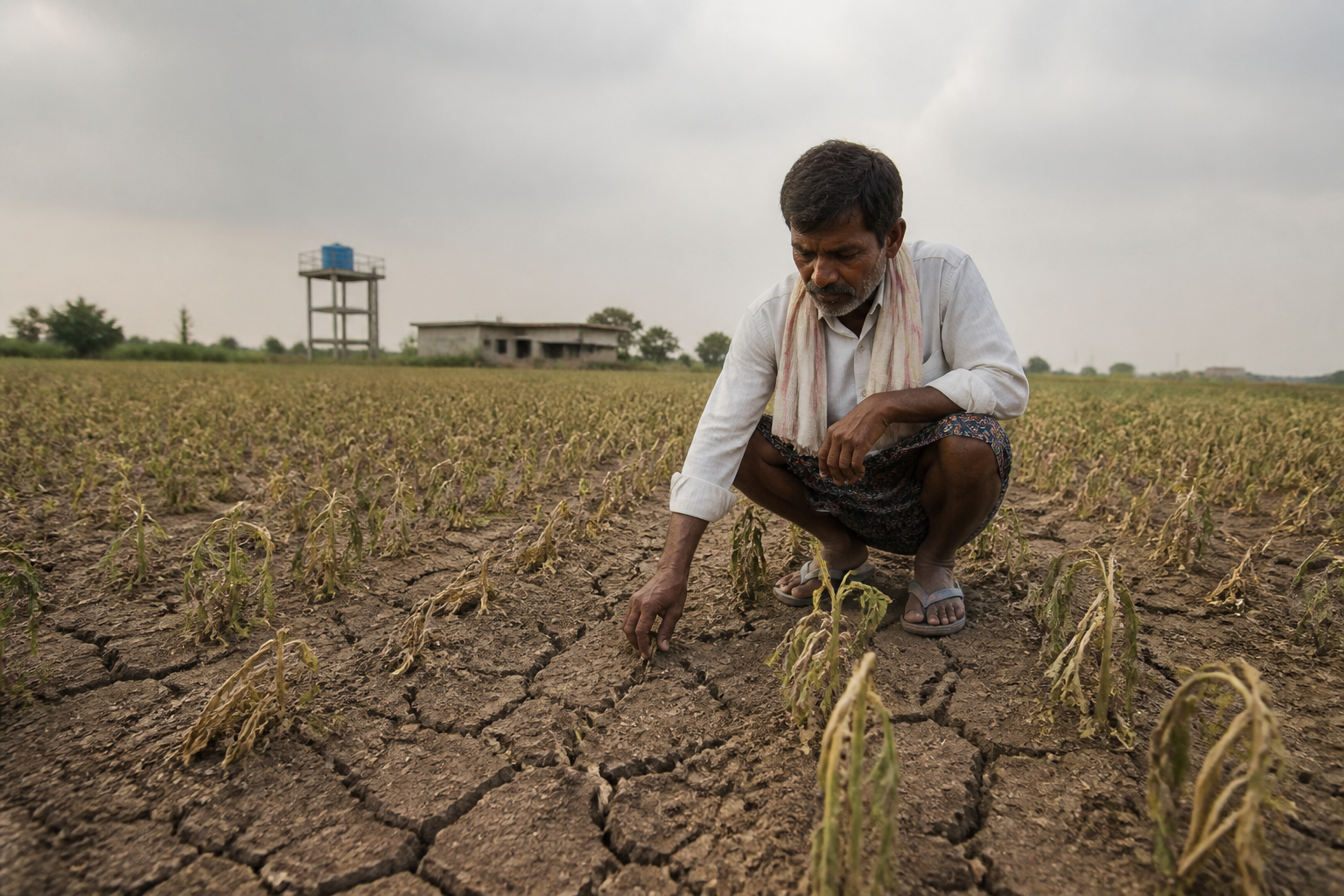
Telangana’s growing climate risk is exposing a weakness in how drought is understood: the system is designed to establish whether drought has already occurred, while farmers may need warnings much earlier, when a rainfall shock begins interacting with depleted groundwater, stressed soils, crop choices and household debt.
That distinction is at the centre of calls by experts for an overhaul of India’s drought assessment framework. The concern is not that the existing system lacks indicators. The current framework, introduced in 2020, widened the assessment beyond rainfall to include vegetation, soil moisture, cropped area, groundwater, reservoirs and stream flow. The concern is that these indicators are primarily used to confirm drought conditions, rather than to continuously identify where a farming system is most vulnerable before crop losses become widespread.
For Telangana, the issue is particularly significant because erratic rainfall can interact with several local pressures at once. A weak monsoon does not produce the same result in every district or mandal. Its effect depends on the condition of groundwater, the quality of soils, the crops being cultivated, the cost of production and the financial resilience of farming households. A rainfall deficit that one region can absorb may push another into agricultural distress.
Agricultural scientist GV Ramanjaneyulu said the assessment process should distinguish between the hazard created by a rainfall deficit and the vulnerability of the farming system exposed to it. “A weak monsoon is a hazard. But whether it becomes a farming disaster depends on what that rainfall shock encounters — depleted groundwater, degraded soils, unsuitable and water-intensive cropping systems, rising cultivation costs and household debt,” he said, according to the Times of India report.
The distinction matters because formal drought declaration is not an immediate response mechanism. Under the existing framework, states are required to assess multiple indicators and conduct field verification before declaring drought. Rainfall alone cannot determine the outcome. This approach is intended to prevent drought declarations based solely on below-normal rainfall, but it also means that the administrative process is focused on establishing the severity of an event after several conditions have aligned.
The framework has evolved over time. India issued its first national Manual for Drought Management in 2009 and revised it in 2016. The 2020 framework broadened the evidence base by adding or strengthening indicators related to vegetation, soil moisture, cropped area and hydrological conditions. This represents an important shift away from a rainfall-only definition of drought. Yet the experts cited in the report argue that a wider list of indicators is not enough unless those indicators are used to assess vulnerability continuously.
This is the institutional gap the proposed reform seeks to address. Instead of maintaining only a seasonal process for determining whether drought has set in, authorities could maintain a baseline vulnerability assessment for districts and mandals. That baseline would show which areas already have stressed groundwater, degraded soils, high dependence on a single crop or other conditions that can magnify the impact of a rainfall shock.
A seasonal drought-risk monitoring system could then be placed alongside it. The proposed system would track rainfall, dry spells, soil moisture, vegetation health and crop conditions as they change. The purpose would not be to replace the formal drought declaration process. It would add an early-warning layer that enables authorities to act before the indicators reach the threshold required for a declaration.
The difference between the two systems is important for governance. A drought declaration is a formal administrative conclusion. An early-warning assessment is a risk-management tool. The first determines whether established criteria have been met; the second helps officials identify where intervention may be needed even when the full criteria have not yet been satisfied.
For Telangana, experts suggest that early identification could allow authorities to target high-risk mandals before crop losses become widespread. The possible measures identified in the report include promoting alternative crops, ensuring seed availability, issuing irrigation advisories, conserving groundwater and extending credit support to farmers. These interventions depend on timely information. Once crops have failed or household debt has deepened, the scope for preventive action is narrower.
The proposal also reveals why drought cannot be treated only as a weather event. Rainfall is the immediate hazard, but the damage is shaped by the underlying condition of the agricultural system. Groundwater levels influence the ability of farmers to compensate for dry spells. Soil condition affects how long moisture is retained. Cropping patterns determine water demand and exposure to a particular rainfall cycle. Cultivation costs and debt influence whether a household can absorb a failed season or shift to another crop.
A system that measures only the hazard may therefore produce an incomplete picture of risk. Two mandals could record a similar rainfall deficit but face different consequences because their groundwater, soils, crop patterns and household finances are not alike. The report’s central argument is that drought policy needs to capture this difference before it becomes visible through large-scale crop damage.
The timing of assessment is another concern. The report states that Andhra Pradesh and Maharashtra have already assessed the drought situation, while Telangana is yet to evaluate crop conditions and other parameters after the conclusion of the kharif season. That assessment is part of the existing process, but the broader policy question is whether post-season evaluation can provide sufficient protection when vulnerability begins to build during the season itself.
A continuous monitoring system would also change the role of local administration. Instead of waiting for a formal declaration, officials would have to interpret multiple signals and connect them to specific interventions. A deteriorating soil-moisture reading, a prolonged dry spell or weakening vegetation health would not automatically mean that drought had been declared. It could, however, trigger an examination of seed supply, irrigation advice, crop diversification or groundwater conservation in the affected mandals.
That would require coordination across departments and levels of government. Rainfall and hydrological information, crop conditions, groundwater status and field verification are not necessarily managed through one institutional channel. The proposed vulnerability layer would have to bring these indicators together in a form that district and mandal administrations can use. The report does not establish whether such an integrated system currently exists in Telangana, but it identifies the absence of a single, continuous vulnerability assessment as a central weakness.
The policy challenge is consequently not only technical. It is also administrative. A framework may contain the correct indicators but still provide limited protection if data is collected too late, not combined across departments or not linked to early action. The value of an indicator depends on whether it changes what the administration does and how quickly it does so.
The approach could also make drought support more targeted. If baseline assessments identify high-risk mandals, interventions need not wait for an entire district to meet formal drought criteria. Authorities could focus preventive measures on areas where the same rainfall conditions are likely to cause greater damage. This would not alter the legal or administrative test for declaring drought; it would improve the timing and precision of support before that test is met.
The evidence in the report does not establish how many Telangana districts or mandals currently face each form of vulnerability. It also does not provide a quantified comparison of groundwater levels, soil conditions, crop losses or debt across regions. Those gaps matter because a vulnerability-based system would need transparent criteria and reliable local data. Without them, early-warning assessments could remain broad alerts rather than operational tools.
What the available evidence does establish is the policy mismatch. India’s drought framework has moved from a narrow rainfall-based approach to a multi-indicator model, but experts believe it still primarily answers the question of whether drought has occurred. Telangana’s changing rainfall patterns raise a different question: which farming systems are likely to suffer most if rainfall becomes erratic, and when can authorities intervene before that exposure turns into loss?
The answer will determine whether drought governance remains largely reactive or becomes preventive. Formal declarations will continue to matter, particularly for administrative relief and official recognition of crisis. But for farmers facing a shortfall that interacts with groundwater stress, degraded soils and expensive cultivation, assistance may be most valuable before the crisis acquires an official label. The next stage for Telangana is therefore not simply to assess drought after the kharif season, but to establish whether vulnerability can be tracked early enough to guide action before agricultural distress escalates.
