


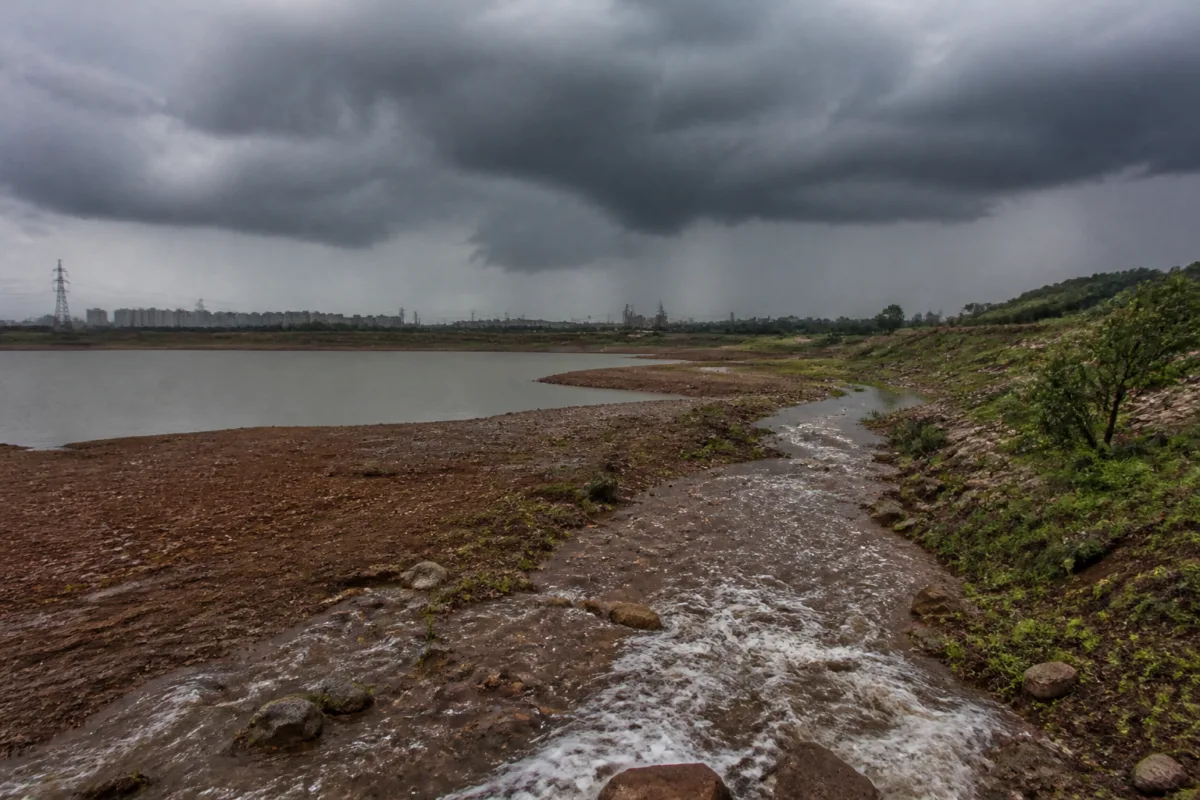
Cyclone Arnab may bring heavy rainfall to parts of Telangana, but it is unlikely to end the state’s water crisis because water security depends on more than a few days of rain. The immediate forecast points to storms, wind and local relief; the larger problem is whether rainfall reaches the catchments, rivers, reservoirs and drinking-water sources that sustain cities and settlements over time.
According to the India Meteorological Department officials quoted by Deccan Chronicle, the cyclone was expected to cross the Andhra Pradesh coast and then move north through Wednesday and Thursday. Telangana’s eastern districts were placed under different alert categories, with red alerts for Bhadradri-Kothagudem, Mahbubabad, Mulugu and Khammam, and orange alerts for Jayashankar Bhupalpally, Warangal, Suryapet, Nalgonda and Nagarkurnool. The forecast also indicated wind speeds of more than 50 to 60 km/h, with maximum speeds possibly reaching 70 km/h.
The forecast presents a familiar urban and regional water dilemma: rainfall can be intense without becoming dependable water storage. Heavy rain over a short period may run rapidly into streams and drains, particularly when the ground cannot absorb it at the same pace. Some of that runoff may reach rivers, reservoirs and local water bodies, but the quantity that ultimately becomes usable water depends on where the rain falls, how intense it is, how long it lasts and whether the upstream catchments receive sufficient precipitation.
This distinction matters because Telangana’s water system is not organised around rainfall in one district alone. Its water security is linked to the wider Krishna and Godavari basins, including catchment areas outside the state in Maharashtra and Karnataka. Rainfall concentrated in Telangana’s eastern districts can produce visible local effects, such as swollen streams, temporary ponding and improved soil moisture, without creating enough inflow into the reservoirs that support drinking-water schemes.
The cyclone therefore exposes the difference between weather relief and water security. Weather relief is immediate and local: a dry area receives rain, temperatures may moderate, soil moisture can improve and smaller water bodies may recharge. Water security is cumulative and regional. It requires adequate rainfall across the relevant river basins, storage in reservoirs and dependable inflows over a period long enough to support domestic, agricultural and other uses.
The distinction is particularly important after what the report describes as a prolonged dry spell and a deficient monsoon. When reservoirs and river systems have already lost water, one rainfall event must first compensate for the deficit before it can create a sustained reserve. Even when a storm produces heavy rainfall totals, rapid runoff can limit the portion that enters groundwater, tanks or large reservoirs. The source does not establish how much water the cyclone will add to Telangana’s major reservoirs, but it makes clear that a single episode cannot automatically be treated as a recovery for the state’s wider water system.
The alert pattern also shows why the impact will not be uniform across Telangana. The eastern districts were expected to experience the strongest effects, while Hyderabad and the rest of the state were placed under a green alert with light to moderate rainfall. Komuram Bheem Asifabad, Mancherial, Peddapalli, Jayashankar Bhupalpally and Mulugu were expected to receive moderate rainfall on Thursday. Such a distribution could benefit particular local catchments while leaving other areas with limited additional water.
For cities, this unevenness creates a planning problem. A city’s water supply may depend on infrastructure located far beyond its municipal boundary and on rainfall that falls outside the built-up area. Urban residents may experience rain directly through waterlogging, traffic disruption or temporary relief from dry conditions, while the reservoirs and river systems supporting drinking-water supply receive insufficient inflows. The visible presence of rain is therefore a poor measure of the health of the larger water network.
The report’s assessment also highlights the role of catchment geography in water governance. Rivers do not follow administrative boundaries, and neither do the rainfall systems that feed them. Telangana’s dependence on the Krishna and Godavari basins means that state-level water planning must account for rainfall and runoff across a wider regional landscape, including areas in neighbouring states. A storm centred on one part of that landscape may be significant for local authorities but inadequate for basin-level replenishment.
This places limits on what disaster alerts can communicate. Red, orange, yellow and green alerts are essential for preparing residents and authorities for wind and rainfall impacts, but they are not measures of reservoir recovery. A red alert indicates severe weather risk in a district; it does not indicate that the district’s drinking-water sources will be replenished. Similarly, light rainfall in Hyderabad may have limited significance for reservoirs elsewhere, while heavy rainfall in an eastern district may not translate into reliable urban supply.
The institutional responsibilities are consequently divided. The IMD provides weather forecasts and warnings. Authorities responsible for reservoirs, river systems and drinking-water schemes must assess inflows, storage and catchment conditions. Local administrations must manage the immediate effects of heavy rain, including runoff and possible disruption. The source does not provide a detailed response from Telangana’s water or municipal agencies, but the geography described in the report shows why forecast information alone cannot answer the question of water availability.
The same evidence points to a broader weakness in how water stress is understood. A rainfall event is often treated as a reset button after a dry period. In reality, water systems respond to the location, timing and duration of rainfall. Rain falling on already saturated ground may run off quickly. Rain falling away from reservoir catchments may have little effect on storage. Rain spread across wider catchment areas over a longer period may be more useful for sustained replenishment than a short, intense storm, even if the storm produces more dramatic local conditions.
The report also refers to the looming impact of El Niño, placing the cyclone within a larger climate and monsoon context. It does not quantify that impact or provide a long-term assessment of Telangana’s water balance. What it does establish is that the state is entering the cyclone episode with depleted rivers, reservoirs and drinking-water sources after deficient monsoon conditions. The immediate forecast must therefore be read against an existing deficit rather than as an isolated weather event.
That framing is important for Hyderabad and other urban areas because drinking-water systems are vulnerable to the gap between demand and dependable supply. The source does not provide current reservoir levels, city demand figures or an estimate of remaining storage, so the precise duration or severity of the water crisis cannot be determined from the available material. But the reported dependence on basin-wide rainfall shows that short-term city weather cannot by itself resolve the problem.
The central question is not whether Cyclone Arnab will produce rain. The forecast indicates that it will bring heavy but passing storms to parts of Telangana after landfall. The more consequential question is whether that rain will fall with the geographic spread, intensity and duration needed to generate sustained inflows into the river systems and reservoirs on which drinking-water schemes depend. The supplied evidence suggests that this outcome cannot be assumed.
Cyclone Arnab may still provide temporary benefits. Parched areas could receive relief, local water bodies may recharge and soil moisture may improve. Those effects matter, especially after a dry spell. But they should not be confused with the restoration of Telangana’s wider water balance. The state’s water crisis will continue to be measured by reservoir and river-system replenishment across the Krishna and Godavari basins, not by the intensity of rain experienced during a few passing storms.
The next significant evidence will therefore come from observed rainfall and inflows after the cyclone moves north on Wednesday and Thursday. Until those effects are measured across the relevant catchments, the responsible conclusion is limited: Cyclone Arnab may soften local water stress, but it is unlikely on its own to restore Telangana’s depleted water systems.

