


Telangana’s drought response is being organised around a difficult resource choice: protecting drinking water supplies even if that means withholding irrigation releases during the Rabi season. Chief minister A Revanth Reddy has announced a four-month employment scheme after Sankranti, alongside village-level measures for water access, livestock and agricultural infrastructure, as the state prepares for what he said could be eight to 10 months of drought conditions.
The announcement is significant not simply because it promises more rural work. It shows how a water shortage is being treated as a combined livelihood, public-utility and administrative crisis. The state government’s proposed response brings together employment, reservoir management, field inspections, farmer communication, fodder supply and electricity planning. That combination reflects the reality that drought in a predominantly agricultural state can quickly move beyond crop losses and become a question of drinking water, wage security, livestock survival and local infrastructure maintenance.
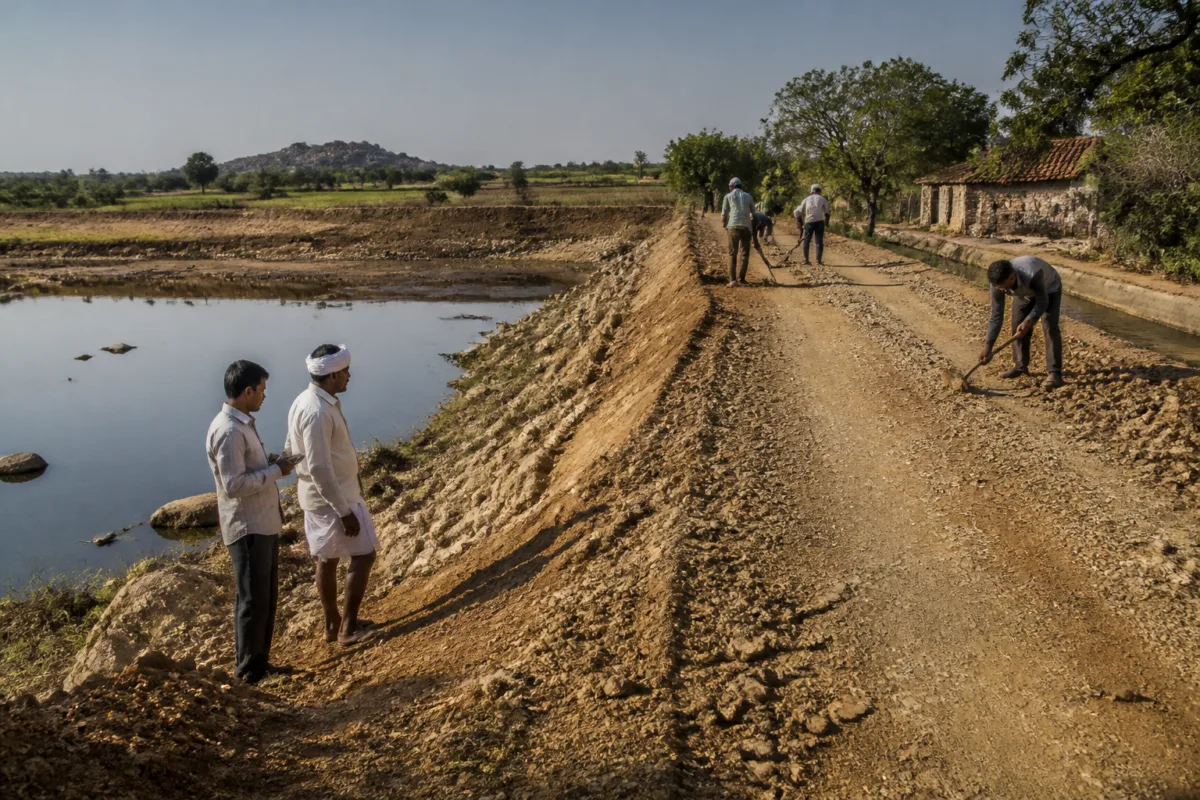
The immediate trigger was a meeting at Praja Bhavan attended by ministers, MPs, MLCs and MLAs to discuss challenges linked by the chief minister to El Niño. Revanth Reddy directed public representatives to visit villages and said their visits would be monitored through a mobile application. The stated purpose is not only political outreach. According to the report, the visits are expected to help restore access roads to agricultural fields, canals, ponds and other minor water bodies while allowing the administration to assess conditions on the ground.
That monitoring arrangement is an important administrative feature of the plan. Rather than treating the drought response as a single department’s responsibility, the government is assigning elected representatives a field role and creating a digital record of their visits. The source does not specify how the application will measure outcomes or whether the information will be publicly released. But the proposed system indicates that implementation is intended to be tracked beyond an announcement made at the state level.
The employment scheme is expected to begin after Sankranti and continue for four months until May. The chief minister said it would provide daily employment to poor people and workers, with funding coming both from the Centre and from substantial state allocations. Additional employment would also be generated under the rural employment guarantee scheme. The government has not, in the supplied report, disclosed the scheme’s total budget, the number of workers to be covered, the wage rate or the precise list of permissible works.
Those missing details matter because the effectiveness of a drought employment programme depends on more than the existence of a funding promise. The choice of works will determine whether the scheme provides temporary income alone or also strengthens rural resilience. The works named by the chief minister—access roads to fields, canals, ponds and minor water bodies—suggest an attempt to connect wage support with the repair of assets that are relevant to farming and local water management. The scale, sequencing and quality of those works will determine whether the public investment produces durable benefits.
The government’s water position is more clearly defined. Revanth Reddy said reservoirs had less than 200 TMC of available water and that only 20% of usable reservoir water was reserved for drinking purposes. He said no water would be released for irrigation during the Rabi season, making drinking water the priority. The figures provide the central constraint around which the rest of the response is being built, although the report does not identify the reservoirs covered, the baseline against which the 20% figure is calculated or the geographic distribution of the available water.
This prioritisation changes the immediate policy question for farmers. Instead of maximising irrigated acreage, the government is asking farmers to cultivate crops and vegetables that require less water. The chief minister also warned that drought conditions could persist for eight to 10 months, extending up to July 2027, while describing irrigation as unviable under the current reservoir position. The report does not provide a crop-wise assessment or identify the alternative crops being promoted. It does, however, establish that the government wants agricultural decisions to be shaped by water availability rather than by normal seasonal expectations.
The timing creates a direct connection between water management and rural income. If irrigation releases are restricted during Rabi, farmers may face lower cultivation opportunities precisely when a seasonal employment programme is being designed to provide work. In that setting, public employment becomes a buffer against the loss of farm-based income, while the proposed restoration of field roads, canals and ponds becomes a way to keep local infrastructure functioning despite reduced irrigation activity.
The response also recognises that drought affects livestock, not only crops. The government plans to establish village-level centres providing fodder and drinking water for animals. This is a separate operational requirement from human drinking-water supply, but it is linked to the same scarcity. A livestock support system can reduce pressure on households that depend on animals, although the supplied report does not state how many centres will be created, how they will be supplied or which department will administer them.
The administration has appointed K Ramakrishna Rao as a special officer to address El Niño-related issues and counter misinformation. The appointment adds a coordinating layer to the response. It also reveals that the government sees public communication as part of drought management. Revanth Reddy said public representatives should explain the drought conditions through Rythu Vedikas, while cultural troupes known as Kalajathas would be organised to motivate farmers. A help desk is also to be established at Gandhi Bhavan under the leadership of MP Chamala Kiran Kumar Reddy.
These communication measures are aimed at a practical problem: farmers may make planting decisions before water conditions are fully understood. The chief minister warned farmers against being misled into sowing crops that could lead to further losses. The report attributes this warning to his criticism of opposition leaders, but the administrative issue extends beyond the political exchange. In a water-constrained season, information about reservoir levels, crop choices and access to public employment becomes part of the infrastructure through which households manage risk.
The drought plan is also being developed alongside pressure on the power system. Revanth Reddy said the government had managed energy requirements despite shortages in the market, had explored bank loans to procure electricity and was prepared to buy power at any cost, although power was not available. He urged people to use electricity judiciously. The supplied account does not quantify the shortage or connect it directly to agricultural demand, but its inclusion in the same meeting shows that the state is treating water and power as overlapping resource pressures.
For rural households, the consequences of these decisions are likely to be felt through several channels at once: availability of work, access to drinking water, the ability to grow a crop, the cost of supporting livestock and the reliability of electricity. The government’s response therefore operates across multiple institutions and programmes rather than through a single drought notification. Its success will depend on whether those parts are delivered together at village level.
The policy architecture announced so far has four identifiable components. The first is financial: central funds supplemented by state resources for the special employment scheme. The second is physical: work on roads, canals, ponds and minor water bodies, along with fodder and livestock-water centres. The third is administrative: field visits by public representatives, monitoring through a mobile application and the appointment of a special officer. The fourth is behavioural: encouraging lower-water crops, educating farmers through Rythu Vedikas and asking residents to conserve electricity.
The source also places the response within the agricultural cycle. The government said the Kharif season had been completed without an irrigation crisis and that it would protect Kharif crops and facilitate procurement. It also referred to a bonus announced for seven varieties of fine paddy. The report includes the chief minister’s criticism of remarks by BRS leader T Harish Rao concerning the bonus, but it does not provide details of the procurement arrangements or the bonus implementation. What it does establish is a transition from managing the completed Kharif season to limiting water exposure during Rabi.
The available numbers illustrate the scale of the constraint but not yet the scale of the response. The water position is described as below 200 TMC, with 20% of usable reservoir water reserved for drinking. The employment intervention is planned for four months, while the drought warning extends for eight to 10 months. This creates a mismatch that the government will need to manage: the first employment package runs only through May, while the stated period of risk may continue until July 2027. The report does not say whether the scheme will be extended or whether other programmes will cover the later months.
That gap is one of the most important issues to monitor. Other unanswered questions include the total number of beneficiaries, the allocation between central and state funds, the locations of fodder centres, the criteria for selecting public works and the mechanism for verifying work and payments. The proposed mobile application may improve monitoring, but the supplied material does not establish whether it will track employment generated, assets completed or water outcomes.
The larger urban and regional question is how a drought response is designed when the crisis begins in villages but affects the wider settlement system. Drinking-water shortages, electricity constraints, agricultural income loss and livestock stress can alter household movement, demand for public services and pressure on nearby towns. The announcement is rural in location, but its underlying challenge is one of integrated infrastructure governance: water, work, energy, transport access and public information must be managed as connected systems.
The evidence currently confirms a clear government priority—drinking water over Rabi irrigation—and a broad package intended to support incomes and village assets. It does not yet establish the programme’s budget, beneficiary coverage, delivery timetable beyond May or the operational results of the proposed monitoring system. The next milestones are the scheme’s launch after Sankranti, the deployment of village-level support centres, the publication of implementation details and the administration’s handling of water conditions through the stated drought period.

