


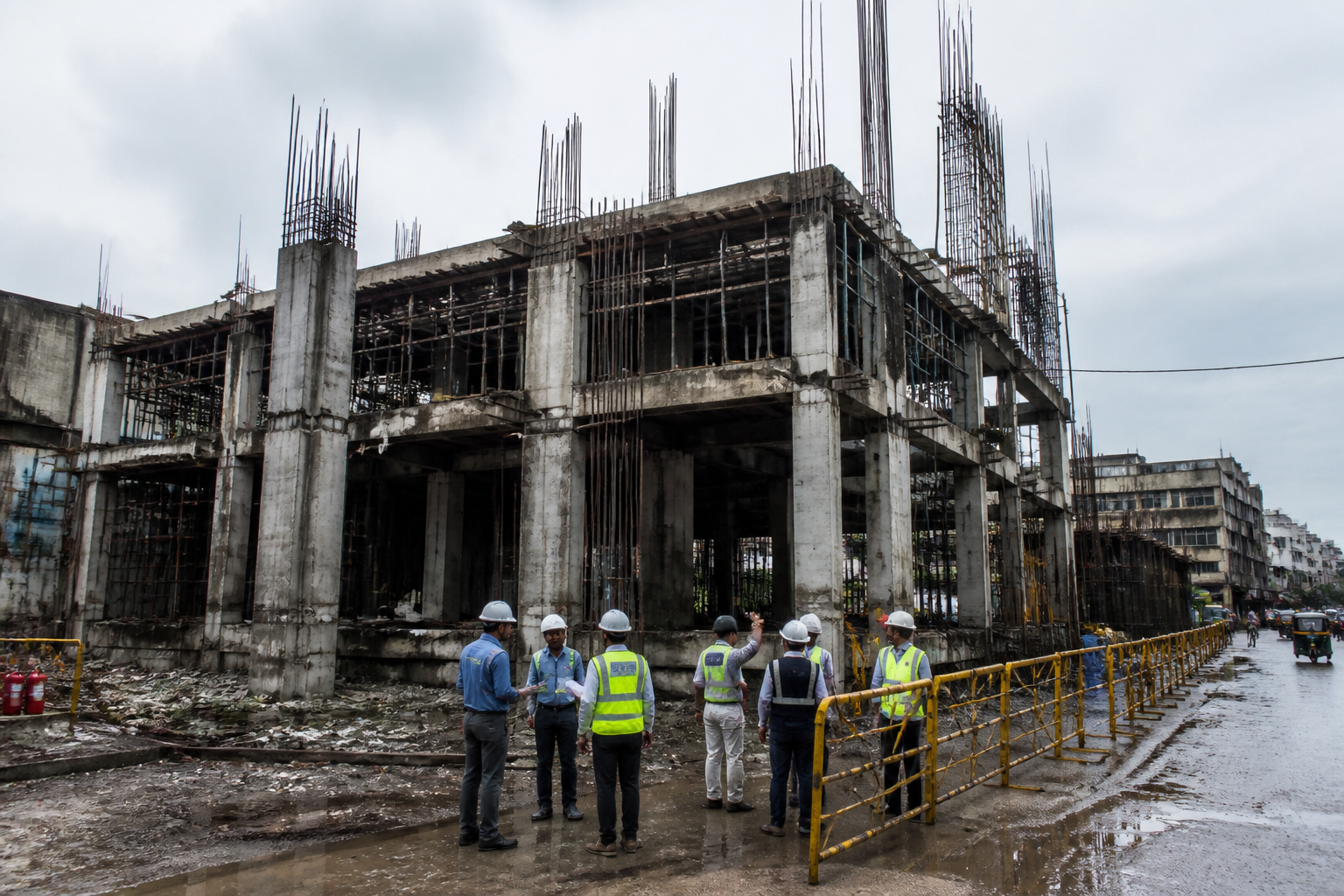
The filing of an approximately 2,000-page chargesheet in the Taratala warehouse collapse has shifted the case from a disaster investigation to a test of how construction approvals, technical scrutiny and municipal responsibility operate in Kolkata. Police have accused seven people, including a former officer on special duty to the city’s former mayor and a municipal engineer, while arguing that the collapse was not caused by a single mistake but by failures at several levels.
The collapse of a warehouse’s under-construction structure in Taratala on June 24 killed 16 people. The immediate question was whether the design had been prepared and approved according to rules. The chargesheet, filed in Alipore court on Saturday, now places that question inside a wider chain involving plan approval, engineering responsibilities, construction materials, site execution and alleged financial transactions.
The police account does not establish guilt. The chargesheet represents the investigators’ case, which will be tested through the judicial process. But the details reported from the filing are important because they identify a recurring weakness in urban construction governance: the formal approval of a plan does not necessarily demonstrate that a structure was adequately designed, properly built or effectively inspected at every stage.
The seven accused named in the chargesheet are Kalicharan Bandyopadhyay, described as the former officer on special duty to former Kolkata mayor Firhad Hakim; municipal engineer Aminul Sheikh; Shambhunath Behera; Abdul Hamid; Dibakar Bhandari; Kamal Samanta; and Mohammad Gulzar. The report states that all seven were arrested at different points after the collapse. Sheikh was arrested in the week before the chargesheet was filed.
The police’s central allegation is significant: responsibility was distributed across people involved in different tasks, and the incident resulted from negligence at multiple levels. That framing matters for the urban system because a construction failure is rarely confined to the final moment when a structure gives way. It can involve design decisions, approval procedures, material selection, supervision, workmanship and the documentation used to certify compliance.
### What the Taratala chargesheet puts under scrutiny
The investigation reportedly sought expert assistance to determine whether the warehouse was designed and constructed properly. Experts from Jadavpur University visited the site and examined the materials used, the design of the warehouse and whether negligence occurred during construction. These areas of inquiry correspond to distinct stages of the approval and building process, even though the available report does not specify the individual findings for each stage.
That distinction is important. A plan may receive municipal approval, but approval alone does not answer whether the construction followed the sanctioned design. Similarly, identifying an unsuitable material would raise a different question from identifying a defective design or an absent inspection. The chargesheet’s reported focus on several participants suggests that investigators are examining the entire chain rather than treating the collapse as an isolated workmanship failure.
The case also raises questions about the relationship between technical and administrative responsibility. The reported inclusion of a municipal engineer and a former officer attached to the mayor’s office indicates that the police investigation has reached beyond private actors involved in construction. The source report does not, however, specify the exact allegations against each accused or establish whether the charges relate to plan approval, inspection, construction activity or another role.
That limitation should remain central to how the case is understood. The names of public officials in a chargesheet do not by themselves prove that municipal approval caused the collapse. They show that investigators believe official decision-making or oversight requires examination. The court will determine whether the evidence meets the legal threshold for the offences alleged.
### Approval is not the same as safety
The reported timeline places municipal approval at the centre of the political and administrative dispute. According to the report, the warehouse plan was approved by the Kolkata Municipal Corporation on January 17 of the year of the collapse. After the incident, questions were raised over whether the design complied with rules. The reported investigation then examined the structure, materials and construction practices.
This sequence exposes a basic institutional gap: urban authorities often deal with approval, construction and enforcement through separate actions, while structural safety depends on all three working together. A plan approval system can certify documents submitted at one stage. It cannot, without continuing inspection and reliable completion records, guarantee that the built structure matches those documents.
The Taratala case therefore turns on more than whether a plan was approved. It asks what was checked before approval, who was responsible for verifying technical details, whether the construction matched the approved design, what materials were used, and whether any warning signs were recorded. The available report confirms that investigators examined these issues, but it does not provide the technical conclusions reached by the experts.
That missing detail is not a minor gap. In a construction-collapse case, the distinction between an allegedly defective design, deviation from an approved plan, substandard material and inadequate supervision determines how responsibility is assigned. It also determines whether the case reveals a failure of regulation, a failure of execution or both.
The police have also reported indications of financial transactions connected with construction of the warehouse, although no money was seized in the case. This is another area where the evidence must be separated from the allegation. An indication of financial dealings is not, by itself, proof of an illegal payment or a causal link to the collapse. The chargesheet may clarify the transactions and their alleged relevance, but those details are not available in the supplied report.
### The municipal accountability question
The political dispute following the collapse focused on the role of the former mayor’s office. The report says that Chief Minister Shubhendu Adhikari blamed the period of former mayor Firhad Hakim’s administration and pointed to the January 17 approval of the warehouse plan. The chief minister also targeted Kalicharan Bandyopadhyay and was quoted as saying that no plan was passed in the Kolkata Municipal Corporation without Kalicharan’s approval.
That statement is a political allegation, not an established finding. It is relevant because it shows how the collapse became linked to the internal functioning of the municipal approval system. It does not, on the evidence supplied, establish that the former mayor or the officer named in the statement committed an offence. The chargesheet’s contents and the subsequent court proceedings will determine the evidentiary basis of the allegations.
The administrative question is broader than the political exchange. If multiple people handled different parts of the process, the city’s system must be able to show a clear record of who reviewed the design, who approved it, who inspected the work, who certified compliance and who was responsible for responding to deviations. When those responsibilities are unclear or poorly documented, accountability becomes fragmented after a failure.
The chargesheet’s reported emphasis on several levels of negligence suggests that the police are examining this fragmentation. But a chargesheet cannot by itself demonstrate whether the municipality’s overall system has changed. That would require information about revised procedures, inspection practices, technical staffing, enforcement action and the monitoring of similar construction sites. None of those developments is established in the supplied material.
### What remains unresolved
The collapse killed 16 people, making the case a major public-safety matter rather than a routine dispute over a building permit. Yet the available account leaves several operational questions unanswered. It does not state the precise sections of law invoked, the detailed allegations against each accused, the findings of the Jadavpur University experts, the approved design parameters, or the specific construction materials identified by investigators.
It also does not establish whether the structure deviated from the approved plan, whether inspections took place during construction, or whether any objections were recorded before the collapse. These facts will be necessary to understand whether the failure arose primarily from the approval process, the design, the construction stage, or a combination of them.
The chargesheet does establish the direction of the investigation. Police say the case involves a chain of responsibility rather than one isolated error. They have included municipal and non-municipal actors, examined the plan and materials with expert assistance, and reported possible financial transactions linked to the construction. These are the documented elements currently available; the strength of each allegation remains for the court to assess.
The Taratala warehouse collapse thus places a familiar urban promise under scrutiny: that a building approved by a public authority is also a building that has been safely designed, constructed and monitored. The chargesheet challenges any automatic assumption that approval closes the accountability chain. The next significant developments will be the court’s consideration of the chargesheet, the detailed disclosure of the technical findings and the evidence showing how each accused was connected to the collapse.
