


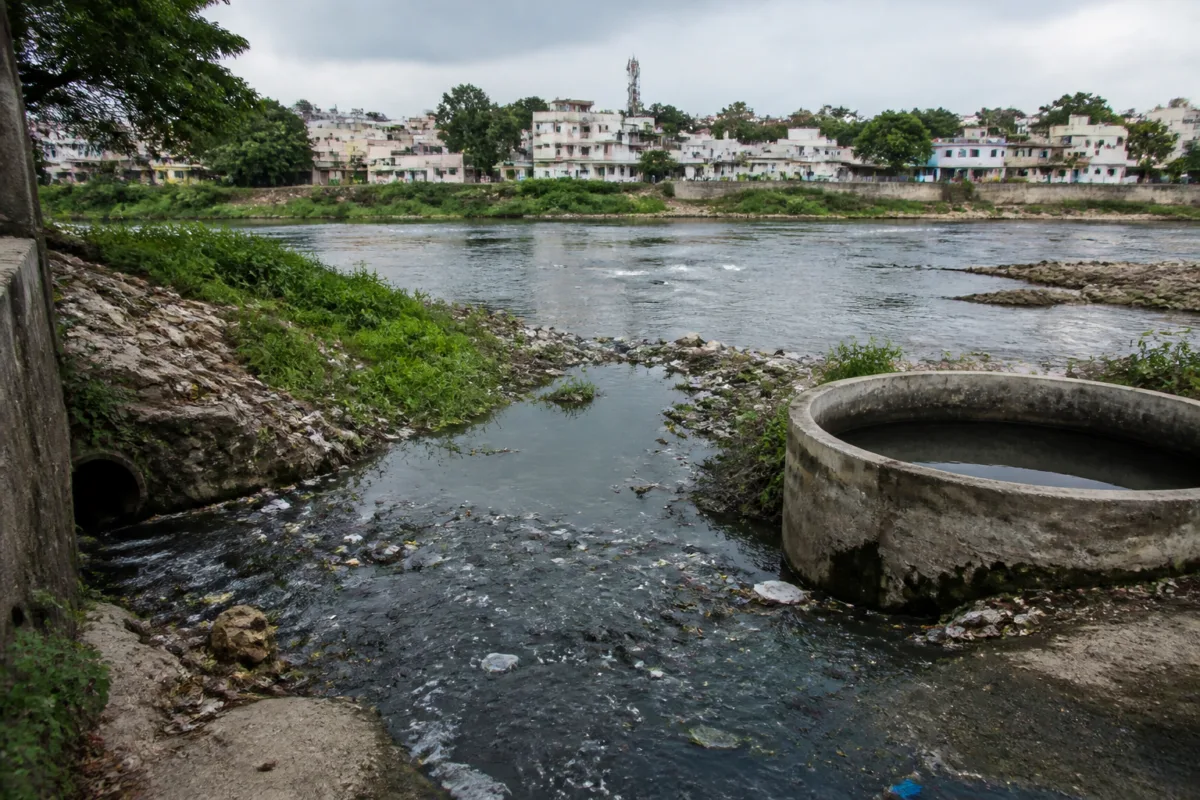
The continuing allegations of sewage entering the Tamiraparani river at more than 20 locations within Tirunelveli Municipal Corporation limits expose a problem that cannot be resolved by inspections alone. The report by Dinamalar describes wastewater accumulating in tanks along the riverbank, flowing through small channels and reaching the river, while civic authorities have said that sewage is being handled through treatment arrangements. The unresolved dispute is therefore not simply about whether studies have been conducted. It is about whether the city has an identifiable, monitored and enforceable system that prevents sewage from reaching a river described in court proceedings as a drinking-water source.
The locations mentioned include Sindupoondurai, where social activists allege that sewage collects in tanks built along the riverbank before mixing with the water. The report also refers to smaller streams through which sewage is said to enter the river directly. These details point to multiple pathways rather than one isolated discharge point. However, the supplied report does not provide laboratory test results, flow measurements, the capacity or operating status of treatment facilities, or a location-wise account of the alleged outlets. Those gaps matter because a long-term urban wastewater response depends on knowing where sewage is generated, how it is conveyed, where it is treated and what happens to the treated or untreated flow afterwards.
The central allegation has been raised against the backdrop of repeated inspections. According to the report, several study teams and judges of the High Court have inspected the issue. The inspections indicate that the matter has attracted sustained institutional attention. They do not, by themselves, establish that the river is currently contaminated at a particular level or that every reported discharge point remains active. The distinction is important: an inspection can document conditions at a given time, but preventing pollution requires a system that continues to work between inspections and can demonstrate its performance through records and testing.
The legal history described by Dinamalar begins in 2022, when social activist S. P. Muthuraman filed a case in the Tirunelveli Magistrate Court. The petition alleged that sewage mixing was polluting the Tamiraparani, identified the river as a drinking-water source and sought action under the law. The municipal corporation subsequently challenged the proceedings before the Madurai Bench of the Madras High Court. In its explanation, the corporation said sewage was being sent through a treatment process. The report says that residents remain dissatisfied because effective action to stop the discharge has not yet been taken.
This sequence reveals the administrative difficulty behind many urban river-pollution disputes. A municipal body may point to a treatment process, while residents and activists focus on what can be observed at the river edge: stagnant wastewater, visible inflows or a foul-smelling channel. Both can exist at the same time. Treatment infrastructure may be present without all sewage being connected to it. A network may carry sewage under normal conditions but fail when pumping, maintenance or local connections are inadequate. A tank may be intended as part of a controlled system but become a point from which wastewater escapes. The supplied report does not establish which of these explanations applies at each site, but it shows why a general assurance is insufficient for a problem involving multiple entry points.
The reported locations also raise a question about the boundary between river management and municipal administration. The allegations concern a river, but the pathways described are urban: tanks beside the river, small channels and wastewater generated within municipal limits. Responsibility is consequently unlikely to rest on a single inspection or department. The municipal corporation would be central to sewerage collection, treatment and local drainage management. River protection and water-supply concerns create a wider public-interest dimension. Where a legal case is already before courts, the quality of the underlying records becomes equally important: maps of discharge points, treatment logs, maintenance records, water-quality reports and details of corrective action would help distinguish an isolated failure from a systemic gap.
The report does not provide the total quantity of sewage generated in Tirunelveli, the volume treated, the number of treatment plants, their designed capacity, their actual utilisation, or the proportion of households connected to a sewerage network. It also does not state whether the alleged discharge points have been independently tested, whether the tanks are part of an authorised system, or whether any penalties or restoration orders have been issued. These are not minor technical details. Without them, the public can know that a dispute persists but cannot assess the scale of the pollution, the performance of the treatment system or the cost of closing the gaps.
The only clear geographical scale in the report is that more than 20 locations within Tirunelveli Municipal Corporation limits are alleged to be involved. That number suggests that the issue should be examined as a network problem rather than as a single illegal outlet. A city-wide response would need to identify each location, record the source and type of wastewater, determine whether the flow is domestic sewage or mixed drainage, and establish where it is supposed to go. The report does not say whether such a consolidated inventory exists. Its absence from the supplied material is itself a reason to avoid treating the municipal explanation or the activists’ allegation as a complete account of the situation.
The 2022 filing is another important data point. It shows that the issue has remained in the public and legal domain for several years. Yet the report does not provide a final court order, a deadline for compliance, a current inspection report or a documented completion certificate for remedial work. As a result, the status of the litigation and the status of the alleged pollution cannot be treated as identical. A case may continue while conditions change, or conditions may remain unchanged despite repeated proceedings. Establishing that relationship requires documents that are not included in the supplied report.
The municipal corporation’s stated position—that sewage is being sent through a treatment process—also needs to be understood operationally. Sewage treatment is not demonstrated merely by the existence of a plant or a stated method. It requires collection, conveyance, treatment, monitoring and safe disposal or reuse of the treated output. If wastewater is reaching the river through tanks or small streams, the relevant question is where the system is failing: before collection, within the conveyance network, at a pumping point, during treatment or after treatment. The supplied report does not identify the failure point. It does, however, show that the public explanation has not settled the dispute for residents and activists.
This is where municipal accountability becomes more than a question of making a new announcement. The authority’s response needs to be measurable at the same locations where the allegations have been made. A credible record would connect each reported site with an inspection date, photographs or other documentation, the responsible agency, the corrective measure and subsequent monitoring. It would also clarify whether the measure is temporary or permanent. Without a location-based record, repeated studies can produce attention without producing closure.
The river’s reported role as a drinking-water source increases the importance of such evidence, but it does not remove the need for precise verification. The petition described in the report makes that claim, and the public-interest concern follows from the possibility of sewage entering a source used for drinking water. The supplied material does not include water-quality results or identify the affected intake points. It would therefore be inaccurate to state that the city’s drinking water has been contaminated on the basis of this report alone. The defensible conclusion is narrower: alleged sewage inflows into the river create a serious source-water protection concern that requires transparent testing and documented action.
The case also illustrates why urban water governance cannot be separated from land-level drainage. Small streams are often treated as secondary channels, but when they carry sewage into a river they become part of the city’s pollution infrastructure. Tanks along a riverbank can similarly function as either containment points or points of failure, depending on how they are designed, maintained and connected. The report does not establish the engineering status of these structures. It does establish that residents are drawing attention to them, and that the city’s existing response has not resolved the public dispute.
For policymakers and residents, the larger question is whether the city is measuring outcomes or only recording interventions. An inspection is an activity. A study is an activity. A treatment process is an intervention. The outcome is whether sewage no longer reaches the river and whether water-quality conditions are documented over time. The source material contains evidence of studies, inspections, a court case and a municipal explanation, but not evidence of a completed outcome. That gap explains why the issue continues to generate concern despite years of official and legal attention.
The next stage of scrutiny should therefore focus on the evidence that can close the gap: the current status of the more than 20 reported locations, the municipal corporation’s latest inspection findings, treatment and discharge records, water-quality test results, and the operative directions of the courts. Until those records are made clear, the Tamiraparani dispute remains a case of sustained institutional attention without a publicly demonstrated solution. The report confirms the persistence of the problem as a civic and legal concern; it does not, by itself, establish the present level of contamination or the effectiveness of every treatment facility involved.

