


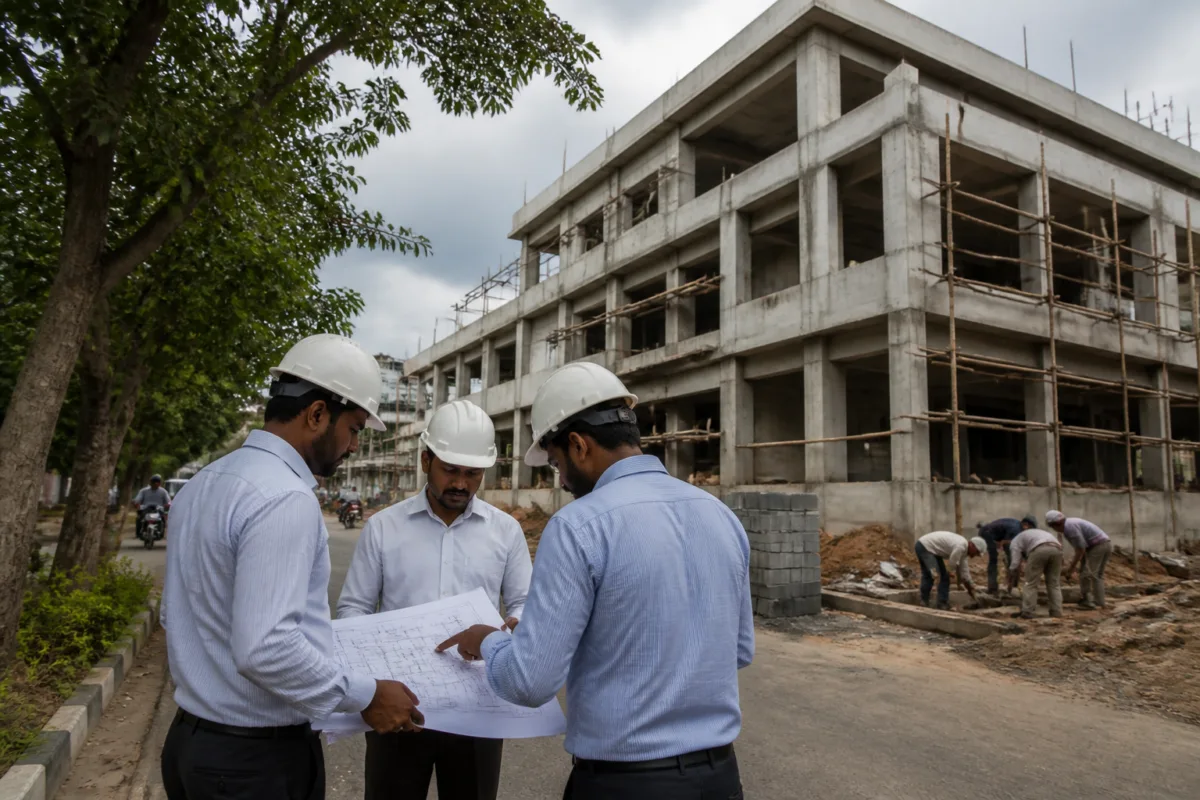
Tamil Nadu’s Public Works Department is facing delays in launching new building projects and maintaining existing government infrastructure, with a report attributing the slowdown to weak coordination among the minister, senior officials and departments that depend on the agency. The consequences extend beyond administrative scheduling: government hospitals, schools, offices and residential buildings may not receive planned construction or maintenance work on time.
The issue matters because the Public Works Department is not a standalone construction agency. It acts as the delivery arm for multiple departments, including public health, revenue and school education. Those departments announce projects and secure budget allocations, after which the Public Works Department is expected to prepare designs, produce estimates, select contractors and supervise construction. Any delay in that chain can hold back a building even when the original policy announcement has already been made.
The report describes a system in which project responsibility is distributed across departments but implementation depends heavily on the Public Works Department. This creates a coordination problem at the point where political announcements, financial approvals, technical preparation and contracting meet. A project can be publicly announced, but it cannot move to construction until funding is confirmed, a design is prepared, an estimate is approved and a contractor is selected.
According to the report, several projects announced in the state budget have not received confirmed funding. As a result, design preparation and the preparation of project estimates have been kept pending. The report raises the question of whether these works can begin before the next budget is presented in March next year. It does not provide a consolidated value for the projects affected or identify the number of buildings awaiting approval.
The department’s maintenance responsibilities make the problem more immediate. The Public Works Department maintains buildings including the Secretariat, courts, government employees’ housing, ministerial and judicial residences, hospitals and other public facilities. Maintenance work is generally carried out through contractors, with departmental engineers processing payments from maintenance funds after the work is completed.
The report says this arrangement was put on hold amid allegations of irregularities. The department has instead been instructed to issue tenders properly before works are undertaken. That change may strengthen procedural controls, but it can also slow repairs if tendering systems, approval timelines and emergency maintenance protocols are not aligned. The report says maintenance in several government offices, schools and hospitals has consequently become uncertain.
This distinction between new construction and maintenance is important. New projects are usually visible through announcements, foundation ceremonies or budget statements. Maintenance is less visible until a leaking roof, damaged ward, unsafe classroom or unusable office disrupts daily operations. In a department responsible for public buildings, a delay in routine maintenance can therefore affect service delivery even when no new construction project has formally failed.
The report also refers to six major announcements made by the minister during the Assembly’s demands for grants. Government orders have reportedly been issued for only two of them: simplifying the contractor-selection process and establishing the Tamil Nadu Infrastructure and Construction Corporation. Other announcements, including modernising maintenance work in government hospitals and offering contract-work concessions to engineering graduates, have not yet moved into implementation, according to the report.
The difference between an announcement and a government order is a central administrative fault line. An announcement indicates policy intent, but implementation normally requires formal orders, funding, responsible agencies, technical rules and a process for monitoring delivery. Without those steps, departments may be unable to convert an announced scheme into a tender or a completed project. The report does not establish why the remaining announcements have not received orders, leaving the exact institutional bottleneck unclear.
The proposed Tamil Nadu Infrastructure and Construction Corporation could change how projects are organised, but the supplied report gives no details about its proposed legal structure, funding, powers, staffing or relationship with the existing Public Works Department. It is therefore not possible to assess from the available material whether the corporation would reduce duplication, centralise project management or create another layer of approval.
The report attributes the wider slowdown to the distribution of responsibilities held by Minister Aadhav Arjuna. It says he is overseeing the Public Works, Highways and Sports departments, along with several other responsibilities, including coordination of monsoon preparedness. Department engineers quoted in the report argue that the three major departments require sustained attention and that additional responsibilities are contributing to delays in decision-making.
Those claims are attributed to unnamed Public Works Department engineers and should not be treated as an independently established explanation for every pending project. The report also says that senior officials have sometimes been unable to meet the minister and that decisions have consequently been delayed. It does not include a response from the minister, the Chief Minister’s Office or the department’s senior administration to these allegations.
The report further points to a lack of coordination among senior officials within the department. That matters because building delivery is sequential but not linear. Design teams, finance officials, administrative departments, tender authorities, contractors and field engineers must exchange approvals at different stages. A delay at one point can leave later teams unable to proceed, while repeated changes to scope or funding can force estimates and tenders to be prepared again.
For citizens, the practical impact is likely to be uneven. A delayed government office may affect administrative access, while a delayed school or hospital maintenance contract can affect staff and users more directly. However, the report does not quantify the number of affected facilities, the duration of the delays or the public cost of the stalled work. These gaps prevent a full assessment of the scale of the problem.
The immediate policy question is not only whether new projects receive money, but whether the state has a reliable system for moving from announcement to execution. The reported emphasis on formal tendering addresses one part of that process. It does not by itself resolve delays in design, estimates, departmental approvals, funding confirmation or decision-making. Similarly, creating a new infrastructure corporation may have limited effect unless its responsibilities are clearly separated from those of existing agencies.
The available evidence establishes a pattern of pending implementation: some announced measures have government orders, others do not; funding for several budget projects is reportedly not confirmed; and maintenance work has been affected by a shift towards formal tendering. It does not establish the total project backlog, the exact financial exposure or whether all delays arise from ministerial and official coordination.
The developments that deserve monitoring are the issuance of government orders for the remaining announcements, confirmation of funds for budgeted building projects, the operational framework of the proposed infrastructure corporation and the restoration of predictable maintenance contracts for public facilities. Until those steps are documented, Tamil Nadu’s building programme remains caught between policy announcements and delivery on the ground.

