


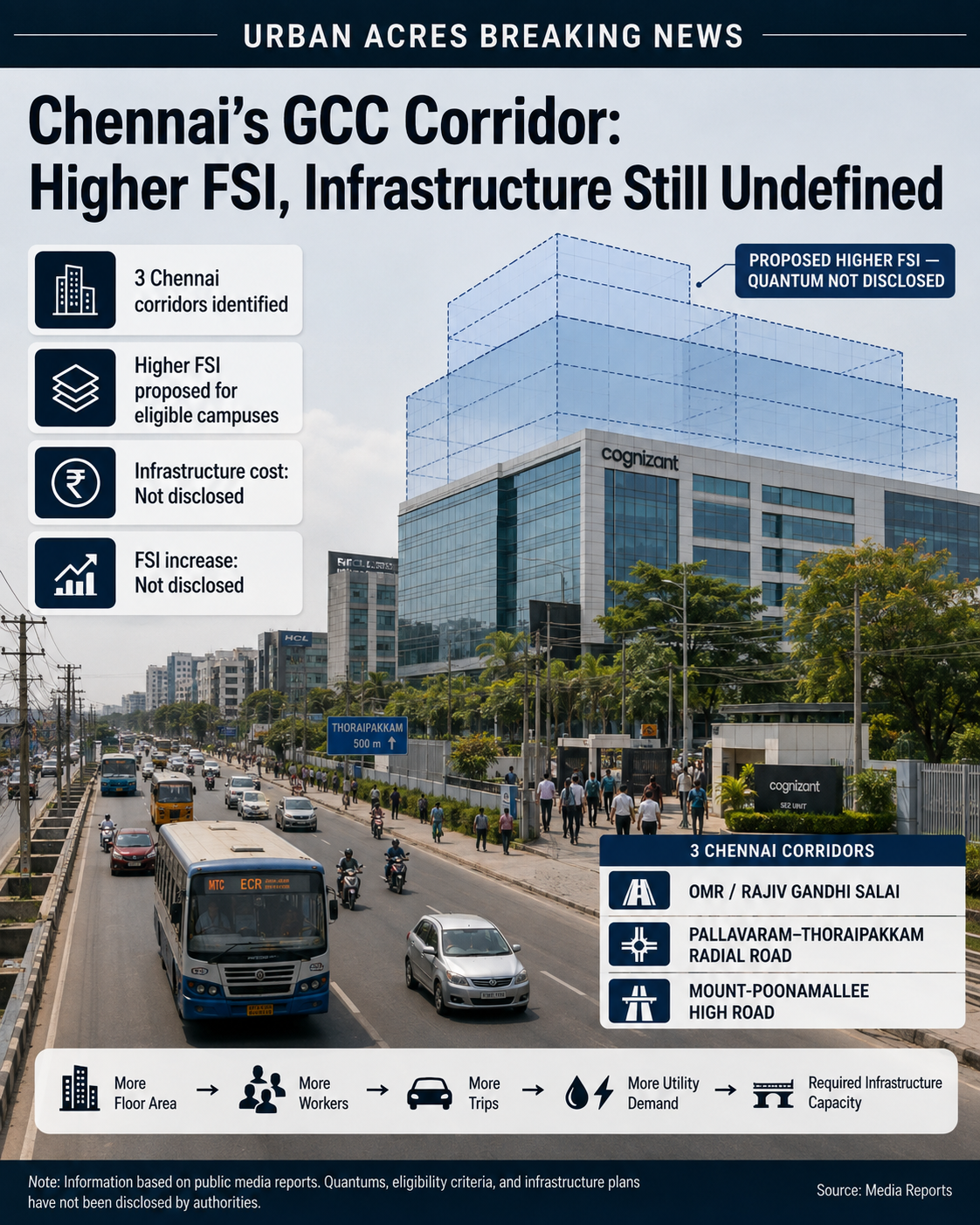
The August 25 programme proposes greater development intensity and shared infrastructure across three established office corridors. But Tamil Nadu has yet to disclose the FSI uplift, corridor boundaries, infrastructure projects, funding mechanism or implementation timetable.
CHENNAI — Tamil Nadu has announced a Global Capability Centres Corridor and Development Programme covering three of Chennai’s principal technology and commercial belts, pairing prospective infrastructure improvements with higher Floor Space Index for eligible GCC campuses.
Industries Minister S. Keerthana announced the programme during the Industries Department’s demand-for-grants proceedings in the Legislative Assembly on August 25. According to DT Next, the programme will cover Pallavaram–Thoraipakkam Radial Road, Mount-Poonamallee High Road and Rajiv Gandhi Salai, better known as OMR.
The announcement matters less because Chennai is entering the GCC market — it already has a substantial capability-centre economy — than because the State is proposing to reshape the physical geography supporting that economy.
Tamil Nadu’s official investment platform currently describes Chennai as having more than 350 Global Capability Centres. Established office-market assessments already identify OMR and Mount-Poonamallee Road as major commercial submarkets, while the Radial Road has emerged as another concentration of newer office development.
The new policy therefore appears to be an intensification strategy: concentrate additional corporate activity on selected corridors, improve the infrastructure serving them and use development rights — through higher FSI — as part of the investment proposition.
But an announcement of higher FSI is not yet a functioning planning regime.
The crucial number is missing: how much FSI?
FSI determines how much floor area can be constructed relative to a site’s land area. Raising it can unlock significantly more office space without expanding the geographic footprint of a campus.
That can be economically efficient. Greater employment density can support agglomeration, improve the viability of mass transit and reduce pressure for ever-further peripheral expansion.
But the infrastructure consequences are equally direct.
More floor area can mean more workers, more peak-hour trips, greater water demand, higher sewage generation, additional electricity and digital-load requirements, more deliveries and potentially more pressure on streets, drainage and public spaces.
DT Next says the government will make efforts to provide enhanced FSI to eligible campuses. It does not report the existing-versus-proposed FSI, the maximum development envelope, qualification threshold or whether the incentive will vary by corridor.
Those omissions prevent developers, residents and planners from quantifying the programme’s likely physical impact.
Infrastructure must be defined before density becomes the headline
The second policy component is potentially more important: common and shared infrastructure.
Again, however, the announcement does not identify the works.
For an employment corridor, shared infrastructure could encompass roads, junctions, pedestrian networks, bus access, Metro integration, stormwater drainage, sewerage, water, substations, fibre systems, public spaces or other services. Urban Acres found no published corridor-level schedule specifying which of these are included, their existing capacity, their target capacity or the sequence in which improvements will occur.
That sequence matters.
Increasing development rights first and attempting to retrofit mobility and utilities afterwards risks converting an investment incentive into a metropolitan capacity problem.
CMDA’s own work on Chennai’s future planning recognises the linkage. Its Third Master Plan studies note that new employment corridors affect housing patterns and create additional transport demand requiring sustainable planning responses.
The GCC programme therefore cannot be treated purely as Industries Department policy. Its implementation becomes an urban-planning exercise involving the agencies responsible for land-use regulation, roads, transit, utilities and local service delivery.
Three corridors, but not one uniform urban condition
The announcement also requires more geographic precision than the phrase “Chennai GCC corridor” currently provides.
OMR, Mount-Poonamallee Road and the Pallavaram–Thoraipakkam Radial Road form distinct urban environments with different surrounding land uses, transport interfaces and development patterns.
CMDA’s metropolitan planning jurisdiction itself spans multiple urban local bodies and an expanded Chennai Metropolitan Area.
That makes the exact corridor limits consequential.
A kilometre-wide influence zone would create a very different planning intervention from incentives restricted to designated office campuses. Likewise, development incentives immediately around high-capacity transit would have different infrastructure implications from blanket increases along road frontage.
The government has yet to publicly define that geography in the material reviewed by Urban Acres.
FSI has regulatory value, but it is not public expenditure
The financial distinction is equally important.
No infrastructure budget for the GCC Corridor programme was reported in the DT Next account.
Higher FSI is primarily a planning and regulatory benefit. It should not be described as government expenditure merely because additional development value may be created for eligible landowners or businesses.
If the State also plans physical infrastructure expenditure, the next disclosure should identify the sanctioned amount, implementing agencies, funding source and individual projects.
The funding structure could ultimately involve conventional Budget spending, agency expenditure, developer contributions or another mechanism. None should be assumed until the government publishes the programme architecture.
What residents and workers should measure
A successful GCC strategy cannot be assessed simply by counting new office towers or corporate announcements.
For employees, the relevant outcomes are whether jobs can be reached reliably by public transport, whether walking from stations and bus stops is safe, whether peak-hour travel deteriorates as employment density rises and whether housing remains accessible within reasonable commuting distance.
For surrounding neighbourhoods, the questions include whether additional development overloads drains, sewer networks, water systems and local roads.
For businesses, predictable utilities and employee accessibility may ultimately matter as much as the additional floor area permitted.
That is the test that should accompany the FSI incentive.
The Ramanathapuram airport reference is not another new announcement
The DT Next report also says the government is planning a “green airport” in Ramanathapuram. Urban Acres has not treated that statement as a second fresh infrastructure announcement.
Tamil Nadu’s 2025-26 Budget had already committed to developing a new airport in the Rameshwaram area of Ramanathapuram district.
The project subsequently entered pre-feasibility work. By February 2026, an AAI report had found a site near Keelakarai technically feasible and identified further requirements including an Obstacle Limitation Surfaces survey and subsequent statutory approvals.
Under the Union government’s greenfield-airport framework, site clearance precedes in-principle project approval.
Unless the August Assembly proceedings disclose a new site selection or approval milestone, the airport statement is therefore better characterised as a reaffirmation of an existing project, not the creation of a new airport proposal.
The real test begins with the notification
For Chennai’s GCC programme, the next milestone is not another investment announcement.
It is publication of the development framework.
The State should disclose the eligible geography, current and proposed FSI, infrastructure-capacity assessment, project list, costs, funding responsibility, delivery agencies and implementation timetable.
Only then will it be possible to determine whether Chennai’s GCC strategy is simply granting more buildable floor area — or creating the transport, utility and public-realm capacity required to support a denser employment city.
