


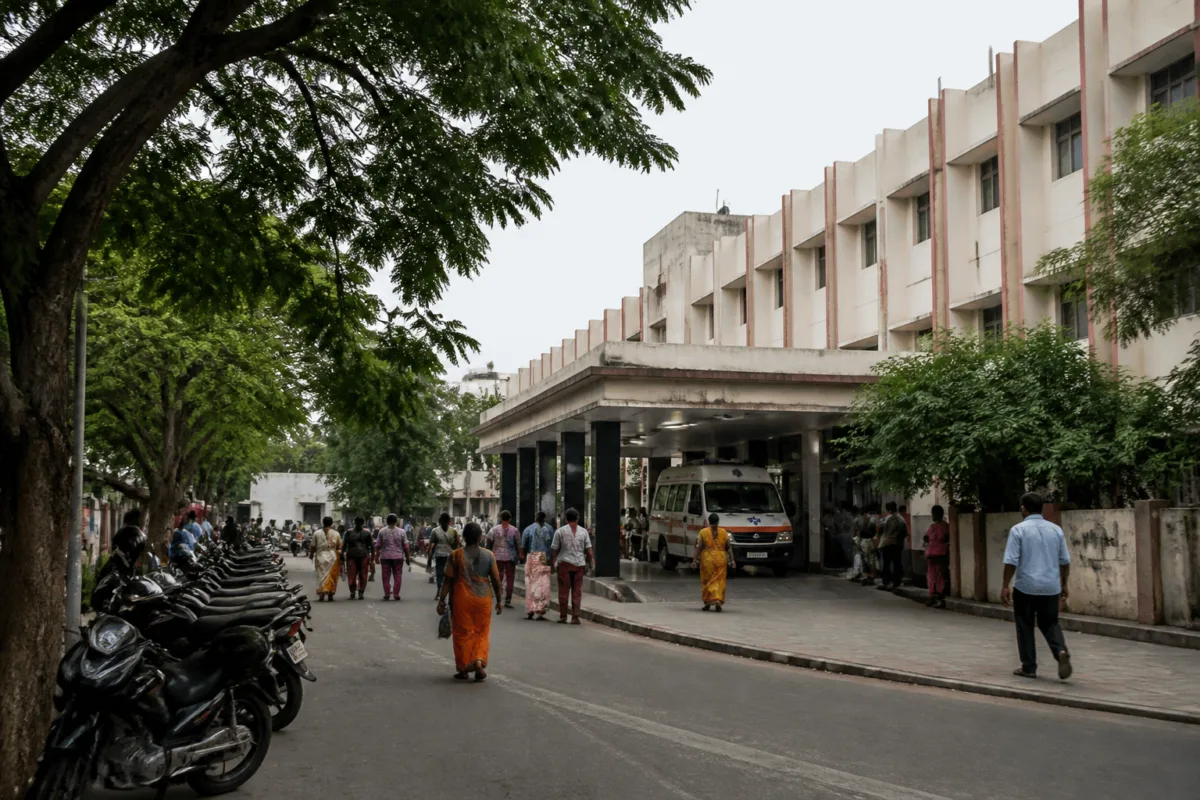
The Madras High Court’s direction to the Tamil Nadu Medical Council to inquire into a surgical needle allegedly left inside a woman’s abdomen has brought an old medical incident back into focus. The case concerns a 2010 caesarean and family-planning procedure at a municipal maternity hospital in Chennai, but the court’s order raises a continuing institutional question: how should public healthcare systems detect, investigate and account for an object allegedly retained during surgery for more than a decade?
According to a report by Dinamalar, Sangeetha, a resident of Ayanavaram, underwent a caesarean section and a family-planning procedure at the Ayanavaram Corporation Maternity Hospital in September 2010, during her second delivery. After returning home, she reportedly experienced continuing abdominal pain and bleeding. In 2022, an examination at the Government Hospital for Women and Children in Kilpauk found a five-centimetre surgical needle inside her abdomen. The needle was subsequently removed through surgery.
The report says Sangeetha then approached the Madras High Court seeking action against the woman doctor who had performed the family-planning procedure. Hearing the case, Justice P.T. Asha directed the Tamil Nadu Medical Council to issue notice to the concerned doctor, conduct an inquiry and pass an order within two months. The case was then closed.
The order does not, by itself, establish professional negligence or determine who was responsible for the alleged retention of the needle. Those questions have been assigned to the medical council’s inquiry. That distinction is important in cases involving adverse medical outcomes: a patient’s experience and the need for investigation are not the same as a final finding of professional misconduct. The court’s direction creates a formal process through which the facts and the conduct of the concerned medical professional can be examined.
The institutional route is also significant. The incident occurred in a municipal maternity hospital, while the inquiry has been directed to the Tamil Nadu Medical Council, the professional body responsible for examining the conduct of a registered medical practitioner. This places the case at the intersection of public healthcare delivery, municipal hospital administration and professional regulation. Each institution has a different role, and the court’s order identifies the medical council as the body that must examine the complaint against the doctor.
The reported timeline shows why accountability in healthcare cannot depend only on the immediate resolution of a procedure. The surgery took place in 2010, but the needle was reportedly detected only in 2022, after the patient experienced continuing symptoms. The gap between the procedure and the discovery was about twelve years. The supplied report does not establish what examinations were carried out during that period, whether the retained object was visible earlier, or how responsibility for follow-up care was allocated. Those details remain relevant to any complete understanding of the case, but they are not provided in the report.
The case also illustrates the practical difficulty faced by patients when a medical problem persists without a clear explanation. Sangeetha reportedly lived with abdominal pain and bleeding after the operation and later underwent an examination at another government hospital, where the needle was identified. The source does not provide details of the number of consultations, diagnostic tests or referrals before the 2022 discovery. It does, however, establish that the eventual identification and removal took place at a public hospital within Chennai’s government healthcare network.
For patients, the most consequential feature of the case is not simply that an object was allegedly retained during surgery. It is that the complaint moved through several stages before reaching a formal regulatory inquiry: the original operation, years of reported symptoms, later detection, surgical removal and litigation seeking professional action. This sequence shows how medical accountability can become a long process, particularly when the clinical event and the eventual discovery are separated by many years.
The High Court’s direction places a time-bound obligation on the Tamil Nadu Medical Council. The council has been instructed to issue notice to the concerned doctor, conduct an inquiry and pass an order within two months. The report does not state what findings the council may reach, what disciplinary measures are available, or whether any separate administrative inquiry has been ordered by the municipal or health authorities. Those outcomes cannot be assumed before the process is completed.
The case therefore needs to be read as an accountability proceeding rather than as a final judgment on the medical episode. The court has required the professional regulator to examine the matter; it has not pronounced the doctor guilty. The inquiry will have to consider the circumstances of the procedure and the evidence relating to the retained needle. The source does not provide the hospital’s response, the doctor’s explanation or the medical council’s position, so those perspectives are not established in the available material.
The public-health dimension is equally important. Municipal maternity hospitals provide essential obstetric and reproductive healthcare, including procedures that are often delivered under high patient loads and within complex operating systems. Yet the source does not provide information about staffing, operating-room protocols, instrument-count procedures or record-keeping at the Ayanavaram hospital in 2010. It would therefore be inaccurate to attribute the incident to any particular systemic cause. What can be stated is that the court’s direction has moved the matter from an individual complaint into a formal regulatory process.
Surgical safety generally depends on multiple layers of checking, but the supplied report does not describe the protocols followed in this case. It also does not say whether the needle was documented as missing during or after the operation, whether the surgical records were available, or whether the later removal procedure produced evidence relevant to the complaint. These unanswered questions are precisely why an inquiry matters. Without documentary and clinical findings, the public record cannot distinguish between a procedural error, a record-keeping failure, a delayed diagnostic issue or another explanation.
The case also highlights the importance of accessible grievance mechanisms. Sangeetha’s legal action sought accountability against the doctor involved in the family-planning procedure. The court’s intervention has now resulted in a defined institutional next step and a deadline. For a patient, such a direction provides a route to have the complaint examined by the relevant professional authority, even though it does not guarantee a particular outcome.
There is a wider lesson in the chronology: the detection of a retained surgical object many years after an operation can expose weaknesses not only in operating-room practice but also in continuity of care. The supplied material does not establish that any specific weakness occurred in this case. It does show that the patient’s reported symptoms continued after the procedure and that the object was found only during a later examination. That makes the process of post-operative review and escalation central to understanding what happened.
The court’s order also demonstrates the role of judicial oversight in directing administrative bodies to act on complaints. Rather than deciding the professional question itself, the High Court has required the designated regulator to undertake the inquiry. This preserves the distinction between judicial supervision and professional adjudication: the court has set the process and timeline, while the medical council is expected to examine the conduct and issue its order.
What the evidence currently confirms is limited but important. A woman underwent surgery at a Chennai municipal maternity hospital in 2010; she later reported continuing health problems; a five-centimetre surgical needle was found in her abdomen in 2022 and removed; she sought action through the Madras High Court; and the court has ordered the Tamil Nadu Medical Council to conduct a time-bound inquiry. What remains unresolved is whether professional misconduct occurred, how the needle was retained, whether the original records remain available and whether any hospital-level responsibility will be examined.
The next significant development is the medical council’s inquiry and order within the two-month period specified by the High Court. Until that process produces findings, the retained needle remains the central reported fact, while responsibility and any regulatory consequences remain matters for determination.

