


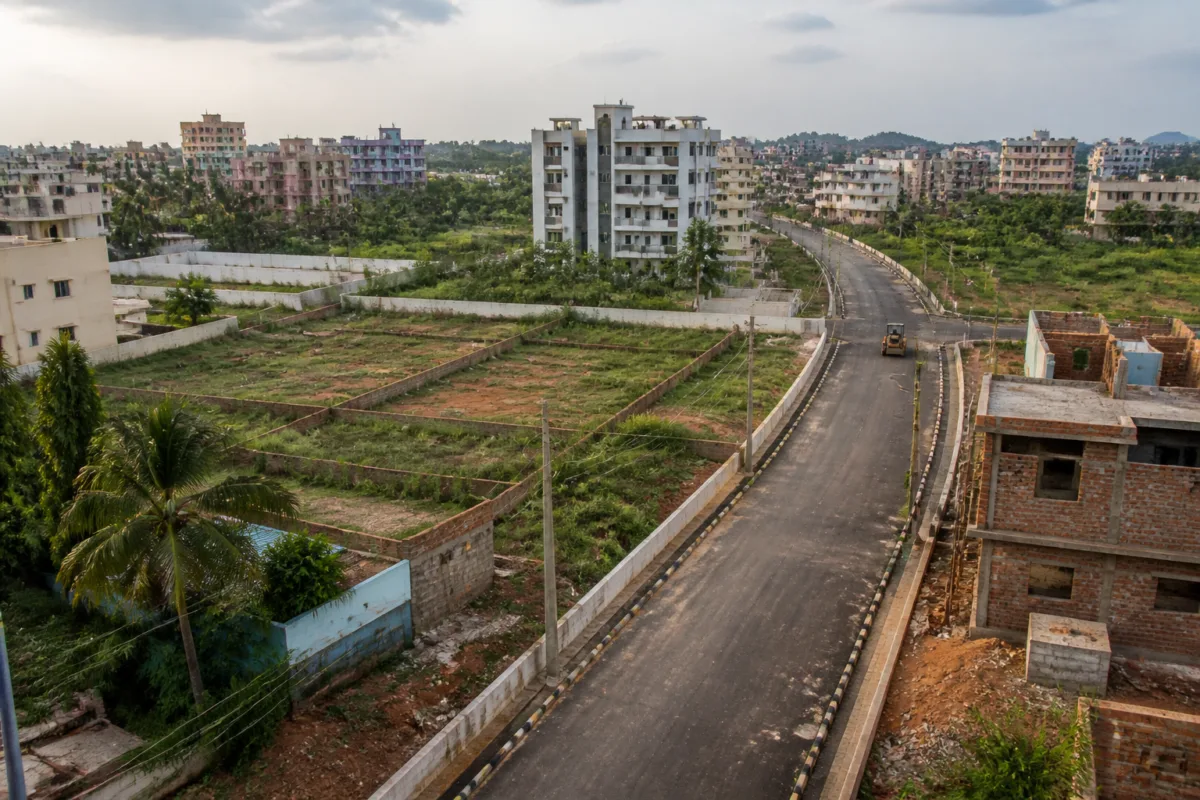
The Bhubaneswar Development Authority (BDA) has proposed additional floor area ratio (FAR) incentives for landowners who voluntarily merge plots under town planning schemes (TPS), while introducing a new City Infrastructure Impact Fee (CIIF) for developments outside TPS boundaries.
The proposals are contained in the draft BDA (Planning and Building Standards) Second Amendment Regulations, 2026, published recently in an extraordinary issue of the Odisha Gazette. The draft seeks to replace Chapter IX, including Regulations 77 to 79, of the BDA’s 2018 regulations.
Under the proposed rules, two or more khatadars, or plot owners, who agree to merge their original plots into a single final plot would be eligible for additional FAR after a 40% deduction. Merged plots measuring more than 500 square metres and up to 1,000 square metres would receive an incentive of 0.5 FAR. Plots exceeding 1,000 square metres would qualify for an incentive of 1 FAR.
In practical terms, a merged plot of up to 1,000 square metres could receive an additional 500 square metres of built-up area. A plot larger than 1,000 square metres would be eligible for an additional built-up area equal to the plot size. For example, a 4,000-square-metre plot could receive 4,000 square metres of extra built-up area under the proposed incentive.
The draft provides for a FAR Incentive Certificate (FIC), which would be issued along with the possession order. The certificate would record the FAR granted, the portion used and the balance remaining. It would remain valid for 10 years from the date on which the final town planning scheme is notified. The BDA could extend the validity subject to conditions and payment of charges, while any unused incentive would lapse after the validity period.
The proposed rules also specify that the incentive must be used first whenever a building proposal exceeds the base FAR. Other permissible methods of obtaining additional FAR could be used only after the FIC incentive has been exhausted.
The draft states that once the incentive is recorded as utilised, it cannot be restored or reclaimed even if the building is later altered, demolished, abandoned or if the sanctioned plan is surrendered. The benefit would also lapse if the amalgamated plot is subdivided or if the amalgamation is cancelled.
The second major proposal is the CIIF for projects located outside TPS boundaries but dependent on access to a TPS road. The fee would apply where a project has direct access to a TPS road or reaches it through an intervening road connected to the TPS network.
For subdivisional layouts, the CIIF would be calculated at 1% of the benchmark value of the plot, multiplied by a TPS infrastructure factor. The draft also proposes fixed charges based on the type of development: Rs 50 per square metre of built-up area for residential plotted development, Rs 60 per square metre for institutional projects, and Rs 75 per square metre for apartment, commercial and industrial uses.
The proposals would link additional development capacity more closely to plot consolidation and the use of town planning infrastructure. The draft regulations will determine how the FAR certificates and infrastructure charges are administered if the proposals are finalised.

