


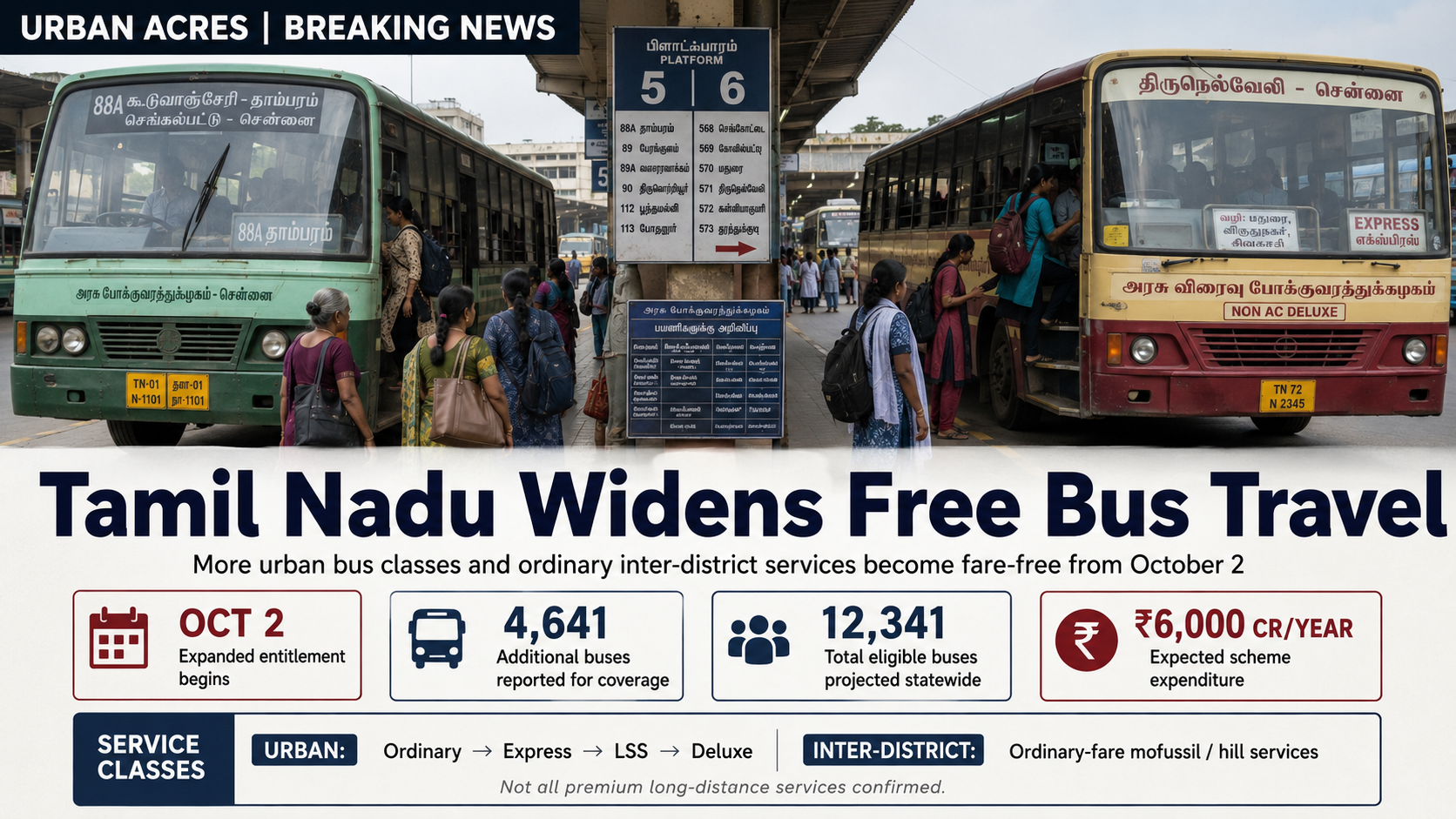
From October 2, women and transgender passengers will gain fare-free access to more urban bus categories and ordinary inter-district services. The expansion is expected to push annual scheme expenditure towards ₹6,000 crore, putting service capacity and transparent subsidy funding at the centre of the next mobility test.
CHENNAI — Tamil Nadu is preparing for the largest expansion yet of its fare-free bus programme for women, extending the concession beyond ordinary city and town services to Express, Limited Stop Service and Deluxe government buses in urban areas from October 2.
For travel beyond cities, the expansion will cover ordinary-fare mofussil and hill services, creating a zero-fare option for many journeys that previously fell outside the scheme. Chief Minister C. Joseph Vijay announced the decision in the Legislative Assembly on August 24 under Rule 110. Women and transgender passengers will face neither an income ceiling nor a prescribed limit on the number of journeys, according to multiple contemporaneous reports.
The distinction between bus classes matters. The announcement should not be interpreted as universal fare-free travel across every Tamil Nadu government bus.
Current reporting specifies urban Express, LSS and Deluxe services, together with ordinary-fare mofussil and hill buses. It does not establish blanket free access to all premium, sleeper, air-conditioned or State Express Transport Corporation services.
That is narrower than an option examined by the Transport Department in July. Officials were then studying an extension that could have included thousands of mofussil buses and around 500 SETC semi-sleeper services, while excluding AC and premium categories.
From an urban concession to a regional mobility policy
Tamil Nadu’s original free-bus programme began in May 2021 and concentrated largely on ordinary city and town services. MTC continues to identify ordinary buses as the services on which women currently travel free.
That structure made the scheme particularly useful for repetitive, everyday trips: commuting to work, accompanying children, reaching markets and hospitals, and accessing education.
The October expansion changes the spatial logic.
By extending zero-fare travel into ordinary mofussil services, the programme begins moving from an urban fare concession towards a broader regional accessibility policy. A woman whose college, workplace, hospital or family connection lies outside her town may now gain more from the scheme than from another free journey within the same municipal boundary.
TNIE reports that 4,641 buses will be added to the eligible pool, bringing the reported total to 12,341. Officials project another 25 lakh women using the scheme daily.
Those numbers should initially be treated as capacity and ridership projections. Whether 25 lakh additional women actually travel, how often they travel and which corridors see the largest demand changes can only be measured after implementation.
₹6,000 crore is an annual scheme cost—not ₹6,000 crore of new spending
The financial framing requires particular care.
The 2026-27 Interim Budget provided ₹4,000 crore for the existing free-bus programme, up from ₹3,600 crore the year before.
Current announcement reporting puts the expanded programme’s annual expenditure at around ₹6,000 crore.
TNIE says officials expect the financial requirement to rise by around ₹1,600 crore, from roughly ₹4,400 crore to ₹6,000 crore.
Urban Acres has not identified, in the documents reviewed for this story, a revised Budget, supplementary demand or final transport order showing exactly how the difference between the existing appropriation and the expanded requirement will be funded.
That document is now necessary.
Fare-free transport is not financially free. The policy works by shifting the fare burden from eligible passengers to the State, which must compensate transport undertakings adequately and predictably.
Tamil Nadu itself recognised this principle in its 2021-22 Revised Budget, stating that where government requires free or subsidised ridership or uneconomic services, explicit subsidy should be paid using normative cost parameters.
Chennai’s expansion intersects with a changing bus operating model
The policy also lands while Chennai’s bus system is changing structurally.
TNIE says 400 non-AC electric buses currently operated through Gross Cost Contracts will become part of the expanded free-travel network.
Under Chennai’s GCC model, private operators provide and operate buses while MTC retains public control over service planning and fares. The World Bank describes the arrangement as part of a wider move towards performance-based bus services and predictable viability-gap funding.
MTC is also procuring additional electric-bus services. Its tender portal currently records large GCC procurements at various tender stages. Those proposed fleets should be separated from vehicles already carrying passengers.
The resulting policy interface is important: an eligible passenger should experience the same zero-fare entitlement regardless of whether the physical bus is publicly owned or supplied under a GCC contract, provided it falls within the notified service class.
The next test is capacity
Fare removal improves affordability. It does not automatically increase service supply.
Tamil Nadu’s own recent policy debate identified this tension. In July, officials put the eight State transport corporations’ fleet at around 21,500 buses, with approximately 19,100 in operation and more than two crore passenger journeys daily.
If zero-fare eligibility brings a substantial increase in women passengers while scheduled kilometres and peak-hour capacity remain unchanged, some routes could experience more crowding or longer waits.
That does not negate the welfare benefit. It changes the metric by which it should be judged.
The correct chain is:
Fare entitlement → eligible route → available bus → acceptable waiting time → safe boarding → journey reliability → affordable access to work, education, healthcare and other opportunities.
A zero-fare ticket solves only one link.
What Tamil Nadu should publish from October 2
The Transport Department should release a public Vettri Payanam service dashboard rather than only statewide beneficiary totals.
At minimum it should disclose, by corporation and service class:
- eligible buses and routes;
- scheduled versus operated kilometres;
- cancelled trips;
- ridership by gender;
- zero-fare passenger journeys;
- average peak-period occupancy;
- subsidy claims submitted by each corporation;
- subsidy actually paid;
- average reimbursement per passenger journey;
- complaints involving refusal to issue zero tickets or skipped stops;
- breakdown rates;
- and additions or removals from the eligible fleet.
For the inter-district component, origin-destination data would be especially valuable. The central policy claim is no longer simply that women can travel around their cities without paying. It is that transport cost will cease to be a barrier to wider geographic opportunity.
That claim is measurable.
