


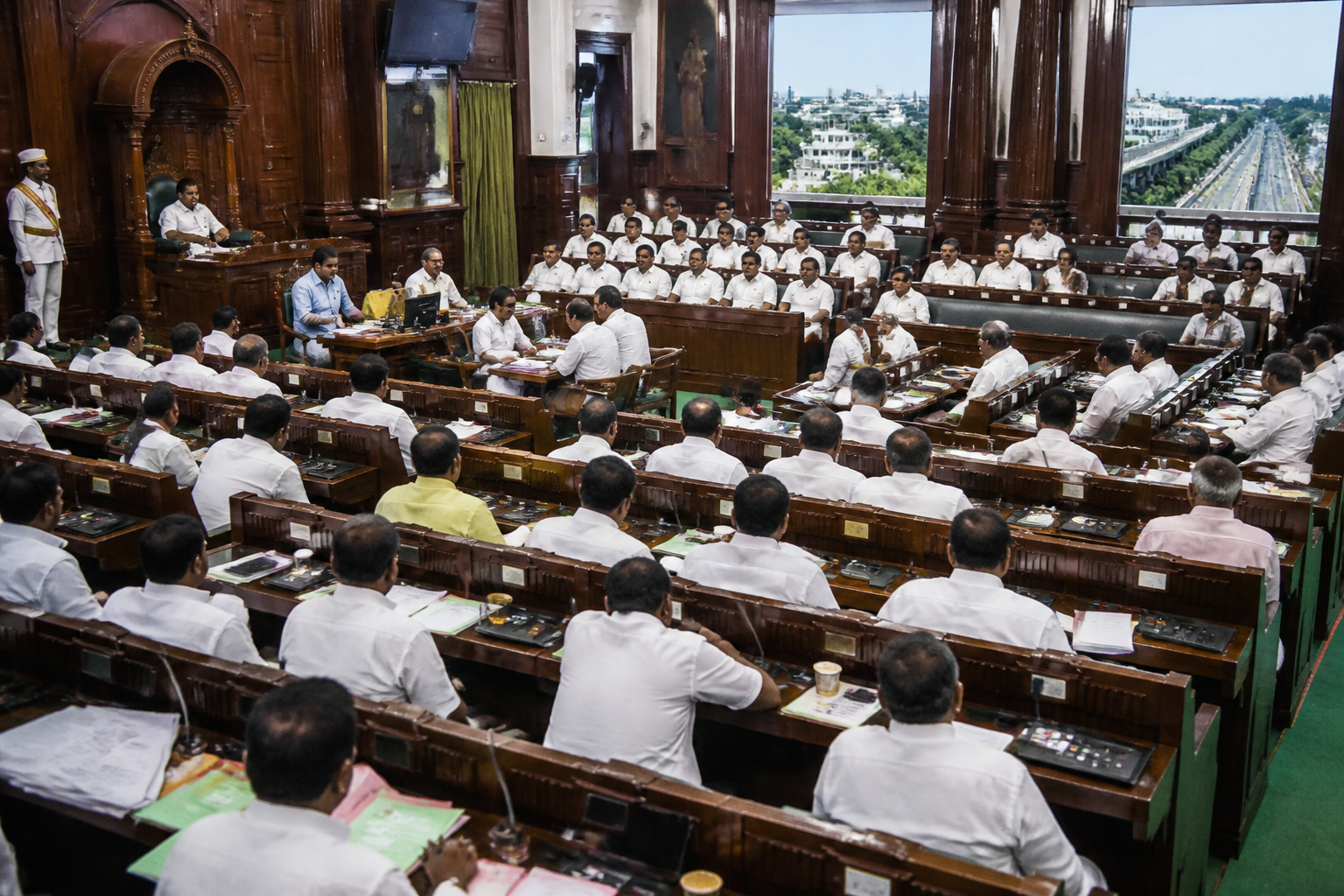
Tamil Nadu Assembly questions are meant to connect elected representatives with the departments responsible for roads, hospitals and other public services. But a reported delay in answering most questions from the state legislature’s first session under the Vijay-led Tamilaga Vettri Kazhagam coalition government has exposed a wider administrative gap: the formal opportunity to ask about public works is not automatically producing timely written accountability.
According to a report by Dinamalar, 14,399 questions were raised by 170 MLAs during a 28-day budget session. Of these, 12,733 were admitted for consideration, while 1,666 were not admitted. Only 1,800 of the admitted questions had received replies at the time of the report, amounting to about 15 per cent. The figures were provided by Assembly officials, who said departments had been occupied with preparing project reports for new announcements after the budget session.
The numbers matter because the Assembly question process is not merely a record of political exchanges. It is one of the formal channels through which elected representatives seek information about government decisions, pending works and the delivery of services in their constituencies. When responses are delayed, the information chain between the legislature, departments and residents becomes slower and less visible.
The reported figures also show how a large legislative workload is filtered before it reaches departments. The 170 MLAs collectively submitted 14,399 questions. After scrutiny, 12,733 were admitted. Within that group, 3,455 were treated as important questions, according to Assembly officials. The remaining questions were nevertheless part of the admitted legislative record and were sent to the relevant departments for replies.
This filtering process creates several stages at which a question can lose momentum. It must first be submitted, then examined for admission, then transmitted to the concerned department, and finally answered after the department gathers the required information. The report indicates that the delay is occurring after admission, when departments are expected to prepare replies. It also says officials have instructed departmental officers to respond more quickly.
The nature of the questions explains their direct connection to urban administration. Many MLAs asked whether roads would be built in their constituencies or whether hospitals would be established. Such questions may require departments to check land availability, technical feasibility, funding, administrative approvals and implementation schedules before giving a detailed answer. That process can be more complicated than providing a verbal response during a sitting of the House.
At the same time, the complexity of verification does not remove the need for a clear response. A question about a road or hospital may be framed as a constituency demand, but the answer can reveal whether the project is under consideration, included in a plan, funded, technically feasible or awaiting approval. Without a written response, residents and local representatives may not know which stage a proposal has reached or which department is responsible for the next step.
The report cites two different aspects of the Assembly’s functioning. AIADMK MLA Thalavai Sundaram said the Speaker had given all MLAs an equal opportunity during question hour and that many constituency-related questions had been answered inside the House. He nevertheless said departments should send written replies quickly so that public-welfare projects could be accelerated.
DMK MLA Durai Chandrasekaran raised a separate problem. He said the Assembly rules require replies to be provided within 15 days, but many questions from the session had not received answers. He also said that, unlike in earlier DMK and AIADMK administrations, replies issued by departments had not reached MLAs even when the departments had prepared them.
That distinction is important. A question can receive an oral response in the legislature, yet still lack a written administrative trail. Written replies have a different value: they provide a record that can be referred to by the MLA, the department and residents. They can identify a project’s stated status, the authority responsible and any conditions attached to implementation. If a reply is prepared but does not reach the representative, the system’s formal accountability is weakened even before the information reaches the public.
The reported delay also reflects the pressure created by the overlap between legislative work and executive programme preparation. After the first budget was presented on August 5, the 28-day session included 17 announcements by the Chief Minister and 1,117 announcements across 51 departments, according to the report. Departments were subsequently engaged in preparing project reports for the new announcements. The same administrative machinery therefore had to process legislative questions while translating budget and policy announcements into implementable projects.
This is a familiar governance tension: announcements create a visible political timetable, while replies to questions require departments to retrieve and verify information from files, field offices and technical units. The former is measured in the number of initiatives announced; the latter is measured by whether specific questions receive accurate and timely answers. The figures reported from the session suggest that the second function has been slower than the first.
For cities and towns, the consequences are practical. Roads and hospitals are not delivered through announcements alone. They require identification of need, site and land decisions, estimates, approvals, procurement and construction or service arrangements. A legislative question can bring these stages into public view, but only if the answer is precise enough to show what has already happened and what remains pending. A delayed reply can therefore delay not only information but also follow-up by the MLA and the department.
The scale of the question backlog should also be read carefully. The report does not establish that every unanswered question represents an approved project waiting to be implemented. Nor does it say that all 12,733 admitted questions were due for the same kind of response. Some may require detailed departmental examination, while others may have been addressed orally or may be awaiting information from subordinate offices. The central fact established in the supplied report is narrower: only about 1,800 admitted questions had received replies when the report was published, and Assembly officials acknowledged the need to speed up responses.
The 15-day rule cited by the report provides the relevant administrative benchmark. If that rule applies to the questions from the session, the reported delay is not simply a matter of departmental convenience. It raises a compliance question for the legislature and the executive: whether the prescribed response period is being monitored, and what happens when a department misses it. The supplied report does not provide a department-wise breakdown, a list of overdue questions or an explanation of the enforcement mechanism. Those details would be necessary to identify where the delay is concentrated.
The issue also points to the importance of information systems in legislative administration. The report refers to replies being sent by post in earlier administrations and says that, in the current instance, some replies had not reached MLAs even after departments had responded. Whether the problem lies in departmental transmission, Assembly processing or delivery is not established in the report. But the reported gap shows that preparing a reply and completing the reply process are not necessarily the same thing.
A reliable system would need to track each admitted question from scrutiny to departmental assignment, response preparation, dispatch and receipt. The supplied material does not say whether such a tracking mechanism exists or whether the status of questions is publicly available. It does, however, show why the distinction matters. Without a visible status trail, it is difficult to know whether a question is pending because it was not admitted, awaiting departmental information, answered but not delivered, or closed through an oral response.
The Assembly’s first session under the new coalition government therefore offers a test of institutional capacity beyond the political claims made inside the House. The session produced a large volume of announcements and questions. The next test is whether the administrative system can convert that volume into usable records and time-bound responses. For constituency issues such as roads and hospitals, the quality of this process affects whether elected representatives can pursue projects with reliable information.
The evidence currently supports three conclusions. First, the volume of questions was substantial, with 14,399 submissions and 12,733 admissions reported. Second, the response rate was low at the time of publication, with about 1,800 replies issued. Third, the delay has more than one possible point of failure, including departmental workload and the transmission of replies to MLAs. What remains unclear is the department-wise distribution of pending questions and whether the 15-day requirement was formally monitored.
Assembly officials have said that departmental officers were instructed to respond quickly. The next measurable step is whether the remaining admitted questions receive replies and whether those responses reach the concerned MLAs within the prescribed process. Until that happens, the question backlog will remain not only a legislative administrative issue but also a sign of how effectively the state’s governance machinery connects public demands with decisions on the ground.
