


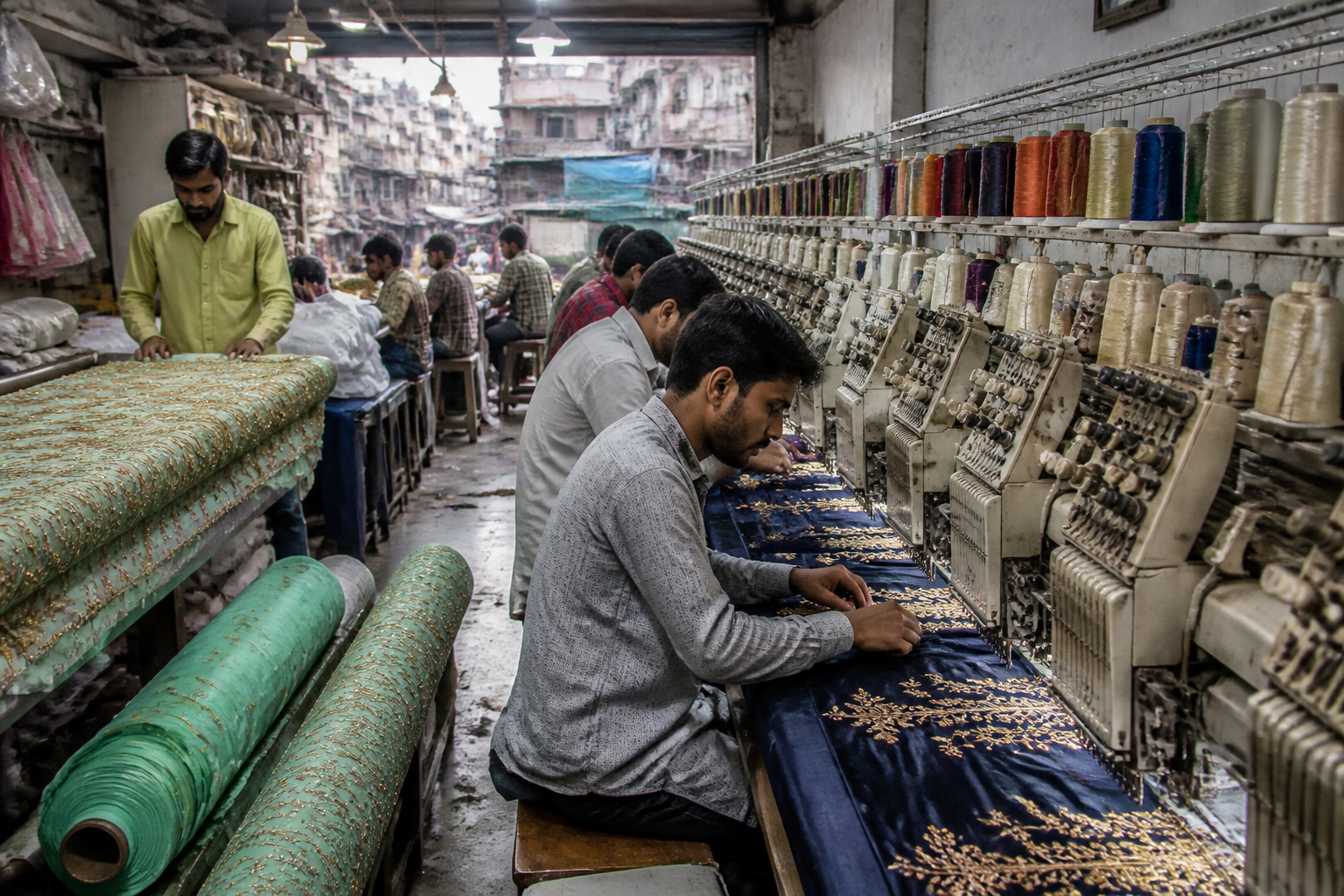
The three-month dispute between Surat’s embroidery workers and unit owners has become more than a disagreement over wages and weekly leave. It has exposed the difficulty of enforcing labour protections in a decentralised industrial economy where production depends on numerous jobwork units, workers face long shifts and government intervention has so far produced directions rather than a settlement.
According to a report by the Times of India, workers in Surat’s textile embroidery sector are demanding paid weekly offs, eight-hour shifts and wages equivalent to what they currently receive for 12 hours of work. Unit owners have agreed to implement provisions under the four labour codes, but have rejected both the paid weekly-off demand and the request for 12-hour-shift-equivalent wages for eight hours of work.
The dispute has continued despite repeated discussions involving the labour department, police officers, industry representatives, worker groups and the district administration. The impasse illustrates a central problem in labour-intensive urban manufacturing: a statutory framework may exist, but its practical effect depends on how employers, workers and enforcement agencies interpret and implement it at the workplace.
Surat’s embroidery sector operates within the wider textile economy that supports industrial activity and livelihoods across the city. The report identifies the Anjani industrial estate in Amroli as a major embroidery hub. The location is not merely a backdrop to the dispute. It represents the type of industrial geography in which production is spread across specialised units and where the relationship between principal industry, jobwork operators and workers can be difficult to regulate uniformly.
Workers say their demands were prompted by long working hours and irregular rest days. Their position is that an eight-hour shift should not result in a sharp reduction in earnings when the existing system is based on 12-hour workdays. For unit owners, however, the demands involve a cost structure they have not accepted. The employers’ position, as reported, is that they will implement labour-code provisions but will not agree to the wage and weekly-off demands.
This difference is important because it separates formal compliance from the broader question of what workers can actually receive. Unit owners have said statutory deductions and contributions would be made, including a 12% provident fund deduction from workers’ wages and an additional 13% employer contribution. They also claimed that workers were unwilling to accept this deduction structure.
The figures place the dispute around two distinct elements of employment. The first is the statutory contribution mechanism, involving deductions and employer contributions. The second is the structure of working time and take-home earnings. The reported negotiations show that the two sides have not reached a common position on how these elements should operate together. The labour department’s direction to implement the labour codes has therefore not resolved the question of wages or rest days.
The chronology of the dispute also shows how an employment disagreement can become an urban governance issue. The agitation gathered pace through worker meetings and informal work stoppages. On August 16, the unrest turned violent during a protest in Anjani industrial estate, after which police arrested several workers accused of involvement in the violence. The report does not establish the circumstances of each arrest, but the incident marked an escalation from workplace disagreement to a law-and-order concern.
The movement later regained momentum through organised protests. On September 12, workers held a dharna outside the collector’s office and asked the administration to ensure implementation of labour-code provisions. A further protest planned for October 2 at the collectorate was called off after a meeting chaired by the district collector. The meeting brought together embroidery unit owners, worker representatives and labour department officials.
That meeting produced an administrative intervention. The labour department issued a circular directing members of the Textile Embroidery Jobwork Association of Surat, or TEJAS, to implement provisions under the four labour codes and extend related benefits to workers. The circular created an official route for compliance, but the subsequent mass meeting of unit owners on October 10 showed the limits of that intervention. Owners decided to implement the labour codes while rejecting the workers’ demands for a paid weekly off and wages equivalent to a 12-hour shift for eight hours of work.
The sequence suggests that the dispute is not simply about whether labour rules exist. It is about the gap between a general direction and the detailed terms under which work is organised. A circular can instruct an association and its members to implement statutory provisions, but the contested issues in Surat involve the everyday operation of shifts, leave, wages and deductions. These are matters that require clarity at the unit level and a mechanism for workers to challenge non-compliance.
The involvement of several institutions further demonstrates the administrative complexity. The labour department has held multiple rounds of discussions with both sides. Senior police officers have also met worker leaders, although those talks did not produce a breakthrough. The district collector’s office became the venue for a negotiated intervention, while the employers’ association became the channel through which the labour department’s direction was communicated.
Each institution has a different role. Labour authorities are responsible for labour-law implementation and related benefits. The district administration can convene the parties and coordinate a response. The police become involved when protests raise concerns about public order or violence. Industry associations can communicate compliance directions to members, but their participation does not by itself settle a dispute between individual workers and units.
This division of responsibility helps explain why repeated meetings have not automatically created agreement. The dispute requires both enforcement and negotiation. Enforcement concerns whether statutory provisions are being followed. Negotiation concerns demands that may go beyond the specific position accepted by employers, including the paid weekly off and the demand for wages linked to a longer existing shift.
The numbers reported from the dispute make the conflict unusually clear. Workers are seeking eight-hour shifts while asking for wages equivalent to the prevailing 12-hour shift. The employers’ proposed contribution structure involves a 12% deduction from workers’ wages and a 13% contribution from employers. The disagreement has lasted nearly three months, included protests on August 16, September 12 and October 2, and continued after the October 10 mass meeting.
These figures are not a complete economic account of the embroidery sector. The supplied report does not provide the number of workers or units involved, average wages, production volumes, the proportion of workers covered by the association, or the number of establishments that have implemented the labour codes. It also does not establish whether the reported contribution structure has been applied consistently across units. Those gaps matter because the practical scale of the dispute cannot be assessed from the duration of the agitation alone.
The absence of a settlement also leaves open questions about representation. Worker groups have organised meetings and protests, while unit owners have acted through TEJAS. The report does not identify a single collective bargaining arrangement binding all workers and employers in the sector. Without clarity on the representativeness of each side, it remains difficult to determine how a sector-wide solution would be implemented across different jobwork units.
The dispute also reveals a tension within the idea of labour-code implementation. Employers have publicly accepted the codes, according to the report, but workers continue to press for specific workplace conditions. This indicates that statutory compliance and worker satisfaction are not interchangeable. A worker may receive a formal benefit while still disputing shift length, weekly rest or the effect of deductions on take-home pay.
For Surat’s urban economy, the unresolved question is whether the city’s industrial system can sustain production without leaving the terms of work to informal arrangements. The report does not establish that all embroidery units operate in the same way, nor does it quantify the wider economic impact of the dispute. It does show, however, that a disagreement within one industrial cluster has required intervention from the labour department, district administration and police.
The next stage will depend on whether the labour department’s circular is followed by unit-level implementation and whether the two sides return to negotiations over the unresolved demands. The reported positions remain far apart: workers want paid weekly offs, eight-hour shifts and wages equivalent to 12-hour work, while unit owners have agreed to labour-code provisions but rejected the wage and weekly-off demands. Until those positions change or an enforcement mechanism clarifies the disputed terms, the embroidery sector’s three-month impasse will remain a test of how labour protections function inside Surat’s jobwork economy.

