


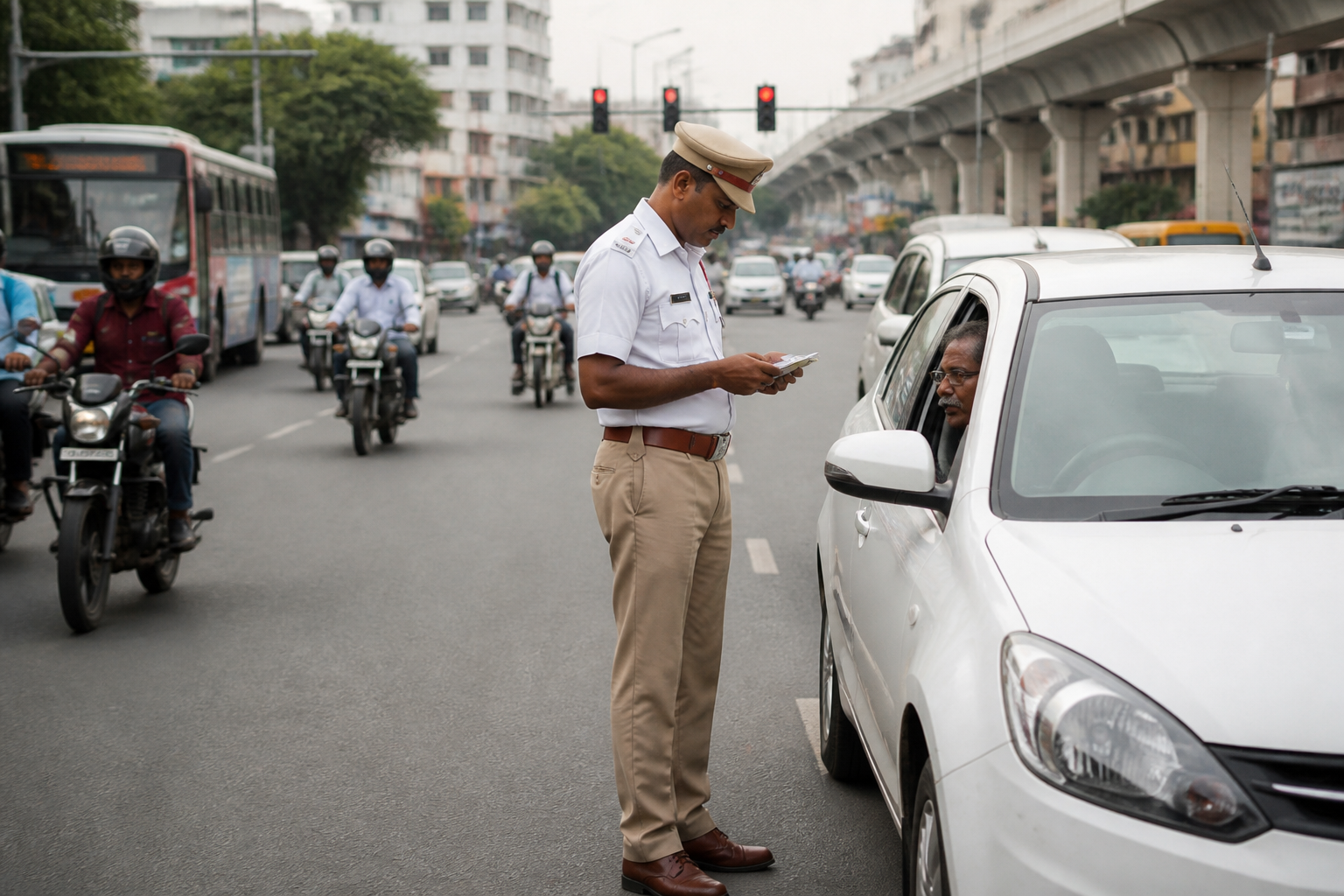
Unpaid traffic challans could trigger wider enforcement action after the Supreme Court directed states, Union territories and authorities to take stronger measures against vehicle owners who do not clear outstanding penalties. The directions include restrictions on several vehicle-related services, including registration renewal, ownership transfer and the issuance of fitness and pollution certificates.
The order was issued by a bench of Justices JB Pardiwala and KV Viswanathan in a matter connected to a public interest litigation filed in 2012, according to Live Hindustan – NCR. The court said that repeatedly sending e-challans to people accused of violating traffic rules was not enough to ensure compliance.
The Supreme Court directed authorities to consider seizing vehicles against which challan amounts remain unpaid. It also asked them to block such vehicles on the transport portal and prevent the processing of services including duplicate registration certificates, address updates and transfers of ownership until the outstanding penalties are paid.
The directions also cover the renewal of vehicle registrations and the issue of fitness and pollution under control certificates. These measures link the enforcement of traffic rules with routine transport and compliance services, rather than treating an unpaid challan as a notice that can remain unresolved indefinitely.
The order has been welcomed by former Indian Police Service officer and former Puducherry Lieutenant Governor Kiran Bedi, who described it as an important measure for enforcement agencies, traffic police and road users. In a social media post shared with a video of a newspaper report, Bedi said the decision was particularly relevant to people who face difficulties on roads because of other motorists’ violations.
Bedi said the order should be read, taught and repeatedly discussed in training programmes, including police and transport training. She also called for the decision to be shared with organisations working on road safety and communicated widely so that road users understand its implications.
The directions place responsibility on states, Union territories and transport authorities to implement the restrictions through their enforcement and vehicle-registration systems. The practical effect will depend on how these authorities identify vehicles with unpaid challans, coordinate data across portals and apply the restrictions while processing transport services.
The order is significant for urban road governance because traffic enforcement increasingly depends on digital challans and transport databases. The Supreme Court’s direction seeks to move the system beyond the repeated generation of notices and towards consequences linked to vehicle ownership and statutory compliance. Further implementation will rest with the relevant authorities and enforcement agencies.
