


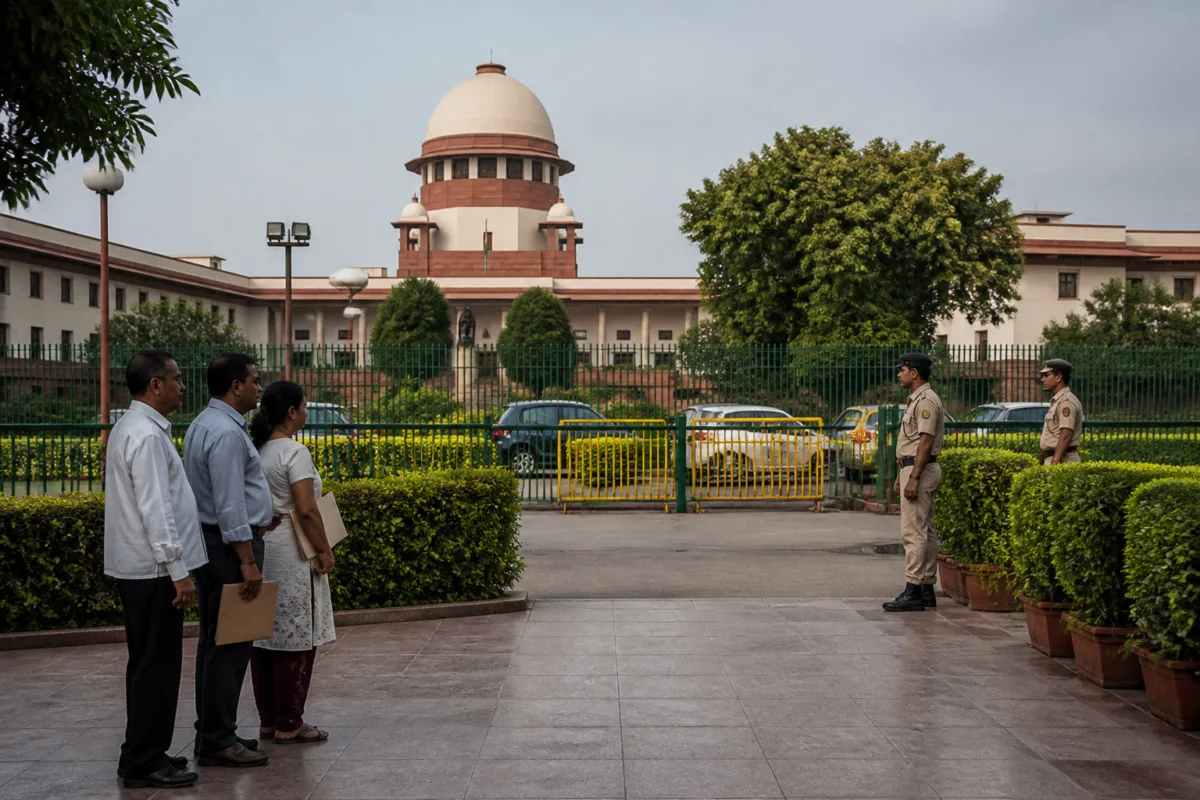
The Supreme Court’s direction that a high-powered committee submit its first fact-finding report within a month has moved the Delhi protest violence case from the stage of collecting complaints to a more structured examination of evidence. But the court’s observation that the committee had received only one complaint also exposes a central difficulty in inquiries into police action: establishing what happened depends not only on the existence of allegations, but on whether affected people can safely and effectively place their evidence before an institution.
The case concerns the student-led protests associated with the Cockroach Janta Party, or CJP, at Delhi’s Jantar Mantar and the subsequent march towards Parliament. The protests involved clashes between demonstrators and security personnel. Security forces used lathi charges and tear gas to disperse the crowd as protesters attempted to move towards Parliament, according to the supplied report. The demonstrations were linked to demands for Union Education Minister Dharmendra Pradhan’s resignation and took place across several cities, with Jantar Mantar serving as the central site.
The Supreme Court had ordered the formation of the High-Powered Inquiry Committee in August while hearing petitions concerning allegations of police excesses against student protesters and violence against police personnel during the demonstrations. The committee is headed by former Punjab and Haryana High Court Chief Justice Ravi Shankar Jha. Its other members include former Delhi High Court judge Shalinder Kaur, former Central Bureau of Investigation director Rishi Kumar Shukla and retired Meghalaya Director General of Police L.R. Bishnoi.
The court’s latest intervention gives the committee a defined short-term task. It has been asked to begin preparing its fact-finding report and submit its first report within one month. The bench, comprising Chief Justice of India Surya Kant and Justice Joymalya Bagchi, also directed the committee to submit interim reports from time to time. The court said the committee could initially report on two important issues, although the supplied material does not specify those issues.
The immediate obstacle is not the absence of an institutional channel. The committee told the court that it had issued notices in 149 newspapers inviting complaints about the violence during the 20 July march in Delhi. It also invited complaints again on 21 October, publicising its online portal and office address. The committee had additionally used print and electronic media and sent notices to protesters who had reportedly made complaints.
Despite these efforts, the committee received very few submissions through its portal or in person. The court recorded that only one complainant appeared before the panel on 29 October 2026 and submitted an affidavit. The court also noted that, despite the committee’s efforts, it had not been able to reach a conclusion about the violence because of a lack of evidence.
That detail changes the character of the proceedings. An inquiry into alleged police excesses cannot rely only on the existence of public allegations. It must establish the sequence of events, identify the conduct being examined, test competing accounts and determine whether the available material supports a finding. The committee’s difficulty in obtaining complaints means that the process is now dependent on assembling evidence from several channels, including material already placed before the Supreme Court.
The bench specifically directed that petitions, videos and complaints relating to the violence be handed over to the committee. It also said that material submitted by petitioners on behalf of victims should be examined. This is significant because the court did not limit the committee’s work to fresh complaints received through its portal or office. It expanded the evidentiary pool to include information already submitted during the litigation.
The court said that information and material filed by the parties, including material submitted on behalf of victims, would be examined and considered. On the basis of material already received, the committee has been asked to seek responses from those who need to respond. This creates a process in which the committee must compare the evidence supplied by petitioners with replies from the people or authorities concerned before beginning to draw conclusions.
The distinction between a complaint and evidence is important in public-order cases. A complaint identifies an alleged harm, but an inquiry must also assess supporting records, video, medical material, official accounts and responses from the parties involved. The supplied report does not establish what evidence has already been filed, how much video material is available or whether any medical or police records have been placed before the committee. Those details remain to be clarified through the committee’s reports and the court’s further proceedings.
The low number of direct complaints also does not, by itself, resolve whether police excesses occurred. Nor does it establish that the allegations are unsupported. It shows that the committee has received limited direct testimony through the mechanisms it publicised. The court’s decision to require examination of material submitted by petitioners indicates that the fact-finding exercise will not be confined to the number of people who personally appeared before the panel.
For urban governance, the case highlights how the management of public protest is tied to the functioning of public space. Jantar Mantar is a designated setting for demonstrations in the national capital, while the route towards Parliament carries heightened security restrictions and administrative controls. When a protest moves from a designated site towards a protected government precinct, crowd control, access regulation and public-order enforcement operate simultaneously. The supplied material does not provide the specific permissions, restrictions or operational orders governing the march, so the precise administrative basis for the security response remains unclear.
The case also involves several layers of institutional responsibility. The Supreme Court is overseeing the inquiry and has set deadlines for the committee. The HPEC is responsible for collecting and assessing material. Security and police authorities are among those whose conduct is under examination or whose responses may be required. Petitioners are supplying material on behalf of victims, while protesters and other affected people are being invited to submit complaints. The inquiry’s credibility will therefore depend on how these different sources are placed on the record and tested.
The court’s approach also gives transparency a defined place in the process. The bench said that, unless confidentiality is required for a specific reason, it would generally prefer the necessary content of the committee’s reports to be shared. This does not amount to a finding on the allegations. It does, however, establish that the inquiry is expected to produce publicly understandable information rather than remain entirely within a closed administrative process.
The timeline recorded in the report adds another layer to the case. The movement began at Jantar Mantar on 20 June and ended on 25 July after the government agreed to the protesters’ other demands and the demand for the education minister’s resignation was raised as a central issue. The incident examined by the committee relates to the 20 July march towards Parliament. The sequence places the alleged violence near the end of a protest campaign that had already continued for more than a month.
The available account does not provide an independent reconstruction of the clashes, the number of people injured or detained, the extent of property damage, or the number of police personnel affected. It also does not identify the specific allegations made in the petitions or explain whether any official disciplinary or criminal proceedings have already begun. These are material gaps that the committee’s fact-finding process may address if the relevant evidence is placed before it.
What the Supreme Court has established at this stage is narrower but consequential. The HPEC must begin its fact-finding work using both newly received complaints and material already submitted in court. It must seek responses from relevant parties, submit its first report within a month and continue to provide interim reports. The court has also indicated that the reports should ordinarily be made available in their necessary form unless confidentiality is justified.
The central question now is not simply how many people have approached the committee. It is whether the committee can assemble a reliable record from petitions, videos, affidavits, complaints and official responses, and explain what that record establishes about the conduct of protesters and security personnel. Until the first report is submitted, the allegations remain under examination. The next significant development will be the committee’s initial fact-finding report and the Supreme Court’s response to it.

