


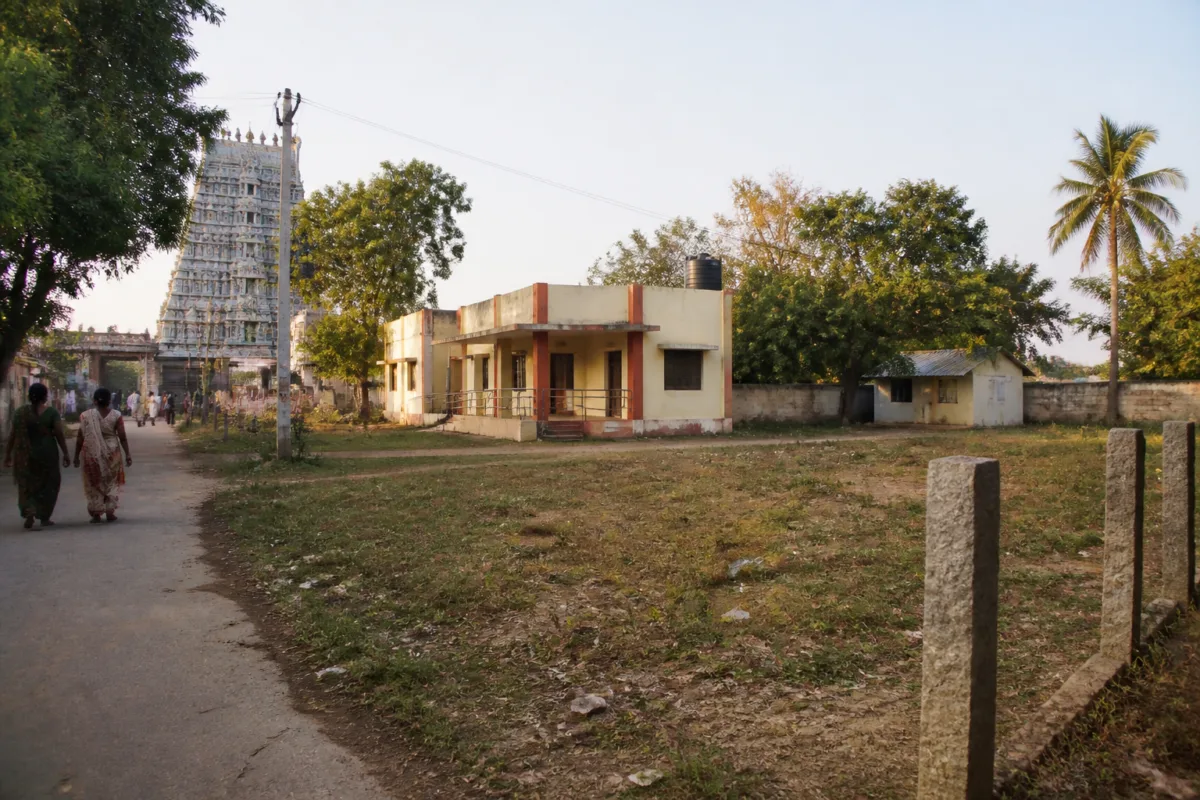
The Supreme Court’s ruling that the government cannot accept temple Inam land as a donation places a significant legal limit on how public authorities can obtain land held for religious institutions. The judgment arose from a Tamil Nadu case, but its implications extend beyond the immediate dispute because it addresses a recurring urban governance question: when land held by a trust is needed for a public facility, can the state take it without compensation simply because the proposed use is public?
The court’s answer, as reported by Sakal, is no. Land and income belonging to a temple cannot be transferred to the government through a gift deed executed by a temple committee or trustee. Even a public purpose does not allow the state to accept such land without payment. If a public authority needs the property, it must determine rent at the prevailing market rate, revise it periodically and pay the temple’s outstanding rent from 2019 onwards in the case before the court.
That distinction is important for cities and villages where public offices, roads, civic buildings and other facilities often depend on land assembled through administrative arrangements. Public authorities may require land for legitimate community needs, but the ruling separates the legitimacy of the project from the legality of the land transaction. A government office may serve a public purpose; that does not automatically convert temple property into government property or remove the institution’s financial rights.
The dispute began in Tamil Nadu, where a temple trustee executed a gift deed for approximately 1.25 acres of temple land in favour of the district collector. A gram panchayat office was subsequently constructed on the site. Devotees challenged the arrangement after the Madras High Court dismissed their petition and then approached the Supreme Court.
A bench comprising Justice Pamidighantam Sri Narasimha and Justice Alok Aradhe held that the government’s acceptance of the land without payment was illegal, according to the report. The ruling therefore focuses not only on the conduct of the trustee but also on the government’s role as recipient. A gift deed may appear administratively convenient, but convenience cannot override the legal character of property held for a deity.
This is the central institutional issue in the judgment. Temple land is not treated as an ordinary parcel that a trustee can surrender at discretion. The income from land received for the management of a temple belongs to the temple, and the reported ruling makes clear that this financial entitlement must be protected even when the property is used for a public facility. The trustee’s authority is consequently not unlimited: managing property is different from giving it away without ensuring the institution’s interests.
For local governments, the judgment introduces a clearer financial obligation. Where public use of temple land is necessary, the state cannot rely on a no-cost transfer merely because the recipient is a government body or a local authority. Rent must be fixed at the current market rate and increased periodically. In the Tamil Nadu case, the court also directed payment of arrears dating from 2019. The order links land occupation to an ongoing payment obligation rather than treating the initial transfer as the end of the transaction.
That approach has practical consequences for public asset management. A government department or gram panchayat using institutional land must be able to identify the legal owner, establish the terms of occupation and account for payments over time. The ruling, as described in the supplied report, makes the absence of a commercial sale or an ordinary acquisition process legally significant. The issue is not simply whether the land is being used for a school, office or another public purpose; it is whether the public body has acquired the right to use it through a lawful and financially fair mechanism.
The ruling also affects the relationship between religious trusts and regulators. In Maharashtra, the report connects the judgment to Section 36(a) of the Mumbai Public Trusts Act, under which a trust may execute a gift deed for immovable property with the permission of the charity commissioner. The Supreme Court’s reasoning places a constraint on how that permission can operate in practice when the property is temple Inam land. Regulatory approval cannot by itself turn property dedicated to a deity into an asset that can be transferred to the government without compensation.
This does not mean that every public project on trust land has been declared impossible. The reported ruling instead establishes a condition for such use: the government must recognise the property rights involved and pay rent at the prevailing market rate, with periodic revisions. The supplied material does not establish how the judgment will be applied to every category of temple land, nor does it provide the full text of the legal reasoning. Those details will matter when courts, charity authorities and governments interpret the ruling in future cases.
The Maharashtra connection is particularly important because the report states that the decision could have a far-reaching effect on the state government’s proposed temple Inam land legislation. The law’s final provisions, scope and implementation framework are not provided in the supplied material. What is clear is that any proposed framework dealing with such land will have to account for the Supreme Court’s position on ownership, trustees’ powers, public acquisition and compensation.
Temple Inam land sits at the intersection of land administration, religious endowments and public infrastructure. That overlap can create ambiguity because the land may be physically located within a settlement and may be attractive for a civic facility, while its legal and financial character is governed by trust obligations. The judgment brings that hidden administrative question to the front: a parcel used by the public is not necessarily public land in the legal sense.
For urban planning, this distinction matters because civic authorities often work with fragmented land ownership. A site that appears suitable for a public building may belong to a private owner, a trust, a charitable institution or another regulated entity. Each ownership category carries different procedures and financial responsibilities. The Supreme Court’s ruling reinforces that land assembly for public infrastructure cannot be reduced to identifying an available site. Authorities must also establish the legal route by which the site will be occupied and the institution whose interests must be protected.
The financial dimension is equally important. If rent is calculated at market rates and revised periodically, the cost of locating a government facility on trust land becomes a continuing public expenditure rather than a one-time administrative arrangement. The direction to pay arrears from 2019 shows how long-term occupation can create liabilities when the original transfer did not establish a lawful compensation mechanism. For local bodies, incomplete land records or informal arrangements may therefore translate into accumulated dues.
The ruling also clarifies the limits of invoking public purpose. Public purpose remains central to land acquisition and infrastructure decisions, but the judgment indicates that it cannot automatically erase the property rights of a temple. The government has routes available when it needs land, yet an uncompensated gift from a trustee is not treated as an acceptable substitute for those routes. This makes procedural legality and institutional accountability part of the infrastructure question itself.
The available report does not specify the full case history, the exact statutory provisions considered by the Supreme Court beyond the Maharashtra reference, or whether any review or subsequent proceedings are pending. It also does not provide the court’s complete order or a detailed response from the Tamil Nadu government. Those matters will determine the ruling’s precise reach. The established point, however, is significant: temple Inam land cannot be freely donated to the government, and public authorities using such land must respect the temple’s financial entitlement.
The next test will be how governments and trust regulators translate the ruling into land records, permission procedures, leases and payment systems. Maharashtra’s proposed temple Inam land legislation will be one important measure of that response. The broader lesson for urban governance is already clear: public use does not by itself establish public ownership, and civic infrastructure must be built through legally valid, compensated and accountable land arrangements.

