


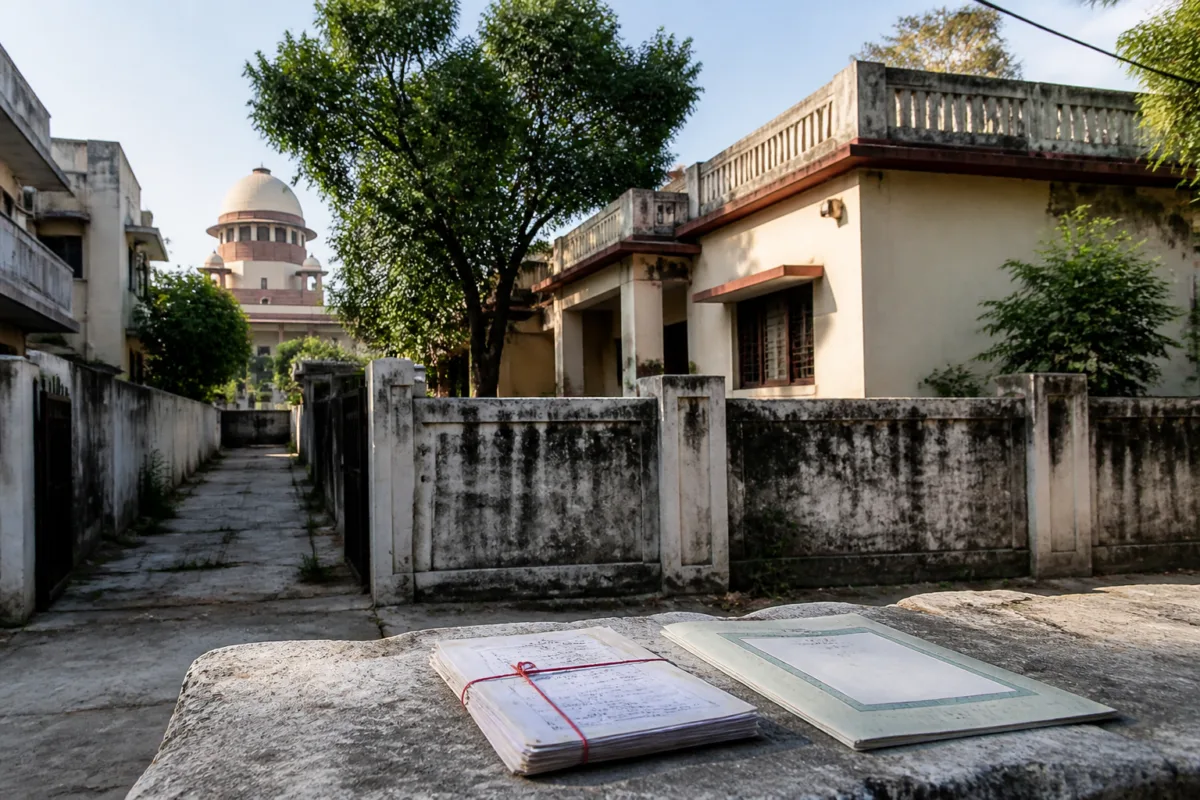
The Supreme Court’s ruling in a dispute over roughly 1,800 sq ft of land has clarified a recurring source of confusion in family property litigation: land that originated as ancestral property does not necessarily remain coparcenary property after succession and partition. Once a legal heir receives an identified share and becomes its exclusive owner, a son cannot claim a birthright in that property merely because he is the owner’s child.
The case involved J. R., who challenged the sale of land that had been allotted to his father from property owned by his grandfather, N. Ramakrishnan. J. R. argued that because the original land was ancestral, the portion received by his father should also be treated as ancestral property. On that basis, he claimed an interest in the land and objected to its sale.
The Supreme Court rejected that reasoning and upheld the High Court’s decision. The court’s conclusion, as reported by Economic Times, turned on the legal route through which the property reached the father. The land had first been part of the grandfather’s ancestral holding. It was then divided among his children, with J. R.’s father receiving a specific share. That division changed the legal character of the father’s allotted portion for the purpose of the dispute.
The central distinction is between property in which descendants acquire an interest by birth and property inherited by an individual legal heir under succession law. A Mitakshara coparcenary can include property in which eligible members have an interest by birth. But the report explains that when a Hindu male dies intestate, Section 8 of the Hindu Succession Act, 1956, governs the distribution of his property among Class I legal heirs. Property received in that manner is generally treated as the heir’s individual property rather than as a continuing coparcenary asset.
The court therefore treated J. R.’s father as the exclusive owner of the share allotted to him. The fact that the property had earlier belonged to an ancestral estate did not, by itself, preserve a continuing birthright for the next generation after the share had been separated. The legal issue was not simply the land’s original history, but the effect of succession and partition on ownership.
This distinction is important because property disputes often use the word “ancestral” to describe land that has been held by a family over several generations. Legally, however, the origin of property is only one part of the analysis. The method by which it was transferred, the identity of the heirs, whether the property remained undivided, and whether a particular share was separated can determine whether a descendant has a present enforceable interest.
The reported facts show how that distinction operated in practice. J. R.’s grandfather owned the larger ancestral property and divided it among his children. J. R.’s father received his portion through that process and subsequently sold it to buyers. J. R. sought a share in the land and argued that the sale should not have taken place without his consent. The courts did not accept that position because the father’s portion was no longer treated as joint family property in which J. R. had a present share.
The ruling also separates a possible future inheritance from a current ownership right. If J. R.’s father had retained the property until his death and died intestate, J. R. could potentially have inherited as a Class I heir, according to the explanation cited in the report. That possibility did not give him a present right to prevent the owner from dealing with the property during his lifetime. Since the father sold the land while he remained its owner, the potential future inheritance did not mature into a claim over the property.
The court’s reasoning also addressed an argument based on Section 29-A of the Hindu Succession Act as applicable through the Tamil Nadu amendment of 1989. J. R.’s advocate argued that the provision recognised the birth-based coparcenary rights of qualifying daughters and female members in a subsisting Mitakshara coparcenary, while preserving the existing rights of sons. The argument would have been relevant if the disputed land had continued to be coparcenary property. The court’s conclusion, however, was that the specific share allotted to J. R.’s father had become his exclusive property.
The case illustrates why the legal status of a particular parcel can differ from the status of the larger family estate from which it originated. A family may begin with a single ancestral holding, but partition can produce separate ownership interests. Once those interests are legally separated, a dispute over one allotted share may no longer be governed by the rules applicable to the undivided estate.
The decision also places the burden of property due diligence beyond a simple search for old family ownership. Documents relating to partition, succession, title transfers and subsequent sales become central to determining whether a claimant has a present interest. For buyers, sellers and heirs, the relevant question is not only whether land was once described as ancestral, but whether the seller received an exclusive and legally transferable share.
The ruling does not mean that every sale of family property can proceed without examining the rights of other members. Its significance is narrower and more specific. Where the property remains part of a subsisting coparcenary, eligible coparceners may have rights recognised by law. But where succession and partition have converted a share into the exclusive property of one heir, a son or grandson cannot automatically revive a coparcenary claim based solely on the property’s earlier history.
The Supreme Court’s decision accordingly confirms a dividing line in Hindu succession law: a child’s relationship with the owner is not, by itself, enough to create a present share in the owner’s exclusive property. The continuing question in similar disputes will be whether the property remained joint and undivided, or whether the chain of succession and partition had already made it the separate property of the person who sold it.

