


Pune’s environment report has finally received unanimous approval after four months of discussion, but the process has also exposed a wider problem: the city’s environmental concerns are being treated as a collection of disconnected complaints rather than as one municipal systems failure. More than 100 corporators raised issues ranging from pollution and shrinking green cover to water scarcity, road construction, rainwater harvesting, lake maintenance and the reuse of treated sewage.
The report was approved at a general body meeting of the Pune Municipal Corporation, with a supplementary motion providing that the suggestions raised during the discussions would be considered in next year’s environmental report. That decision gives the civic administration a formal route to record the concerns. It does not, by itself, establish whether the complaints will result in measurable action, budget decisions or administrative accountability.
That distinction is central to understanding the significance of the Pune environment report. Environmental reporting by a municipal corporation is not only a yearly documentation exercise. It is also a test of whether the authority can connect the condition of roads, drains, lakes, sewage treatment plants, public spaces and tree cover to the everyday experience of residents. In the discussion reported by Loksatta, these subjects appeared together because they are connected on the ground, even when they are managed through separate civic departments.
The mayor, Manjusha Nagpure, said the city would need to take difficult decisions to restore its identity as a green city. She also said that corporators had expressed concern about the deteriorating environment, declining greenery and increasing water scarcity. The statement places the report within a larger institutional question: whether the corporation’s response will move beyond announcing schemes and promises towards decisions that can be implemented and monitored.
The reported concerns cover both environmental quality and the functioning of civic infrastructure. Road construction was identified as an area where shortcomings require attention. Tree conservation and rainwater harvesting were also discussed, along with the cleaning of lakes and the reuse of water from sewage treatment plants. Each issue has a direct physical presence in the city. A road project can affect drainage and tree cover; the condition of a lake can influence local environmental quality; and the failure to reuse treated water can increase pressure on fresh water supplies.
The report does not provide numerical measurements for these concerns in the material available. It does not state the extent of green-cover loss, the volume of water scarcity, the number of non-operational sewage treatment projects or the quantity of treated water that is being reused. That absence is important. Without such baselines, future environmental reports may record repeated concerns without making it possible to determine whether conditions have improved, worsened or remained unchanged.
The discussion also identified several sewage treatment projects as non-operational, according to the mayor’s remarks reported by Loksatta. This is a significant administrative point because the existence of a treatment facility and its functioning are not the same thing. If projects are closed or not operating, the city must be able to establish why they are inactive, who is responsible for repairs or operations, what the financial implications are and how the disruption affects the wider sewage and water-management system. The supplied report does not provide those details, so the causes and scale of the problem remain unestablished.
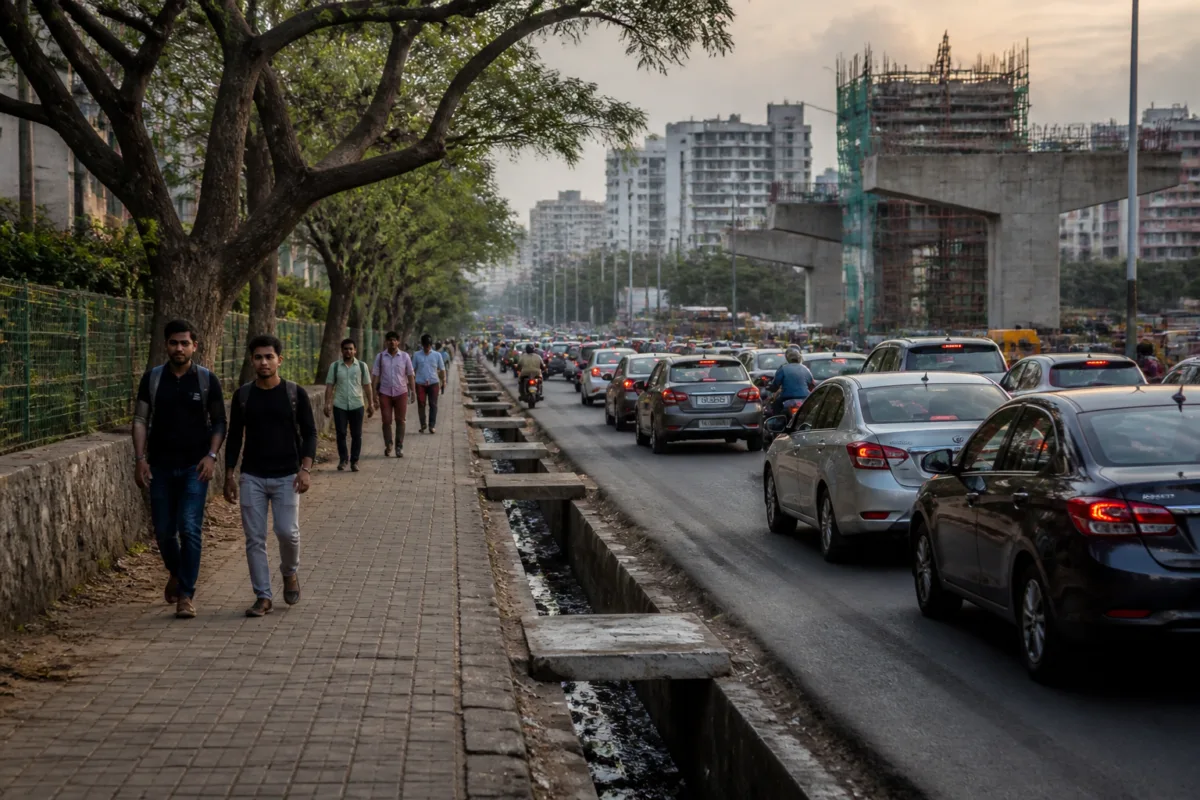
The mayor also linked illegal roadside vending to pollution and pedestrian movement. She said vendors occupy roads illegally, forcing pedestrians to walk on carriageways instead of footpaths. This creates obstruction for vehicles and, in her account, contributes to rising pollution. The point reveals how street management is also an environmental issue. When footpaths are unavailable, pedestrian movement shifts into traffic space. The result is not merely an encroachment dispute; it becomes a question of road safety, transport efficiency, public-space design and the way the city allocates limited street space.
However, the report does not include a quantified assessment of this relationship. It does not specify the locations affected, the number of footpaths obstructed or the measured contribution to pollution. The mayor’s statement should therefore be understood as an on-record civic assessment rather than as a verified pollution study. That distinction matters if the corporation intends to use the environmental report as a basis for enforcement or infrastructure decisions.
The four-month discussion period is itself revealing. More than 100 corporators reportedly placed their concerns and suggestions before the civic body from August onwards. The duration indicates that the report became a forum for a wide range of local environmental complaints. It also raises a structural question about how these inputs are converted into priorities. A long discussion can improve democratic scrutiny, but only if the final document identifies which department must act, by when, with what resources and against which performance measure.
The supplementary motion to include the suggestions in the following year’s environmental report creates continuity between one reporting cycle and the next. It could allow the corporation to track whether the concerns raised this year have been addressed. Yet the available report does not describe a tracking mechanism, a public dashboard, departmental deadlines or a system for recording partial compliance. Without those elements, carrying forward suggestions could become an administrative archive rather than an implementation tool.
The issues raised also point to the fragmented nature of urban governance. Green cover may involve tree protection and road construction decisions. Water scarcity is connected to supply, conservation, rainwater harvesting and the reuse of treated sewage. Lake cleanliness may involve waste removal, drainage and land-use pressures. Sewage treatment projects require operational oversight, maintenance and coordination between the infrastructure that carries sewage and the plants that process it. The report brings these questions into one political discussion, but the next challenge is to ensure that the municipal administration treats them as connected outcomes rather than isolated departmental files.
This is where the Pune environment report can become more useful than a routine annual publication. A meaningful report should allow residents to understand the condition of the city’s environmental assets and the performance of the systems that support them. In the present case, the public discussion has identified the pressure points, but the supplied material does not establish the baseline data needed to judge performance. The next report will need to show whether the concerns raised by the corporators have been translated into specific actions and measurable results.
The civic debate also places implementation at the centre of environmental governance. The mayor’s criticism that the administration must move beyond new schemes and assurances suggests dissatisfaction with a model in which announcements substitute for execution. The issue is not whether new programmes are necessary. It is whether existing infrastructure, including sewage treatment facilities and public drainage-related assets, is functioning as intended, and whether the corporation can demonstrate that through evidence.
For residents, the practical meaning of the report lies in these everyday systems. Water scarcity is experienced through access and reliability. Environmental decline is experienced through reduced greenery, polluted surroundings and poorly maintained public assets. Pedestrian vulnerability is experienced when footpaths cannot be used. The discussion therefore moves environmental governance away from a narrow focus on trees or pollution readings and towards the broader question of whether municipal infrastructure is supporting a liveable city.
The material available confirms that Pune’s elected representatives have identified a wide set of environmental and civic failures, and that the report has been approved unanimously after extended deliberation. It does not yet establish the scale of each problem, the financial commitments required, the responsible departments or the timetable for corrective action. The next environmental report, as well as the corporation’s implementation records, will show whether the supplementary motion becomes a mechanism for accountability or simply a promise to revisit the same concerns another year.

