


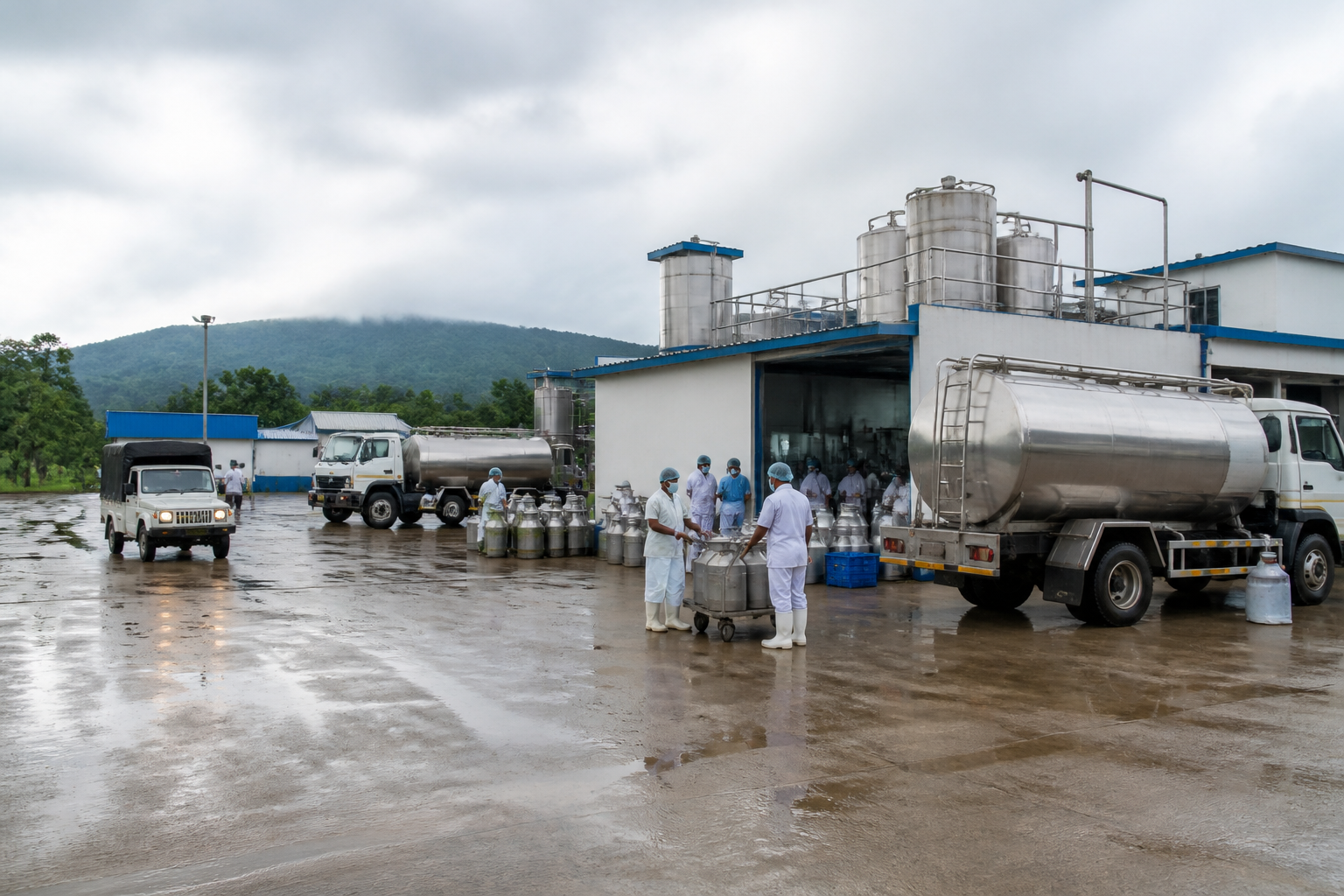
The inauguration of a 20,000-litre-per-day Sudha dairy plant in Tezpur is more than a new processing facility for Bihar’s state-backed dairy cooperative. It marks the latest step in Comfed’s effort to build a regional supply and retail network in the Northeast, while linking Assam’s urban demand to a larger system of milk procurement, processing, distribution and rural livelihoods.
Assam Chief Minister Himanta Biswa Sarma inaugurated the plant at Kanyaka Dairy in Jamugurihat, Shantipur, in Sonitpur district, in the presence of Comfed chairman-cum-managing director Shirshat Kapil Ashok. The facility is intended to strengthen the supply of Sudha products in Tezpur and nearby areas. It also gives the cooperative additional processing capacity in a market where its products are already sold through a network originating in Guwahati.
The immediate development is modest in capacity when compared with Comfed’s proposed long-term plans. The Jamugurihat facility can process 20,000 litres a day, while Comfed has proposed establishing its own 1 lakh-litre-per-day dairy processing unit in Assam. The cooperative has requested suitable land from the Assam government, and the Assam Industrial Development Corporation has identified potential sites for inspection and consideration by Comfed officials.
That contrast between the operating plant and the proposed larger unit is important. It shows that regional expansion is being built in stages rather than through one immediate, statewide facility. A smaller plant can support local distribution around Tezpur while the cooperative assesses land, demand and the institutional arrangements needed for a much larger processing centre. The supplied report does not establish a construction timeline for the 1 lakh-litre unit, but the land-identification process indicates that the proposal has moved beyond a purely conceptual announcement.
Comfed began marketing Sudha packet milk and other dairy products in Assam in November 2018 through a third-party dairy plant at Amingaon in Guwahati. Its operations later expanded to other parts of Assam, as well as neighbouring Meghalaya and Arunachal Pradesh. The Guwahati unit now supplies products through about 2,200 retail vendors and sells an average of around 50,500 litres of milk a day.
The product network extends beyond packet milk. The report lists curd, paneer, curd juice, peda and milk cake among the products marketed through the Guwahati operation. This matters because a dairy network is not only a system for moving liquid milk. Processing, cold-chain requirements, retail access and product diversification determine how far a cooperative can reach beyond the immediate catchment of a plant.
The figures reported for Comfed’s Assam operations also point to a sizeable commercial base. In the financial year 2025-26, the Guwahati unit recorded business of Rs 121 crore and earned a profit of Rs 8 crore. These numbers suggest that the Assam operation has developed from an initial market-entry arrangement into a commercially significant regional business. However, the supplied material does not provide a breakdown of revenue by product, district or retail channel, so the precise drivers of that performance remain unclear.
The deeper significance of the expansion lies in the relationship between processing capacity and milk procurement. Comfed’s PRO said the cooperative currently supplies 16-18 lakh litres of Sudha milk to the market daily, apart from other dairy products. It purchases about 25 lakh litres of milk from farmers each day, while the government aims to raise procurement to 50 lakh litres.
These figures describe two different parts of the dairy system. Procurement reflects the volume collected from producers, while market supply refers to the milk and products distributed to consumers. The gap between the two cannot be treated simply as unused capacity because the system also includes processing losses, conversion into products, inventory, geographic distribution and other operational requirements. Still, the procurement target indicates the scale at which the cooperative network is expected to grow.
The expansion of processing facilities can help address one of the central logistical challenges of dairy markets: milk is produced daily, but demand is distributed across towns and cities with different levels of access to organised retail. A plant closer to Tezpur can reduce the need to serve the area entirely through a distant processing base, although the report does not provide comparative transport distances, logistics costs or changes in delivery times after the Jamugurihat plant began operations.
For consumers, the most direct effect is likely to be stronger availability of Sudha products in Tezpur and nearby areas. The reported expansion of the retail network suggests that access is being treated as a combination of processing capacity and last-mile distribution. A plant by itself does not create a functioning urban supply system; products must also reach vendors, maintain quality during distribution and match local demand.
For rural producers, the proposed increase in procurement could create a larger market for milk, but the available information does not establish how many farmers are currently linked to Comfed in Assam or how procurement would be organised there. The report states that greater milk procurement from rural dairy farmers is expected to strengthen the cooperative network and create opportunities for new products. That is an stated institutional expectation, not evidence of a completed change in farmer incomes or collection infrastructure.
The Assam expansion also illustrates how state-backed cooperatives can operate across administrative boundaries. Sudha is owned and marketed by the Bihar State Milk Cooperative Federation, but its distribution footprint now includes Assam, Meghalaya, Arunachal Pradesh, Delhi NCR and Kolkata. The model combines a home-state cooperative identity with markets in other regions, requiring arrangements for processing, procurement, retail distribution and government coordination outside Bihar.
This makes land and industrial infrastructure part of the cooperative’s growth strategy. The proposed 1 lakh-litre-per-day plant requires a suitable site, and the involvement of AIDC shows that the expansion depends partly on state-level industrial facilitation. The supplied report does not specify the land parcel, investment amount, financing structure, construction agency or expected commissioning date. Those details will determine how quickly the larger plan can become operating capacity.
Bihar’s own dairy growth provides the production context for Comfed’s expansion. According to information received from the Press Information Bureau, milk production in Bihar increased from 7.77 million tonnes in 2014-15 to 12.85 million tonnes in 2023-24. The report attributes this increase to initiatives by the state and central governments. This is a substantial rise over the period, although the supplied material does not break down the contribution of herd size, productivity, procurement systems, technology or changes in consumption.
The Bihar numbers help explain why Comfed is seeking markets beyond its home state. Rising production creates the need for collection, processing and dependable outlets. Expanding into other urban markets can provide additional demand, while regional plants can support distribution closer to consumers. But the Assam operation also means that the cooperative must manage a more complex network, with different production geographies, state institutions and market conditions.
The reported numbers reveal the scale of the challenge. Comfed’s current farmer procurement is about 25 lakh litres a day, with a government target of 50 lakh litres. Its reported daily supply of Sudha milk is 16-18 lakh litres, while the Guwahati unit alone markets approximately 50,500 litres a day. These figures should not be directly combined because they refer to different parts of the network and possibly different operational geographies. They do, however, show that the proposed Assam unit would be entering a system that is already handling significant volumes.
The central urban question is therefore not simply whether Assam will get another dairy plant. It is whether processing capacity, rural collection and retail distribution can be developed together. If one part expands faster than the others, the network may face bottlenecks: milk may not be collected at the intended scale, plants may operate below capacity, or products may not reach consumers consistently. The supplied report confirms the expansion plans and current operating figures, but it does not yet provide evidence on utilisation rates or district-level supply performance.
The Jamugurihat plant is an operational step in that wider process. The proposed 1 lakh-litre unit, if it receives land and progresses through the required development stages, would represent a much larger commitment. The next measurable milestones are the selection and allocation of land, the formalisation of the project, construction and commissioning, and the expansion of procurement and retail networks that would support the additional capacity. Until those stages are documented, the clearest evidence is that Comfed has established a foothold in the Northeast and is attempting to turn that foothold into a larger cooperative supply chain.
