


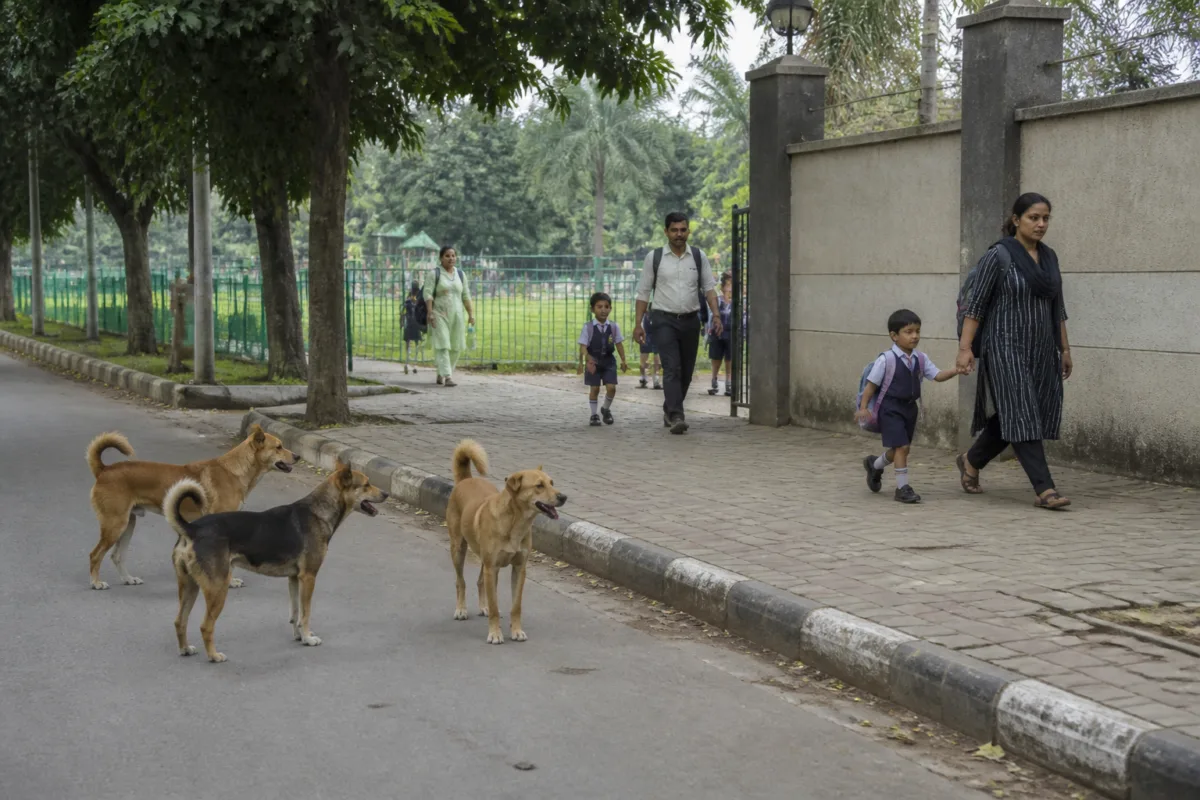
The Madhya Pradesh High Court has decided to develop one city in the state as a model for containing the stray dog menace, with the location expected to be selected at the next hearing on November 30. The move follows petitions seeking implementation of Supreme Court directions to keep key public places free of stray dogs.
A division bench comprising Chief Justice Alpesh Kogje and Justice Vivek Jain took up the matter during a combined hearing of petitions concerning stray dogs in different parts of Madhya Pradesh. The court was also hearing a suo motu petition initiated after a four-year-old child was badly wounded by a pack of stray dogs in 2022, along with public interest litigations on the issue.
The Supreme Court had earlier this year expressed concern over the stray dog menace and directed that major public places, including schools, colleges, hospitals and railway stations, should be kept free of stray dogs. The matter was subsequently referred to state high courts to monitor implementation of the directions.
During Tuesday’s hearing, counsel for the Madhya Pradesh government told the bench that a status report on implementation of the Supreme Court guidelines had already been presented. The court was also informed that efforts to address the problem had been undertaken in major cities.
The amicus curiae appointed in the case, however, said the response was limited to the state’s major cities. Smaller towns, semi-urban areas and villages were also facing the stray dog problem, the amicus curiae told the court, calling for an elaborate action plan covering the wider state rather than only its largest urban centres.
All stakeholders agreed with the suggestion that one city should be adopted for developing a model approach to containing the menace. The model could then be expanded to other places in Madhya Pradesh, according to the proceedings reported by The Times of India.
The court’s proposed model-city approach places public-space safety at the centre of the implementation challenge. Schools, colleges, parks, hospitals, bus stands and railway stations were specifically identified in the proceedings as places where the Supreme Court guidelines require action. Implementing the directions across these locations will involve coordination between the state government, local administrations and agencies responsible for public facilities.
The case also highlights the geographic limits of city-focused municipal responses. While major cities may have greater administrative capacity and dedicated programmes, the amicus curiae’s submission pointed to the need for measures in smaller towns, semi-urban settlements and villages as well. The court is expected to decide which city will be developed as the model at the November 30 hearing.

