


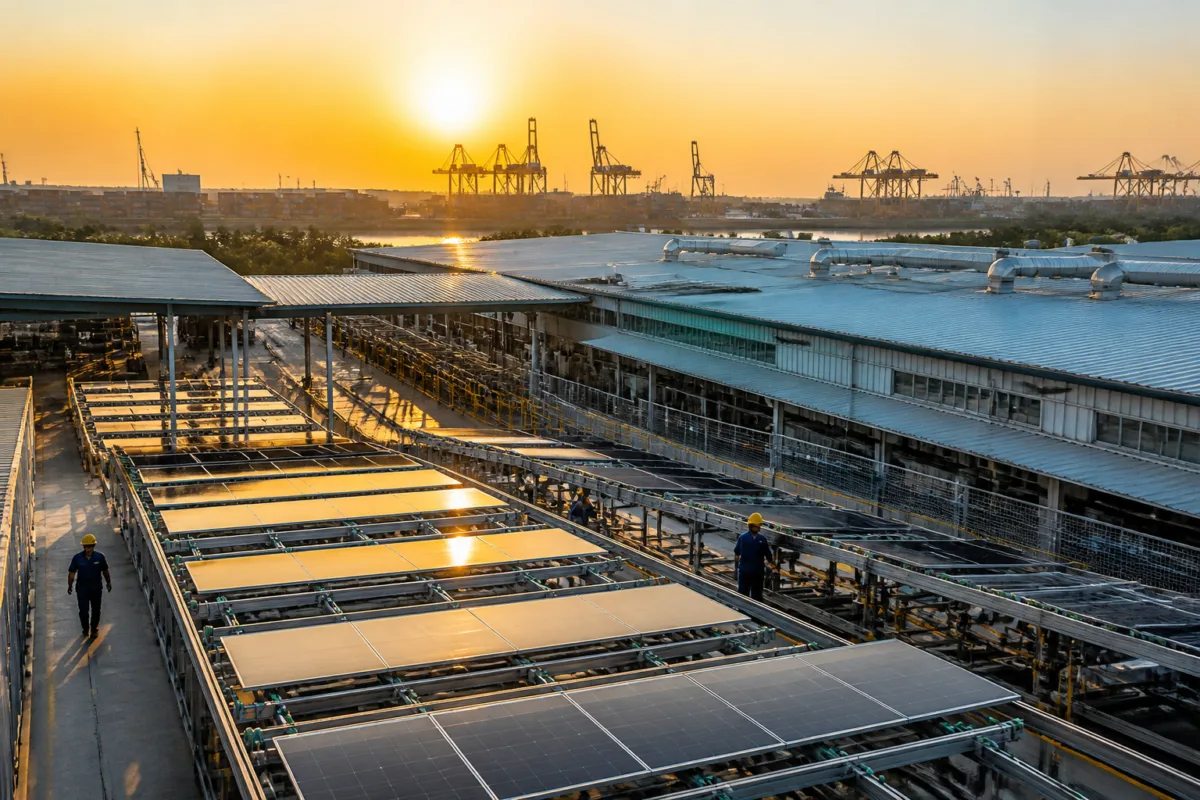
Solex Energy’s plan to establish solar module and cell manufacturing capacity in the United States is presented as an international expansion move, but the company’s own account also exposes a central weakness in India’s renewable-energy manufacturing system: the country has built far more module capacity than cell capacity, while much of the installed base is older technology or not operational.
The Gujarat-based company is considering US manufacturing as part of a $1.5 billion investment roadmap through 2030, according to Chairman and Managing Director Chetan Shah. The company has not disclosed the proposed locations, investment amount or project schedule in the United States. Shah said a team is studying the relevant parameters, including the investment required and possible locations.
That distinction is important. Solex Energy’s US entry is currently a stated expansion intention rather than an announced project with a confirmed site, capacity or commissioning date. Its significance lies in what is driving the decision: access to a large solar market, restrictions on Chinese imports and the search for a reliable supply chain for clean-energy components.
Shah described the United States as a high-potential market and said the company was looking to invest there alongside other Indian business houses. He also said the move would allow Solex Energy to respond to global demand for clean-energy components while positioning itself as a cost-effective alternative to Chinese suppliers. The company has not provided details of any US regulatory approvals, partnerships or procurement commitments.
Solex Energy’s existing and proposed Indian capacities show the scale of the manufacturing platform it is seeking to build. The company currently operates a 4 gigawatt module manufacturing facility in Gujarat and aims to increase module capacity to 10 GW. It is also establishing 10 GW of cell manufacturing capacity and 2 GW of ingot and wafer production, according to Shah’s account.
Modules convert electricity generated by solar cells into usable power, while cells are the functional units inside modules. Ingots and wafers sit earlier in the manufacturing chain. Building capacity across these stages would give a company a more integrated supply base, although the information supplied does not establish how much of Solex Energy’s planned Indian capacity is operational, under construction or yet to receive approvals.
The wider numbers cited by Shah point to a pronounced imbalance in India’s solar manufacturing chain. As of October 2026, India had about 262 GW of module manufacturing capacity but only about 37 GW of cell capacity. On those figures, module capacity was roughly seven times cell capacity. That gap means the country can announce or build substantial module capacity without having a comparable domestic supply of the cells required to use it.
Shah said the imbalance is aggravated by the condition of existing capacity. He described much of the installed module capacity as based on older mono PERC technology and said several facilities were non-operational. He added that module capacities had been established for the latest TOPCon technology. The supplied account does not provide a capacity-wise breakdown of operational plants, technology shares or the reasons individual facilities are not operating.
The contrast between module and cell capacity also explains why policy implementation has become a concern for manufacturers. Shah called for an extension of at least 12 months for the ALMM-II framework, citing cell availability and current market conditions. ALMM-II requires the sourcing of made-in-India cells from manufacturers included on an approved list of module manufacturers.
The policy is therefore not only a procurement rule. It connects the eligibility of solar modules with the availability and approval of domestic cell production. If module capacity expands faster than approved cell capacity, manufacturers may face difficulties meeting sourcing requirements even when nominal domestic module capacity is high. Shah’s comments identify this supply-chain gap as an industry concern, but the supplied report does not establish whether the government has agreed to an extension or what specific timeline is under consideration.
For Solex Energy, the proposed US manufacturing push and the request for more time under ALMM-II are connected by a common industrial challenge: capacity is being built across different parts of the solar supply chain, but those capacities do not necessarily mature at the same pace. A company may have substantial module capability while still depending on the availability of cells that meet domestic policy requirements. The same mismatch can influence how quickly new investments become commercially usable.
The US plan also reflects a change in the competitive geography of solar equipment. Shah said steep anti-dumping duties on Chinese imports had left India as the sole viable supplier of low-cost alternatives for the US market. This is a company chairman’s assessment, not an independent market measurement contained in the supplied material. It nevertheless indicates how trade barriers are shaping investment decisions in solar manufacturing.
For Indian manufacturers, overseas investment can serve several purposes at once: it can place production closer to a major market, respond to local sourcing expectations and reduce exposure to cross-border trade restrictions. In Solex Energy’s case, the company has not yet disclosed whether its proposed US facilities would manufacture modules, cells or both, although the broader investment plan refers to solar module and cell capacities.
The proposed expansion also raises a question about the relationship between domestic industrial policy and international growth. India’s manufacturing strategy is intended to support the country’s net-zero goals, Shah said, while ALMM-II is designed to promote the use of approved Indian-made cells. At the same time, companies are seeking opportunities in overseas markets where demand and trade rules may make local production attractive.
That does not mean that international expansion reduces the importance of Indian capacity. Solex Energy’s stated Indian plans remain substantially larger in disclosed capacity terms than its unspecified US proposal. The company’s domestic roadmap includes expansion of module manufacturing from 4 GW to 10 GW, 10 GW of cell manufacturing and 2 GW of ingot and wafer production. The US element is currently a market and investment study within the larger $1.5 billion plan.
The key issue for India’s solar industry is therefore not simply whether companies can add gigawatts of announced capacity. It is whether module, cell, wafer and upstream capacities become operational in a coordinated sequence, use competitive technologies and meet the requirements of the policies governing procurement. The figures cited by Solex Energy show that nominal capacity at one stage of the chain cannot by itself demonstrate supply-chain resilience.
There is also a technology dimension. Shah said many installed capacities were based on mono PERC technology, while module capacities had been set up for TOPCon technology. The supplied material does not compare the costs or performance of these technologies, but the reference indicates that manufacturing investment is taking place during a technology transition. Plants that cannot adapt to newer requirements may contribute less to effective supply than their nameplate capacity suggests.
For cities and the built environment, these industrial questions are not remote. Solar modules and cells are inputs into the energy systems used by buildings, infrastructure and distributed power projects. The availability, price and origin of those components can affect how quickly renewable-energy installations are supplied, although the source does not provide project-level evidence linking Solex Energy’s plans to any specific city or infrastructure project.
The evidence currently confirms three developments. Solex Energy is studying a US manufacturing presence as part of a $1.5 billion investment plan through 2030; it is expanding an Indian manufacturing platform spanning modules, cells, ingots and wafers; and it is seeking at least a 12-month extension to ALMM-II because of concerns over cell availability. What remains unresolved are the location, investment size, capacity and timeline of the proposed US facilities, as well as the government’s response to the extension request.
The next meaningful indicators will be the disclosure of specific US project details, progress on Solex Energy’s Indian cell and upstream capacities, the operating status of existing module plants and any formal decision on ALMM-II. Until then, the company’s expansion plan is best understood as both an international growth strategy and a reflection of the coordination problems confronting India’s rapidly expanding solar manufacturing chain.

