


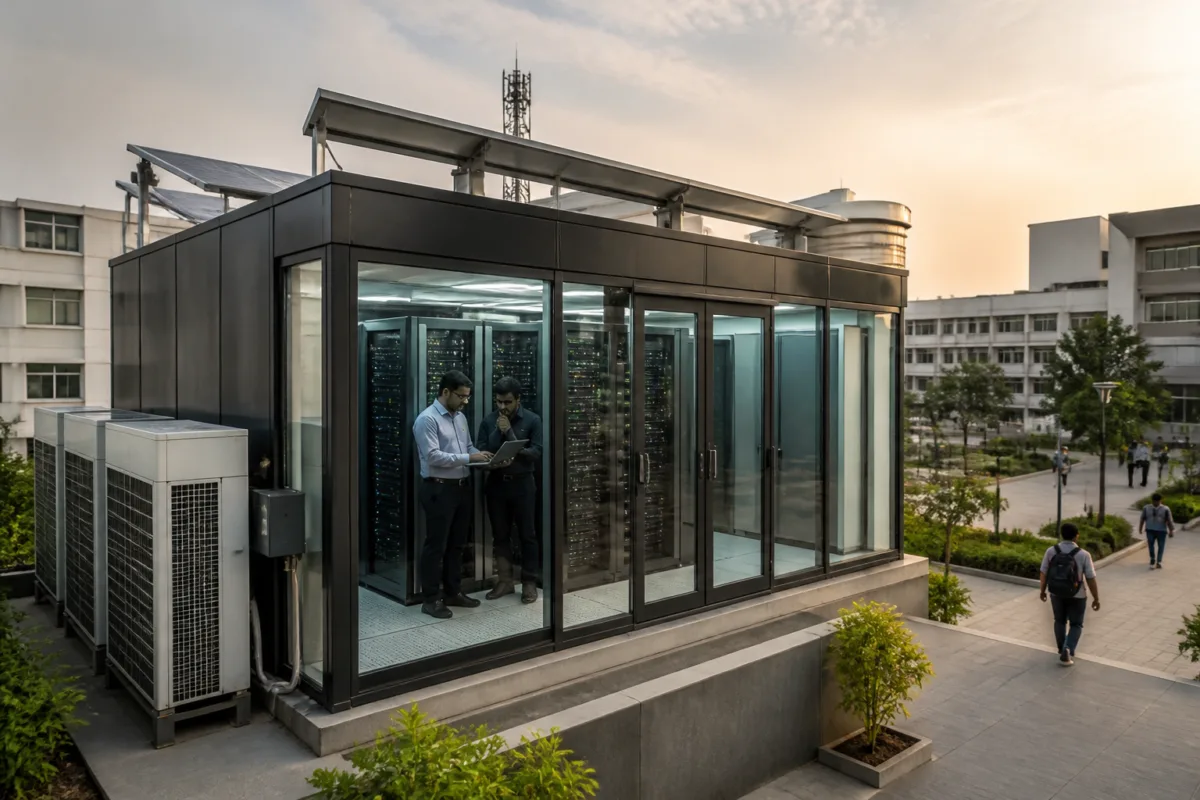
Small data centres could help India expand access to artificial intelligence without depending entirely on electricity-intensive and cooling-heavy large facilities, IIT Madras director V Kamakoti said at an AI governance conclave on the institute’s campus on Thursday.
Kamakoti said large data centres would remain important for training artificial intelligence models, but smaller facilities, which he called “pico-clouds”, could be sufficient for using or inferring from large language models. The approach, he said, could help bridge the AI divide across the country.
“We will need large language models to train AI models. But small data centres or pico-clouds are enough to use the models,” Kamakoti said, according to the Times of India report. He added that India could become a country that uses AI responsibly while ensuring that the technology does not adversely affect energy use and other natural resources.
The distinction between training and inference is central to the infrastructure question raised at the conclave. Training AI models requires substantial computing capacity, while inference refers to using an already-developed model to generate outputs or perform tasks. Kamakoti’s comments suggest that the latter activity need not always be concentrated in the largest data-centre facilities.
For Indian cities, the issue connects AI adoption with the availability and cost of power, cooling systems and digital infrastructure. Large data centres require significant electricity and cooling capacity, while the proposed pico-cloud model would place smaller computing facilities closer to users or institutions. The report did not provide details on the proposed locations, technical specifications, investment requirements or implementation timeline for such facilities.
The remarks were made while launching a conclave focused on AI governance at IIT Madras. Alongside the infrastructure discussion, the institute announced plans to release 500 videos explaining how AI is improving different sectors and how technology can affect quality of life. The Centre for Responsible AI at IIT Madras is partnering with Better India on the project.
Each video will examine a different sector, including agriculture, space, legal services and manufacturing, Kamakoti said. The initiative is intended to present sector-specific applications of AI rather than treating the technology as a single, uniform intervention.
The employment impact of AI was also discussed at the event. Professor B Ravindran, head of the Wadhwani School of Data Science and AI and the Centre for Responsible AI at IIT Madras, said AI would not necessarily replace every job. “A job is composed of different kind of skills and AI is not uniformly good at replacing every one of them. Each job will have to be reimagined with the impact of AI,” he said.
The comments place computing infrastructure and workforce transition within the same governance discussion. IIT Madras has not, according to the report, announced a specific pico-cloud deployment programme or quantified the energy savings that smaller data centres could deliver. The institute’s next stated initiative is the production of the 500-video series across the identified sectors.

