


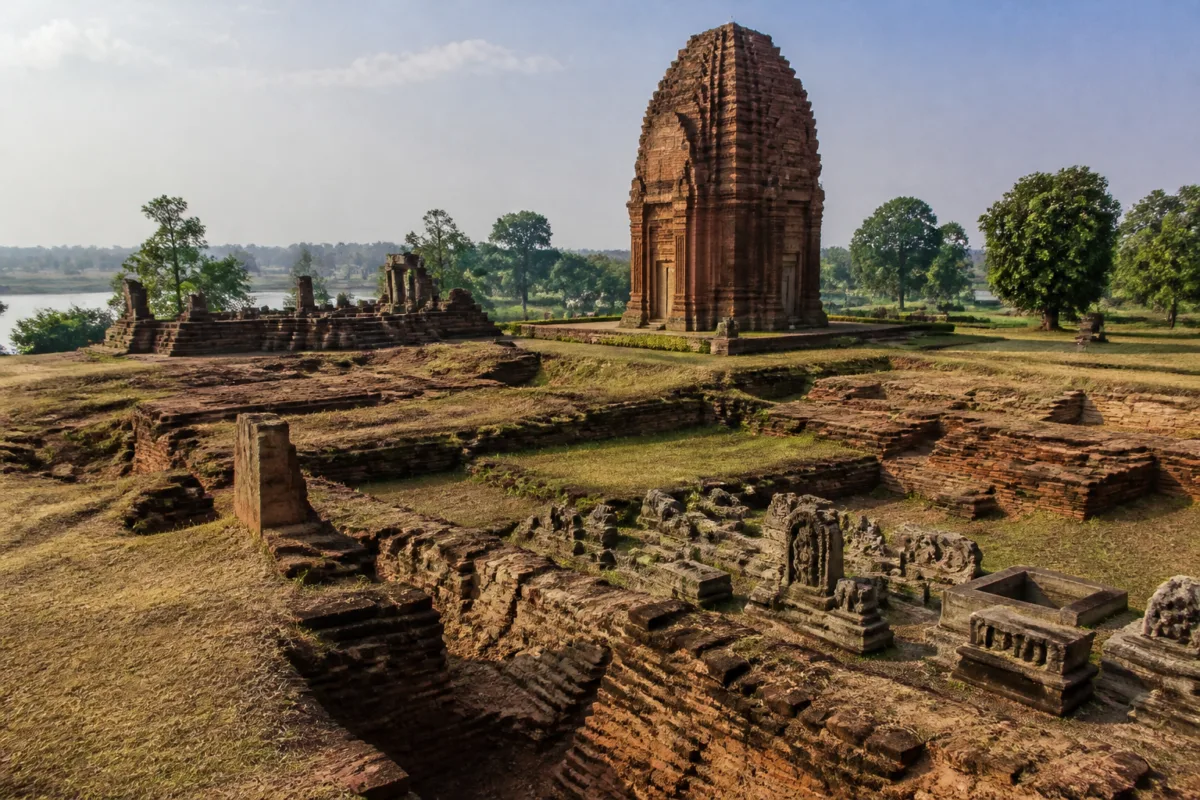
Sirpur’s entry on UNESCO’s Tentative List is more than a recognition of an ancient temple or a cluster of archaeological ruins. It brings renewed attention to Sripura, an early medieval capital on the Mahanadi in present-day Chhattisgarh, whose remains indicate a functioning city organised around trade, water, craft production, religious institutions and political power.
India submitted the Sirpur cultural and archaeological landscape to UNESCO on September 28, 2026, beginning the preliminary process for possible World Heritage recognition. The listing does not itself confer World Heritage status, but it changes the frame through which the site is understood. Sirpur is no longer only a heritage excursion from Raipur or a location identified with the Lakshmana Temple. The evidence presented in the nomination material describes a broader urban landscape that developed between the fifth and 12th centuries CE.
That distinction matters because archaeological sites are often presented through their most visible structures. At Sirpur, the red-brick Lakshmana Temple is the best-known landmark, but the settlement around it reveals the more complex infrastructure of a city. Excavations have identified broad streets, drainage and water-management systems, courtyard houses, royal buildings, religious establishments, granaries, workshops and commercial spaces. Together, these remains suggest that Sripura’s urban character rested on networks and institutions, not just monumental architecture.
The site’s present appearance makes that history easy to miss. Sirpur is now a quiet village located about 80 kilometres from Raipur, close to the Mahanadi. Beyond homes and agricultural fields, however, fragments of the earlier settlement appear in the form of temples, Buddhist monastic cells, palace remains, wells, sculptures and traces of streets. The contrast between the contemporary settlement and the buried or scattered urban footprint is central to the challenge of conserving Sirpur. Its significance is distributed across a landscape rather than concentrated inside a single monument.
The available evidence also points to an economy supported by specialised production. Excavations recovered what researchers described as an almost complete goldsmith’s toolkit, including pincers, tongs, a hammer and a touchstone used to test gold. Evidence of pottery production and bronze casting has also been reported. A National Book Trust study on the history of Indian glass records the discovery of glass slag, drawn wire and crucibles containing glass-making material. These findings suggest that glass was manufactured at Sirpur rather than simply arriving as finished ornaments.
Such objects help restore the working population to the story of the city. They indicate spaces where artisans produced goods, traders exchanged commodities and households used tools in daily economic activity. The archaeological record therefore moves the narrative away from kings and temples alone. It shows a city in which manufacture, storage, commerce and domestic life operated alongside political and religious institutions.
Sirpur’s location beside the Mahanadi was another important element in its development. The city stood in fertile territory and along routes connecting central India with eastern India and the Deccan. UNESCO’s nomination material identifies it as a meeting point for merchants, artisans, pilgrims and religious communities. Archaeological studies suggest trade connections towards Cuttack, Varanasi and other commercial centres, although the precise extent of those networks remains a matter of historical interpretation.
What the evidence establishes more firmly is that Sirpur was not an isolated religious settlement. The combination of commercial spaces, workshops, water systems and religious establishments points to an urban centre whose economic and cultural life depended on movement. Rivers, roads, storage facilities and markets formed the connective tissue between the city’s different functions. In this sense, Sirpur offers an early example of how urban form can reflect the relationship between geography, production and exchange.
Its religious landscape adds another layer to that urban history. Shaiva and Vaishnava temples, Buddhist monasteries and stupas, and Jain establishments existed within the same broad settlement. UNESCO’s nomination material identifies interaction between different faiths in a shared civic and cultural setting. The significance is not simply that several traditions are represented at one archaeological site. It is that their institutions appear to have operated within the same urban environment, alongside markets, residences, workshops and administrative spaces.
The reign of Mahasivagupta Balarjuna, one of the prominent Panduvamshi rulers associated with Sirpur, is particularly relevant to this history. Although the ruler was associated with Shaivism, the period also witnessed Buddhist patronage. Inscriptions and monastic remains indicate a political environment in which Buddhist institutions flourished alongside other religious establishments. An inscription associated with Anandaprabhu Vihara records the establishment of a village and a feeding house for Buddhist followers during his reign.
This evidence complicates any attempt to assign Sirpur a single religious identity. The Lakshmana Temple, commissioned by Queen Vasata in memory of her husband Harshagupta, remains one of the clearest architectural markers of the site. Generally dated to the seventh century, it is among India’s earliest surviving examples of monumental brick temple architecture. Its red-brick tower, sculptural ornamentation and carved stone doorway demonstrate a high level of architectural and material skill. But the temple is one part of a landscape that also includes monasteries, stupas, Jain establishments and civic infrastructure.
That wider setting is important for contemporary conservation. A monument-centred approach can protect an iconic structure while leaving the relationships that made the historical city meaningful poorly understood. Sirpur’s streets, wells, drainage, production areas and commercial spaces are not background details. They explain how the settlement functioned and how its institutions were connected. The UNESCO process could therefore place greater emphasis on the cultural and archaeological landscape rather than treating the site as a list of disconnected buildings.
The institutional question is equally significant. The Sirpur Special Area Development Authority is responsible for the local development framework, and its chief executive officer, Dhammsheel Ganvir, said the UNESCO Tentative List inclusion could help position the ancient capital on the global tourism map. Ganvir described Sirpur as a 1,500-year-old heritage site and a valuable part of the region’s cultural history. His statement reflects the tourism opportunity attached to the listing, but the nomination also raises the need to manage access, interpretation and conservation across a dispersed site.
For years, Sirpur has largely been promoted as a heritage excursion from Raipur, centred on the Lakshmana Temple, Buddhist ruins and Gandheshwar Temple. That model presents the site as a short itinerary of attractions. The archaeological evidence suggests a different framework: Sirpur should be read as a former city whose religious buildings were embedded in a larger system of streets, water infrastructure, homes, workshops and markets.
The available report does not establish the scale of current visitor growth, the funding required for conservation or the administrative arrangements that would follow a successful World Heritage nomination. It also does not settle the precise boundaries of the ancient urban settlement or the full extent of its trading networks. These are important gaps because recognition of a landscape requires more than international visibility. It requires clarity about what is being protected, which institutions are responsible, and how archaeological remains will coexist with present-day settlements and livelihoods.
Sirpur’s potential global significance lies in the way its evidence connects architecture with everyday urban life. The goldsmith’s tools, glass-working materials, wells, drainage systems and courtyard houses are as important to the city’s story as the temples and royal remains. They show that the built environment was produced by many kinds of workers and users, and that religious diversity operated within an economic and civic landscape.
The UNESCO Tentative List has therefore reopened a larger question about how India identifies and presents its urban heritage. Cities are often remembered through monuments, while the systems that sustained them disappear from public view. Sirpur’s remains make those systems visible. They suggest that the ancient capital’s enduring value lies not only in what survives above ground, but in the evidence of how people organised movement, belief, production, water and exchange over several centuries.
The next stage will determine whether this broader understanding becomes part of Sirpur’s conservation and tourism planning. For now, the Tentative List entry confirms the site’s international heritage potential, while the archaeological record makes clear that its story is fundamentally that of a city: diverse, productive and connected to the wider networks of central and eastern India.

