


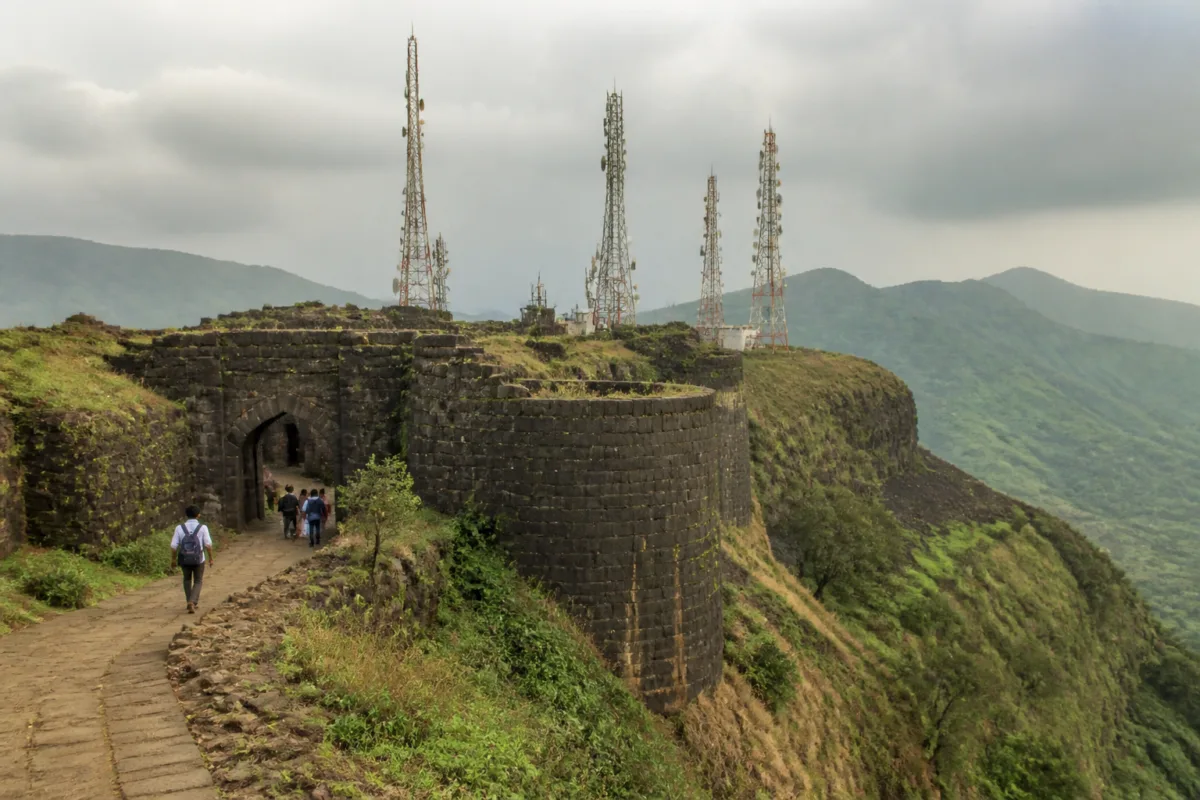
Thirteen mobile and communication towers reported atop Sinhagad Fort near Pune have raised questions about how modern telecom infrastructure is being approved and monitored at protected heritage sites. The structures have also prompted concern over the fort’s visual character and any future consideration of it for international heritage recognition.
A survey by Sachin Joshi, a researcher at the Bharat Itihas Sanshodhak Mandal, identified 13 small and large towers on the fort, according to Pune Mirror. The report said visitors approaching through the Pune Darwaza can see the towers against the fort’s historic stone walls and skyline.
Sinhagad, formerly known as Kondhana, is located about 25 km south-west of Pune at an elevation of roughly 4,400 feet above mean sea level. The fort is associated with the 1670 battle in which Maratha commander Tanaji Malusare was killed during its recapture. It is among Maharashtra’s most prominent historic forts, although it is not part of the current group of 12 forts nominated by the state for the UNESCO World Heritage list, the report said.
The reported tower count includes older public communication installations. A Doordarshan relay tower was installed before 1977, when Pune did not have a local television network, while All India Radio transmitters and a police wireless system were added later. The report said private telecom companies and FM radio operators subsequently installed additional towers without permission.
Vilas Wahane, assistant director of the Maharashtra State Archaeology Department, told Pune Mirror that the department had not issued no-objection certificates for private towers. He said clearances for Doordarshan, All India Radio and police wireless systems dated to around 1980, before Sinhagad was formally declared a state-protected monument.
Wahane said the department would investigate the towers and check whether some stood on privately owned land within the fort area. He indicated that the inquiry would examine the installations and that action could follow if unauthorised construction was established.
The Forest Department said it does not approve mobile towers at the site. Pune Forest Department Range Forest Officer Manoj Barbole told the publication that decisions rested with the State Archaeology Department. The exchange highlights an administrative issue common to infrastructure in protected landscapes: permissions may involve separate authorities responsible for forests, archaeology, land ownership, telecommunications and public safety.
The report also said that the district administration had earlier removed illegal stalls, makeshift hotels and unauthorised parking areas along the route between the base parking area and the Tanaji Malusare memorial. The continued presence of permanent towers, despite those actions, has become a separate heritage-management concern because the installations are more difficult to remove and may involve private land agreements.
Historians and heritage activists cited in the report argued that private towers should be shifted to nearby hills, while essential government communication systems should be retained only where they remain necessary. Sachin Joshi said the private structures damaged the appearance and dignity of a state-protected monument. Historian Sanjay Joshi linked the issue to concerns over visual clutter at forts being considered for UNESCO recognition.
The UNESCO implications require careful distinction. Pune Mirror reported that modern communication towers could affect the heritage presentation of forts proposed for international recognition and that the issue had been raised in relation to Maharashtra’s nominated forts. Sinhagad is not among the 12 currently nominated sites, so the report does not establish that the fort has been rejected or formally disqualified from any future nomination.
The immediate governance question is therefore narrower and more practical: whether each tower has a valid permission, whether it is still required, and whether its location is compatible with the applicable heritage controls. A credible response would require a documented inventory distinguishing public-service installations from private commercial towers, identifying land ownership, and publishing the permissions and safety requirements applicable to each structure.
Until that process is completed, the towers remain an unresolved conflict between communications access and conservation of a historic skyline. The State Archaeology Department’s proposed inquiry is the next reported step. Its findings will determine whether the structures are unauthorised, whether they can be relocated, and how Maharashtra applies heritage rules when essential infrastructure and private commercial activity overlap at protected sites.

