


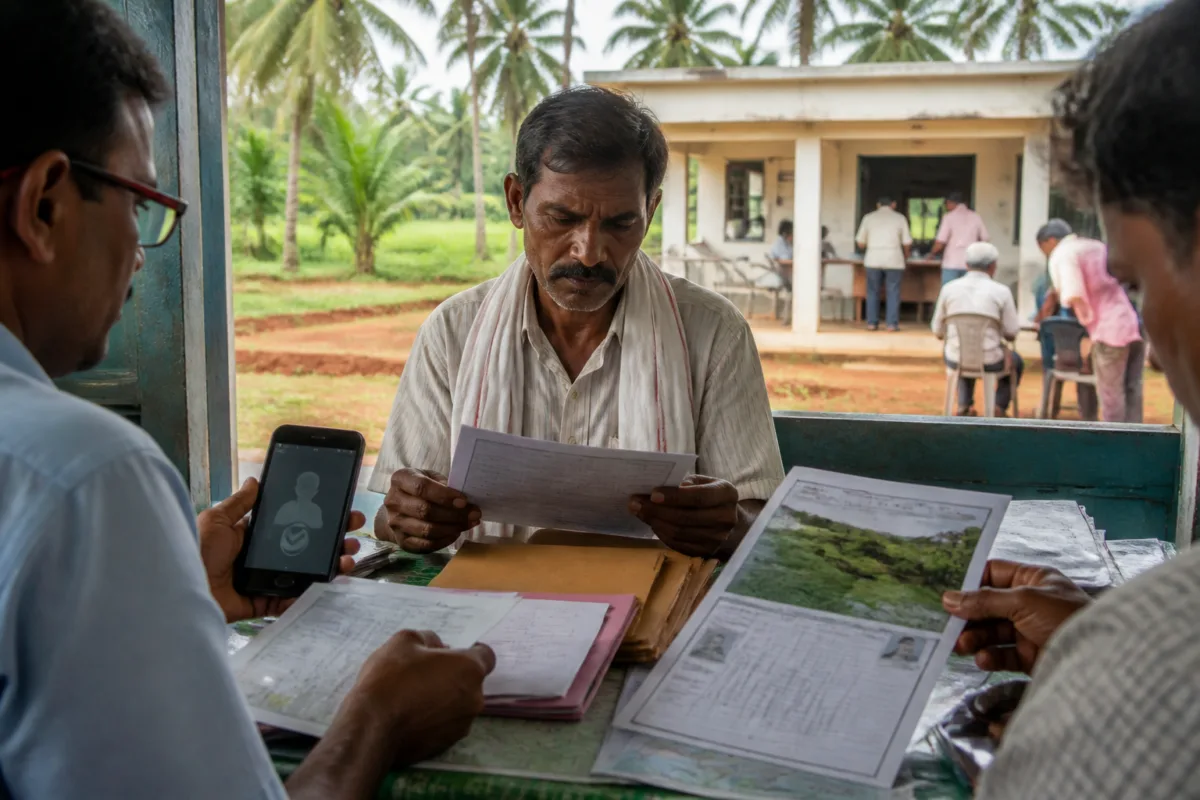
Sindhudurg’s farmer debt-relief programme has delivered Rs 14.40 crore to 2,758 farmers, but a further 1,556 e-KYC cases remain pending and 1,062 eligible farmers have no Farmer ID. The figures reveal that the scheme’s delivery problem is not limited to delayed verification: it is also tied to how land ownership and cultivation are recorded in official systems.
The farmers excluded by the Farmer ID condition include women farmers, heirs cultivating land after obtaining consent from family members, and cultivators working on temple endowment and other assigned lands. In many of these cases, the farmer’s name is not recorded in the land record known as the seven-twelve extract, preventing registration for a Farmer ID.
The issue matters because a digital identity intended to streamline access to agricultural schemes is functioning as an eligibility gate. Farmers who cultivate land or have borrowed for cultivation but do not appear as recorded landholders can be separated from the benefits of a debt-relief programme, even when their loans are included in the eligible list.
According to figures made available by the Sindhudurg District Deputy Registrar of Cooperative Societies’ office, 6,370 farmers were uploaded to the debt-relief portal. Of these, 5,397 were found eligible for Aadhaar authentication. The eligible group included 3,474 borrowers from development and district cooperative banks and 1,923 borrowers from nationalised and rural banks.
The numbers show that the programme has moved through several different administrative filters. First, borrowers had to appear in the uploaded list. They then had to qualify for Aadhaar authentication, complete e-KYC and, in the cases now under question, possess a Farmer ID. Each stage is designed to establish identity and eligibility, but the cumulative process creates a separate risk: farmers can clear one filter and still be stopped by another requirement linked to land records.
The latest district figures record 3,260 completed e-KYC cases and 1,556 pending cases. Separately, 1,062 farmers were reported to be without Farmer IDs. The report does not establish how many of these categories overlap. That distinction is important because the total number of affected farmers cannot be calculated simply by adding the pending e-KYC and missing Farmer ID figures.
Payments have been made in three instalments. On 7 August, 1,569 farmers received a combined Rs 7.77 crore. On 24 August, another 929 farmers received Rs 5.50 crore. On 1 October, 260 farmers received Rs 1.12 crore. Together, 2,758 farmers received Rs 14.40 crore.
The distribution was split between cooperative and other banking channels. Development and district banks credited Rs 8.84 crore to the loan accounts of 2,127 farmers. Nationalised and rural banks credited Rs 5.56 crore to the accounts of 631 farmers. These figures indicate that the relief mechanism is operating through multiple institutional channels, while the unresolved cases are concentrated at the intersection of banking records, identity authentication and land documentation.
The seven-twelve extract is central to the problem described in the report. Farmers whose names are absent from the record may still be cultivating land, but their relationship with the land is not represented in the form required for Farmer ID registration. The affected groups include cultivators of temple endowment land, farmers working assigned or grant-related land, heirs who borrowed on the basis of a consent letter, and small farmers cultivating land under an oral arrangement.
This creates a structural mismatch between agricultural activity and formal land documentation. A person may be economically dependent on cultivation and may have obtained a crop loan, while the administrative system continues to recognise another person, an institution or no current cultivator as the relevant recorded holder. When a welfare programme relies on the recorded land relationship without a parallel mechanism to recognise actual cultivators, the documentation gap becomes a barrier to relief.
Women farmers are among those identified as affected. The report does not provide a gender-wise breakdown, so it is not possible to quantify the number of women excluded. However, their inclusion in the list of groups without Farmer IDs shows that the problem is not confined to a narrow category of disputed land. It also involves the way family cultivation, inheritance and borrowing arrangements are documented.
The same applies to heirs of farmers. Where an heir cultivates land but the formal record has not been updated, the person may be the active farmer without being the recorded landholder. A consent letter can support the borrowing relationship, but it does not necessarily alter the land record or create eligibility for the digital identity required by the relief system.
The case of temple endowment land raises a related administrative question. Cultivators may work such land over time, but their rights or permissions may not appear in the same form as private ownership. The report says that a larger number of farmers cultivating temple endowment and assigned lands are among those facing difficulty because their names are not included in the seven-twelve extract.
The Sindhudurg District Central Cooperative Bank has sought a change in the implementation approach. Its chairperson, Manisha Dalvi, said that a request had been made through Guardian Minister Nitesh Rane to Revenue Minister Chandrashekhar Bawankule, asking that the Farmer ID not be made mandatory for debt relief. The report does not state whether the request has been accepted or whether an alternative verification process has been notified.
That unresolved policy response is significant. Removing the Farmer ID requirement entirely would address the immediate barrier identified in the report, but it would also leave open the question of how authorities would verify the farmer, the loan and the cultivation relationship. The supplied report does not specify any replacement mechanism. It therefore establishes the exclusion problem, but not the administrative solution.
The case also shows why the success of a welfare scheme cannot be measured only by the amount disbursed. Rs 14.40 crore has reached 2,758 farmers, demonstrating that the payment system has delivered benefits to a substantial portion of the eligible list. At the same time, 1,556 e-KYC cases remain pending and 1,062 farmers lack the identity document required by the process. The two outcomes exist together: a programme can make significant payments while leaving a defined group outside its final stage.
For citizens, the practical consequence is a delay between being listed as eligible and receiving relief. A farmer quoted in the report, Rama Dhondu Gawankar of Lore village in Vaibhavwadi taluka, said that his name appeared on the debt-relief list and that Rs 30,470 was due, but that he had not yet received the benefit despite Aadhaar linkage. His case illustrates the difference between inclusion in a database and completion of payment.
For administrators, the challenge is to reconcile three records: the bank’s loan account, the identity verification record and the land or cultivation record. The report indicates that these systems are not aligned for every farmer. The missing Farmer ID is not presented as evidence that the farmers do not cultivate land; it is a sign that their cultivation or inheritance arrangement is not captured in the format required by the digital programme.
The evidence available from Sindhudurg therefore points to a design issue in benefit delivery. Digital identification can reduce duplication and support targeted payments, but it cannot by itself resolve informal cultivation, delayed inheritance updates, consent-based borrowing or institutional land arrangements. Where these conditions are common, a single land-linked identity requirement can reproduce the exclusions already present in the underlying records.
The next steps remain with the authorities responsible for the debt-relief programme, revenue records and banking verification. The immediate questions are whether the Farmer ID requirement will be relaxed, how the 1,556 pending e-KYC cases will be cleared, whether the 1,062 farmers without Farmer IDs will receive an alternative route, and whether the government will publish a revised process for women farmers, heirs and cultivators of temple or assigned lands. Until those decisions are recorded, the district’s payment figures will continue to show both progress and a documentation gap that the relief programme has not yet resolved.

