


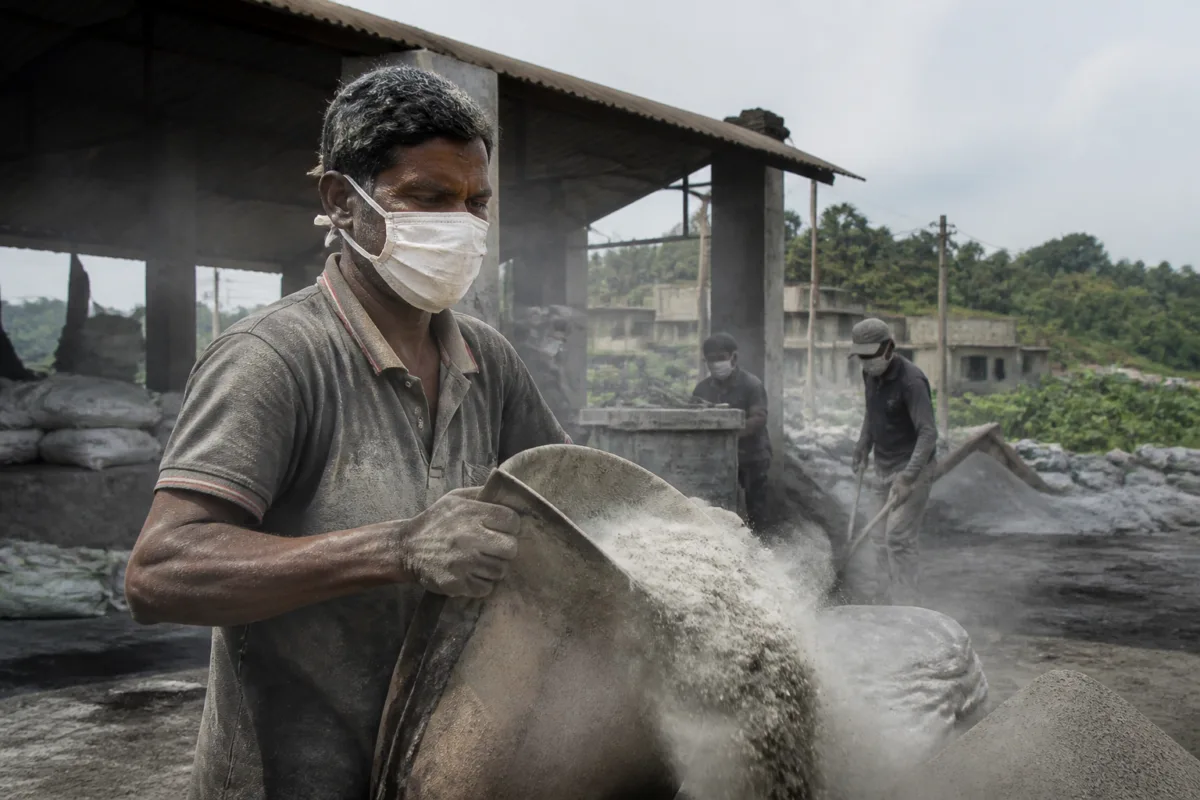
Silicosis compensation in Jharkhand has become a test of whether India’s occupational health and welfare systems can identify workers whose illness is linked to industrial exposure. For 22 years, Jamshedpur-based activist Samit Kumar Carr has documented suspected silicosis cases among workers in the ramming mass industry and pursued compensation, pensions and rehabilitation for affected families across Jharkhand and neighbouring West Bengal.
Carr, 71, is the founder and general secretary of the Occupational Safety and Health Association of Jharkhand, or OSHAJ. According to figures he provided, the organisation identified more than 3,000 suspected patients between 2003 and 2025. Of these, 2,158 suspected cases involved ramming mass workers. Yet only 86 cases—52 in Jharkhand and 34 in West Bengal—have been officially recognised for compensation, he said.
The difference between suspected cases and officially recognised cases is the central institutional problem revealed by the campaign. It does not establish how many workers have silicosis, because the suspected-case figures and recognition figures come from different stages of documentation and official assessment. But it does show how many workers can remain outside the compensation system when diagnosis, certification and proof of employment do not align.
The ramming mass industry is the common occupational setting in the cases documented by OSHAJ. Carr has followed affected workers through parts of Jharkhand’s tribal belt, including Chandil, Chaibasa, Dumaria, Gurabandha and Dhalbhumgarh. The cases span East Singhbhum, West Singhbhum and Seraikela-Kharsawan districts in Kolhan, as well as Jhargram in West Bengal.
Silica exposure is difficult to convert into an administrative claim when workers lack a recognised diagnosis or a clear employment record. Carr said workers exposed to silica dust are often treated for tuberculosis, even though tuberculosis and silicosis are distinct diseases and can occur together. The report notes that national tuberculosis guidance recommends occupational-history screening and evaluation for silicosis among exposed patients. The practical question is whether that guidance consistently results in a formal diagnosis and a compensation claim.
Carr’s demand is for a clear definition of silicosis and a standard diagnostic process. “We need a clear definition and a standard diagnostic process so genuine victims are identified and become eligible for compensation and welfare schemes,” he said. Without a common process, cases may depend on where a worker is examined, whether occupational exposure is recorded, and whether the worker can produce documents connecting the illness to an employer or industrial activity.
This creates a gap between public health and labour administration. A patient may enter the health system because of respiratory illness, while compensation requires evidence of occupational exposure, diagnosis and responsibility. If those records are not connected, the worker’s illness can remain a medical problem without becoming an occupational injury recognised by the state.
The problem is especially difficult in the unorganised sector. Carr has asked the government to screen tuberculosis patients with a history of silica exposure, register workers and link worker registration to factory licences. He has also sought safeguards for workers in informal employment, where responsibility for exposure can be difficult to establish. These demands point to a registration problem as much as a diagnostic one: workers who are not recorded before illness may struggle to prove where and how exposure occurred after they become sick.
The proposed link between worker registration and factory licensing would place occupational exposure within the regulatory chain that already governs industrial operations. The supplied report does not establish whether such a system currently exists in the affected areas or whether any government has accepted the proposal. It does, however, show the administrative weakness that Carr believes the system must address: worker records, workplace regulation, health screening and welfare eligibility are not functioning as a single continuous process for many affected people.
The compensation figures also illustrate the importance of transparent official records. Carr said OSHAJ’s campaign helped secure more than Rs 13.5 crore in compensation and welfare assistance. OSHAJ’s website places the figure at more than Rs 15 crore. The report says the amount could not be independently verified. The difference is not enough to determine the overall impact of the campaign, but it makes clear that publicly accessible case-level and scheme-level records would be necessary to establish how many families received compensation, under which provisions and through which authorities.
NHRC records show that OSHAJ began pursuing silicosis-related cases before the commission in 2007. This places the campaign within a longer institutional history rather than a recent advocacy effort. The persistence of the issue over nearly two decades also suggests that bringing cases before a rights commission has not, by itself, resolved the underlying questions of diagnosis, registration and rehabilitation.
The campaign’s own capacity is limited. Carr said OSHAJ currently has seven field volunteers and four paid staff members. He estimates that he has spent nearly Rs 45 lakh of his own money on documentation and legal follow-up. These figures describe the scale of civil-society involvement, but they also expose a structural dependence on private effort to perform functions that are closely connected to public health, labour inspection and welfare administration.
A field organisation with 11 staff members cannot plausibly replace a permanent state system for identifying exposed workers across multiple districts and two states. Nor can individual legal follow-up resolve a problem that begins at the workplace and continues through hospitals, diagnostic services, labour departments and compensation authorities. The organisation’s work may bring cases into view, but the recognition process still depends on public institutions accepting and acting on the evidence.
The geography of the cases matters. The affected locations are spread across rural and semi-rural parts of Jharkhand’s tribal belt and extend into West Bengal. That distribution can make access to specialised diagnosis, legal assistance and government offices more difficult, particularly when workers are employed informally or move between workplaces. The supplied report does not provide travel distances, hospital capacity or district-level processing data, so the precise effect of geography cannot be quantified here. It does show that this is not a single-factory dispute confined to one urban site.
Jamshedpur provides the campaign’s institutional base, but the issue is regional and industrial. The cities and towns connected to the affected districts depend on networks of factories, contractors, transporters and informal workers that are often less visible than the final industrial product. Occupational exposure is therefore part of the built environment’s production system: the materials and industrial processes used to support development can impose health costs on workers when safeguards and records fail.
The case also raises a question about the meaning of official recognition. Recognition is not simply a medical conclusion. It is the point at which a health condition becomes legible to a welfare and legal system. A worker may have symptoms, a history of dust exposure and a diagnosis that is recorded in a hospital, but still remain outside compensation if the evidence is not collected in the form required by the responsible authority.
That is why the gap between 2,158 suspected ramming mass worker cases and 86 officially recognised cases deserves scrutiny without being treated as proof that every suspected case is confirmed silicosis. The figures cannot establish the true disease burden. They can establish that a large number of cases remain at some stage before official recognition, and that the pathway from suspicion to compensation is narrow.
The available evidence points to three connected policy tasks: recognising occupational exposure during clinical screening, maintaining a reliable register of workers and workplaces, and creating a consistent process for diagnosis and compensation. Carr has specifically called for screening among tuberculosis patients with silica exposure, worker registration and links between registration and factory licences. The report does not state whether these measures have been adopted or provide a government response to the demands.
What can be confirmed is that OSHAJ has pursued cases before the NHRC since at least 2007, that the organisation reports thousands of suspected cases, and that only a small number have been officially recognised according to Carr’s account. The compensation totals remain unverified, while the need for a standard diagnostic process is the principal concern identified by the campaign.
The larger urban question is whether industrial growth can be administered without making workers’ health invisible. Silicosis compensation depends on more than a payment after illness. It depends on whether the system records workers before exposure becomes a claim, whether doctors are equipped to connect illness with occupation, and whether authorities can assign responsibility when employment is informal. The next significant developments would be any official response to the proposed screening and registration measures, clarification of the compensation figures, and evidence of a standard diagnostic pathway across the affected districts.

