


The renewed excavation at Ujjain’s Vaishya Tekri is not simply a search for a buried Buddhist monument. It is an attempt to resolve a 90-year-old break in the archaeological record of one of central India’s oldest urban centres, using modern surveying methods before the ground is disturbed again.
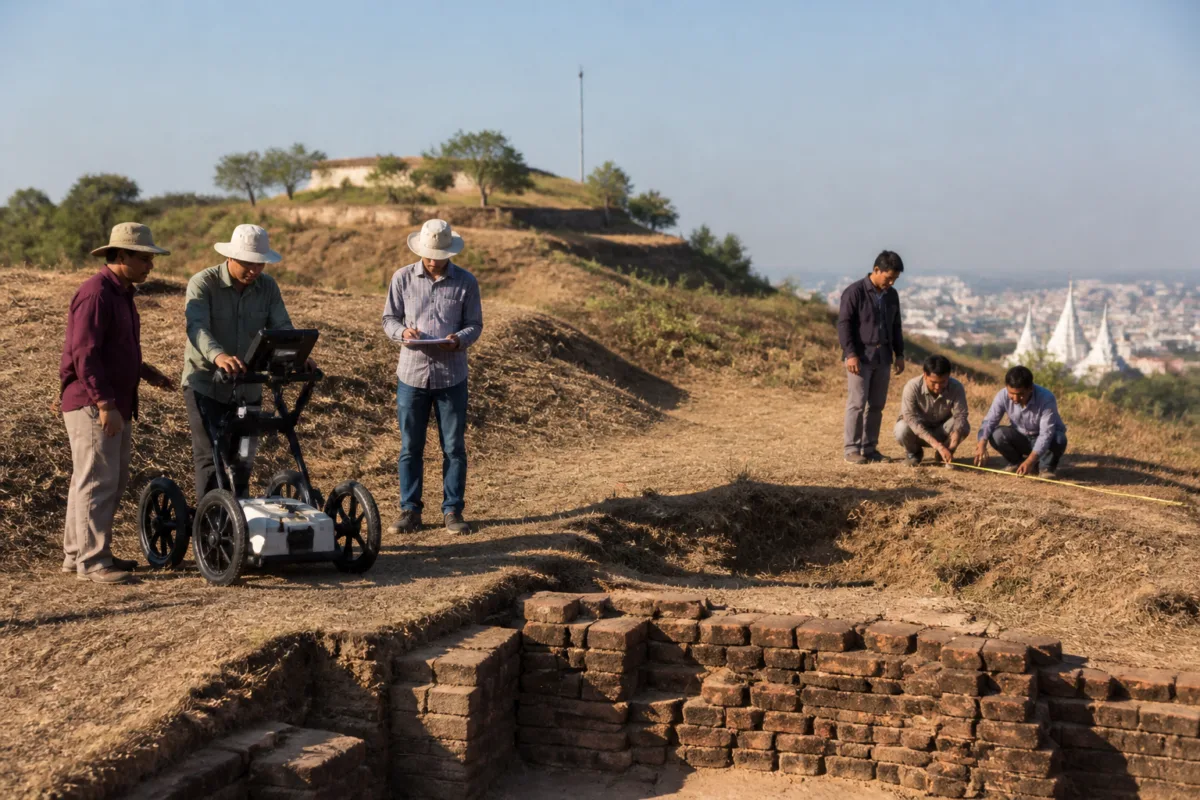
The Archaeological Survey of India has approved fresh excavation at the site, where an earlier investigation in 1939 was abandoned after a reported gas leak caused several labourers to lose consciousness. The new project will be led by superintending archaeologist Shivakant Bajpai and carried out jointly by the Madhya Pradesh state archaeology department and the local administration. A recent Ground-Penetrating Radar survey by officials, archaeologists and technical experts from Maulana Azad National Institute of Technology has been used to identify possible buried structures before digging begins.
That sequence matters. The first excavation was conducted through radiating trenches and exposed parts of a principal stupa along with two smaller stupas. But it did not establish the complete plan or elevation of the main structure. The renewed effort therefore begins with a problem that is both archaeological and administrative: how to investigate a large, fragile and partially eroded site without repeating the limitations of the earlier intervention.
Historical records give the site its exceptional scale. The Annual Administration Report of the archaeological department of Gwalior State for 1938-39 described the monument as “perhaps the biggest known” stupa. It recorded a diameter of approximately 350 feet and a height of at least 100 feet. By comparison, the Great Stupa at Sanchi is described as measuring around 120 feet across and 54 feet in height. These figures, if confirmed through excavation and reconstruction, would place Vaishya Tekri among the most significant Buddhist architectural remains associated with the Mauryan period.
The comparison with Sanchi is useful, but it is not yet a final archaeological conclusion. The dimensions in the historical report describe what investigators believed they were seeing at the time, while the new excavation has yet to establish the monument’s full footprint, construction phases or original elevation. Much of the outer brick facing has reportedly disappeared, and erosion appears to have removed parts of the upper structure. The task now is to separate surviving physical evidence from descriptions and interpretations carried forward over generations.
The site has been dated to the Mauryan period, around the third century BCE, nearly 2,300 years ago. Earlier work recovered a punch-marked coin and an Avanti coin, findings cited as support for the site’s antiquity. The 1938-39 report also noted a construction technique it called “peculiar construction not met with anywhere else”. The core was made of tightly rammed local murum, while the exterior was faced with large bricks, some more than 22 inches long, laid in mud mortar.
Those details make the excavation important beyond the question of size. A monument’s construction method can reveal how materials were sourced, how labour was organised and how architectural knowledge moved across regions. At Vaishya Tekri, however, the available evidence remains partial. The source material does not establish whether the unusual building technique was unique to the wider Mauryan world or simply appeared unusual to the investigators who documented it. That is one of the questions a layer-by-layer excavation may clarify.
The site has also accumulated several historical associations that remain unconfirmed. The report suggested that the monument could be among the stupas attributed to Emperor Ashoka, but this was never conclusively established. An interpretation cited by Bajpai links its construction to the period when Ashoka was governor of Ujjain and possibly to the influence of his wife Devi, who is described as the daughter of a prominent merchant chief of Vidisha. The merchant connection has been associated with the name Vaishya Tekri.
Other scholars have connected the site with Kanakgiri Vihara, mentioned in ancient Buddhist literature, and with a large Buddhist monument described by the Chinese traveller Hiuen Tsang in his account of Ujjain. Neither connection has yet been confirmed by archaeological evidence. The excavation’s value will therefore lie partly in its ability to test these associations rather than simply repeat them. Artefacts, structural alignments, construction layers and their original context will be more decisive than historical resemblance alone.
The use of Ground-Penetrating Radar marks a significant change from the 1939 investigation. GPR uses high-frequency radio waves to detect variations beneath the ground without disturbing archaeological deposits. It cannot by itself provide a complete history of a monument, but it can help identify subsurface anomalies and narrow the areas where excavation is most likely to yield useful evidence. In a site where earlier trenches exposed only parts of the structure, that preliminary mapping can support a more targeted intervention.
This is also where the institutional design of the project becomes important. The ASI has provided approval, while the state archaeology department and local administration are responsible for carrying out the excavation and arranging local support. Ujjain divisional commissioner Asheesh Singh had earlier said the administration was prepared to provide assistance, including land-related support. The division of responsibilities indicates that archaeological discovery depends not only on specialist interpretation but also on access, logistics, land administration and coordination between different levels of government.
The project is part of Chief Minister Mohan Yadav’s flagship archaeological initiative to bring greater attention to the buried heritage of ancient Ujjain. The supplied evidence does not specify the excavation’s budget, completion date, conservation plan or arrangements for public access after the work. Those omissions are important because finding a monument and preserving it are separate administrative tasks. Excavation exposes material to weather, visitors and further deterioration, making decisions about conservation and site management as significant as the initial discovery.
Ujjain’s urban history gives the project a wider significance. The city is not being examined here as an isolated archaeological location, but as a place where religious, commercial and political histories may have intersected over long periods. The references to Buddhist institutions, Mauryan administration, merchant networks and later travel accounts suggest a layered urban landscape. Yet the source material does not establish the precise relationship between Vaishya Tekri and the wider settlement. That relationship will have to emerge from evidence recovered at the site and from the way the excavation is documented.
The available numbers also show why caution is necessary. A reported diameter of 350 feet is nearly three times the cited diameter of the Great Stupa at Sanchi, while a height of at least 100 feet is almost twice Sanchi’s cited height. These comparisons create a powerful historical proposition, but they cannot substitute for a complete survey. The earlier excavation did not establish the full plan, and erosion has altered the mound. The new work must determine which dimensions belong to the original monument, which relate to later deposits and how much of the structure remains in place.
The central urban question is therefore not only whether Ujjain contains a stupa larger than Sanchi. It is whether public institutions can convert a compelling historical claim into a transparent, scientifically documented and conserved heritage asset. The Vaishya Tekri investigation has already moved beyond the circumstances of the abandoned 1939 dig through the use of non-invasive surveying and a coordinated excavation team. Its credibility will now depend on how clearly the project records its methods, findings and uncertainties.
The evidence confirms that ASI approval has reopened the search for a major Mauryan-period Buddhist monument at Vaishya Tekri, but it does not yet confirm the stupa’s complete dimensions, Ashokan association, links to Kanakgiri Vihara or identification with the monument described by Hiuen Tsang. The developments to watch are the start of excavation, the structural evidence found beneath the mound, the chronology established from material in context and the conservation and public-management decisions that follow any discovery.

