


The death of 60-year-old civic worker Vijay Sukharu Sapte, who was allegedly mistaken for a wild boar and shot inside Sanjay Gandhi National Park (SGNP) on October 20, has exposed a problem that Mumbai’s urban expansion tends to hide: hunting continues inside one of India’s most prominent metropolitan forests. The incident is being investigated by the forest department, but the evidence described by officials and wildlife experts points to a wider challenge involving illegal demand, difficult terrain, limited surveillance and settlements located within or near the forest.
A preliminary forest department investigation found Sapte’s body around 450 metres inside the forest, near the Yeoor Hills range towards Thane and adjoining a creek. Officials also suspect that he may have been part of a group of hunters involved in the shooting. The circumstances remain part of the investigation, but the location has particular relevance to how hunting takes place. Forest officials said animals often approach water sources to drink, making them easier to track.
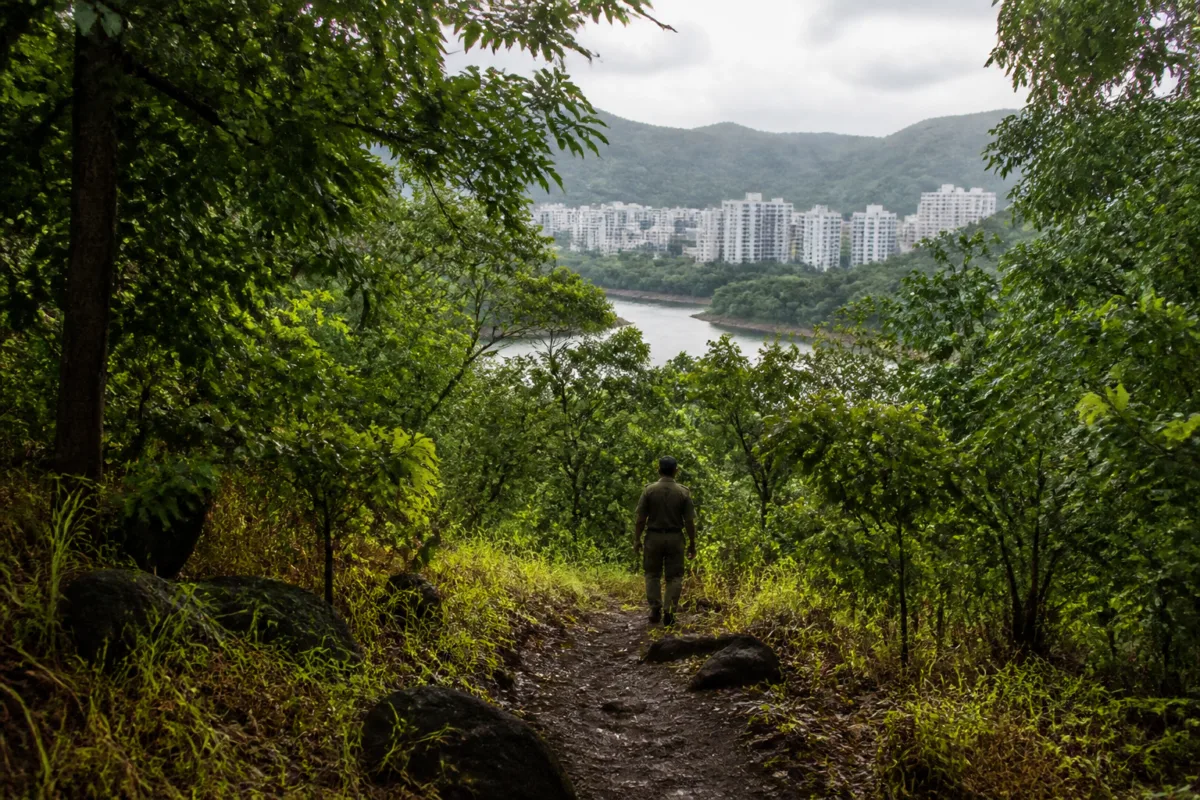
The incident therefore cannot be understood only as a shooting case. It occurred in a landscape where a protected forest, expanding settlements, access routes and human activity meet. SGNP covers 103 square kilometres and includes hill ranges, creeks and stretches that officials describe as difficult to access. In a dense metropolitan region, that combination creates a surveillance problem that is physical as well as administrative: the forest is large, uneven and connected to urban areas, but the department cannot monitor every part of it continuously.
The park’s scale is significant because enforcement depends on access and presence. A force of 433 Maharashtra Security Force personnel currently patrols SGNP, according to the report. Yet officials said the terrain and the size of the forest limit effective coverage. A senior forest department official said some parts remain inaccessible to the department and that animals frequently move beyond forest boundaries. Such movement complicates enforcement because wildlife does not follow administrative jurisdictions, while poachers can track animals across forest and adjoining areas.
This is the central urban contradiction. SGNP is embedded in a major metropolitan region, but its protection cannot be managed like a fully enclosed urban facility. Its edges meet neighbourhoods, hamlets, creeks and settlements. Human access is not limited to formal entry points, and animal movement may extend beyond the areas that forest staff can routinely patrol. The resulting gaps create opportunities for hunting while also making responsibility harder to define when activity crosses the forest boundary.
The demand side of the problem is equally important. Forest officials said illegal markets for wild animal meat remain a key driver of hunting, including the killing of wild boars, deer and hares. Pawan Sharma, honorary wildlife warden of Mumbai and director of the Resqink Association for Wildlife Welfare, told The Indian Express that these animals are preferred because they are comparatively easy to spot and hunt. He said they do not generally attack hunters and occur in relatively high numbers, making them easier targets.
Sharma also said some poachers may preserve skeleton remains as trophies. The report does not establish the scale of this market, but it identifies an economic chain behind the hunting: animals are tracked, killed and moved towards illegal demand. This shifts the policy question from isolated trespassing to enforcement across access, sale and consumption. Patrols inside the forest address only one part of that chain.
The record cited in the report indicates that the problem predates the October shooting. In March, forest officials found that macaques were being shot with bows and arrows in Thane’s Upvan area. In 2019, carcasses of deer and leopards were found in separate incidents inside SGNP. The following year, the forest department launched an anti-snare drive after traps set for wild animals were discovered at multiple locations. Several live animal traps were also found at different sites in 2020 and 2021.
These incidents suggest that hunting pressure has appeared through different methods and in different parts of the urban forest landscape. Shooting, bows and arrows and snares each demand different forms of detection and response. An anti-snare drive reportedly reduced the problem, but wildlife expert and forest department accounts indicate that poaching continued. The pattern is therefore not of a single recurring tactic, but of a persistent enforcement challenge adapting to the conditions of the forest.
The Wildlife (Protection) Act, 1972 prohibits hunting protected wild animals. The legal prohibition establishes the formal framework, but the report shows the limits of law when detection is difficult and the protected area has porous edges. Enforcement requires not only patrols but also information about animal movement, access routes, traps, weapons and illegal markets. The available account does not provide figures for arrests, prosecutions or convictions, so it is not possible to assess from the supplied evidence how effectively cases move through the justice system.
The presence of hamlets and alleged encroachments within the forest adds another institutional layer. Officials alleged that some residents provide information about animal movements or help poachers gain access. At the same time, the department has started sensitisation camps in villages to encourage cooperation. The senior official said many people remain unaware that killing animals is a crime under the Wildlife Protection Act.
This response reflects the difficulty of treating communities around protected forests only as enforcement subjects. The department’s stated approach combines policing with awareness and cooperation. However, the supplied material does not establish how many camps have been held, how participation is measured or whether the programme has changed reporting or enforcement outcomes. Those gaps matter because community intelligence can be crucial in a terrain where official patrols cannot cover every route.
The park’s relationship with the surrounding city also complicates the idea of a fixed boundary. Wildlife may move between forest areas and adjoining urban or semi-urban spaces, including the Yeoor Hills and Upvan areas mentioned in the report. When animals leave the core forest, monitoring becomes dependent on coordination between forest officials, local authorities, security personnel and residents. The report identifies the jurisdictional problem but does not specify the mechanisms currently used to manage it.
The available numbers make the capacity question visible. SGNP’s 103 square kilometres must be patrolled by 433 Maharashtra Security Force personnel, while officials acknowledge that some areas remain inaccessible. These figures do not by themselves establish a staffing standard or prove that the force is inadequate. They do show the operational scale of the task: a large and varied forest inside a city, with surveillance requirements spread across hills, creeks, water sources and settlement edges.
The history described in the report also challenges the assumption that urban proximity automatically protects wildlife. Mumbai’s visibility, infrastructure and public attention may make major incidents more likely to be reported, and Sharma said such incidents are rare in Mumbai compared with Maharashtra’s interior regions. But rarity does not mean the threat is absent. The discovery of carcasses, traps and animals shot across multiple years indicates that the metropolitan forest remains exposed to illegal hunting even when the problem is largely invisible to most residents.
The deeper urban question is how a city governs a protected landscape that is neither isolated wilderness nor ordinary public land. SGNP performs ecological and spatial functions within a metropolitan region, but the report shows that its protection depends on institutions operating across difficult terrain and overlapping human geographies. Urban expansion increases contact between people and wildlife, while illegal demand creates incentives for access into the forest.
The October 20 shooting has brought that system into public view. What the supplied evidence confirms is that poaching has continued despite earlier anti-snare action, that illegal wildlife meat demand is identified by officials as a driver, and that patrol limitations remain a recognised problem. What remains unclear are the full circumstances of Sapte’s death, the scale of the illegal market, the number of active hunting routes and the outcomes of previous enforcement cases. Those are the facts that future investigations and official updates will need to establish.

