


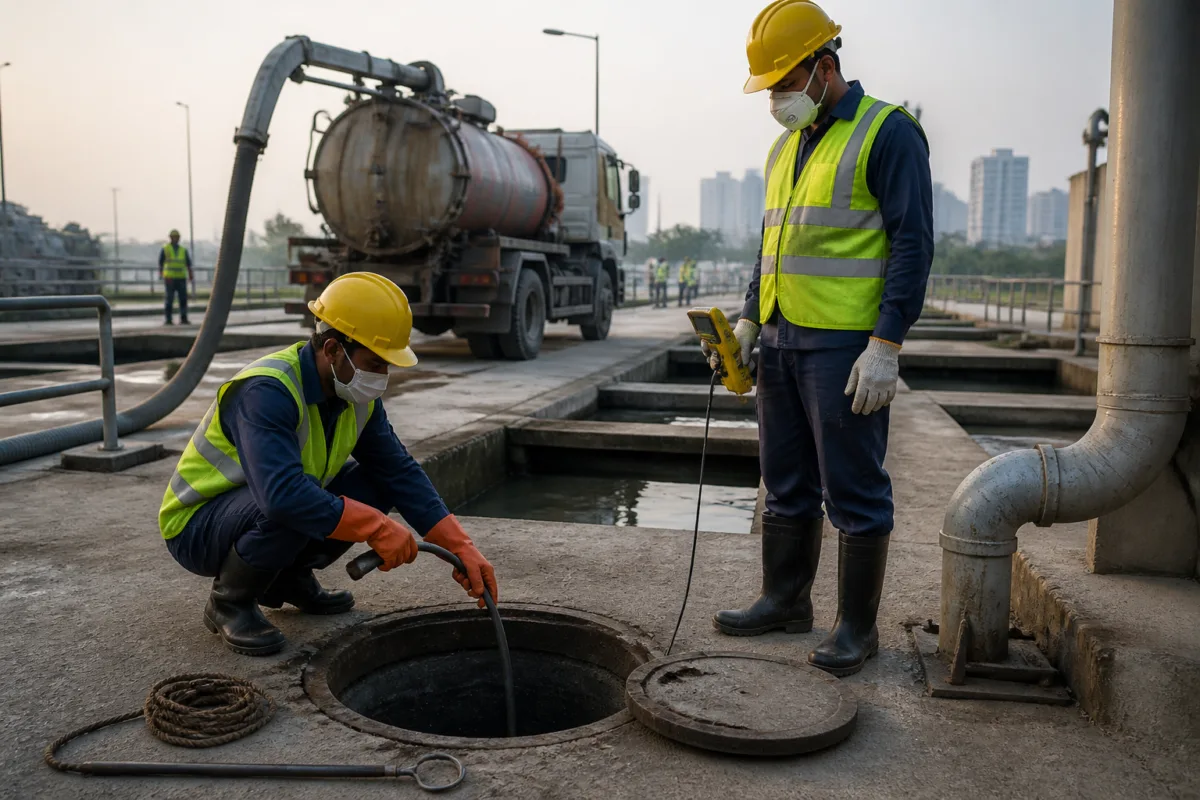
Sanitation workers in India have an average life expectancy of 63.8 years, 11.4 years lower than people in other occupations, according to a study released on World Toilet Day. The report attributes 30.2 per cent of sanitation workers’ deaths to exposure to poisonous gases and toxic substances.
Titled “Bridging the Life Expectancy Gap of Sanitation Workers in India”, the study was released by Reckitt, Jagran Initiative and the International Institute for Population Sciences. It also says sanitation workers live 9.6 years less than agricultural and other workers with similar levels of education and income.
The findings place occupational safety at the centre of sanitation service delivery. Workers responsible for maintaining toilets, sewerage systems and other essential public-health services can face serious risks when hazardous cleaning and maintenance work is performed without adequate equipment, mechanisation or monitoring. The source report specifically recommends reducing manual cleaning, installing sensors that can detect poisonous gases and expanding health-insurance coverage.
The study estimates that the life-expectancy gap causes an annual economic loss equivalent to about 1.03 per cent of India’s gross domestic product. It also reports that only 1 per cent of sanitation workers contribute to health insurance schemes, indicating limited financial protection against occupational illness and injury.
Gaurav Jain, executive vice-president for South Asia at Reckitt, said sanitation workers play an important role in protecting public health but face serious health and safety risks during their work. He said training must be supported by stronger technology and social security. Sameer Gupta, treasurer of Jagran Initiative, said sanitation workers’ own health challenges are often overlooked despite their importance to community health and wellbeing.
The report says the Harpic World Toilet College has provided 16 hours of training to 250,000 sanitation workers so far. The training covers the use of safety equipment, health and safe working practices.
Training alone, however, is not the only measure identified in the study. Its recommendations combine mechanisation, gas-detection technology and wider insurance coverage. Together, these measures point to a broader requirement for sanitation systems: worker safety needs to be built into the design and operation of cleaning services, rather than treated as an additional intervention after accidents or exposure occur.
The report’s findings also connect public sanitation with labour protection. Mechanisation can reduce dependence on manual cleaning, while sensors may help identify hazardous conditions before workers enter confined or contaminated spaces. Insurance can provide financial support when workers face health consequences, although the study’s reported participation figure shows the protection gap remains substantial.
For cities and other local authorities, the issue is therefore not limited to the availability of sanitation services. It also concerns how those services are procured, supervised and equipped, and whether the workers performing them receive adequate safety training, protective equipment and social protection. The study calls for these elements to be strengthened together to narrow the life-expectancy gap.

