


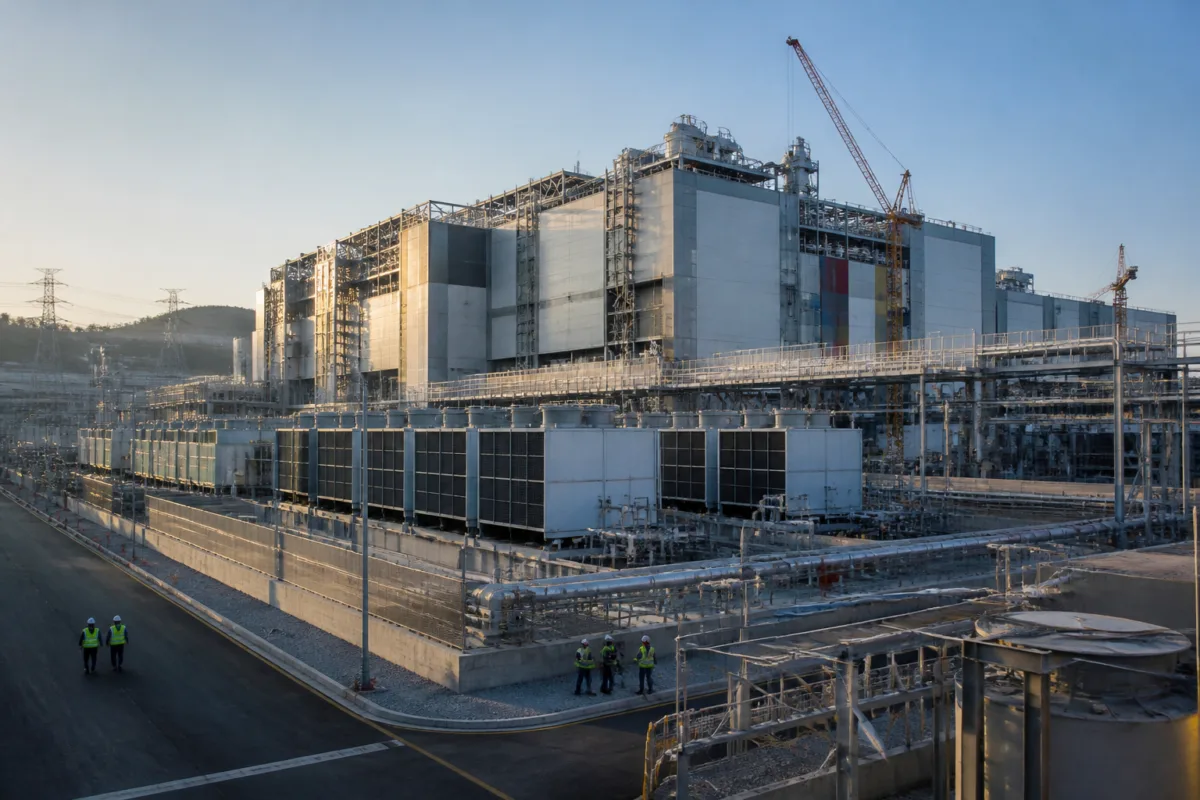
Samsung Electronics is approaching a landmark that says as much about the scale of the semiconductor cycle as it does about one company’s balance sheet. The South Korean chipmaker’s cash and cash equivalents are estimated to have reached 214.8 trillion won by the end of the third quarter, putting it on course to become the first company in the country to cross the 200 trillion won threshold. The more consequential part of the development is how that cash is expected to be used: to finance semiconductor factories, research and development, and a large shareholder-return programme at the same time.
The figures reported by Times of India, citing industry data and Yonhap news agency, show that Samsung’s cash position rose by 24.8 trillion won from 190 trillion won at the end of the previous quarter. It was almost double the 108.5 trillion won held at the end of the third quarter of 2025. Total assets also increased to 791.8 trillion won at the end of September, up 32.4 trillion won over three months.
That pace of accumulation matters because semiconductor manufacturing is an infrastructure-intensive business. The source report says Samsung expects investment in chipmaking infrastructure and research and development to exceed 100 trillion won this year, a historic high for the company. Of that amount, 84.4 trillion won is expected to be directed towards expanding memory-production facilities.
The numbers therefore describe more than corporate liquidity. They point to a large industrial expansion programme in which financial strength is being converted into physical production capacity and technical capability. Although the supplied material does not identify the locations, construction schedules or employment impact of these facilities, the scale of the proposed spending indicates that Samsung’s investment decisions will be organised around long-term manufacturing capacity rather than only near-term earnings.
The immediate financial trigger is the artificial intelligence-driven semiconductor boom. Samsung expects what it describes as a semiconductor supercycle to continue through next year, supported by ongoing investment in artificial intelligence and a crunch in memory supply. In this context, cash reserves provide the company with room to pursue capacity expansion while also meeting its stated commitments to shareholders.
That dual use of capital is the central tension in Samsung’s latest position. Market watchers cited in the report estimate that the company’s growing cash balance would be sufficient to cover the highest possible payout under its shareholder-return policy. Samsung had indicated that between 90 trillion won and 110 trillion won would be made available for shareholder returns in 2026. The company is expected to announce its shareholder policy for the coming year at a board meeting scheduled for January.
For industrial infrastructure, the significance lies in the fact that the proposed shareholder payouts and factory investments are not presented as mutually exclusive. Samsung’s cash position has grown sufficiently to support both, at least according to the estimates cited in the report. That gives the company flexibility at a time when chipmaking investment is rising to a historic level for the business.
The distinction between cash, total assets and investment commitments is important. Cash and cash equivalents are immediately available financial resources. Total assets include the wider value of the company’s holdings and therefore do not represent money that can automatically be deployed. The reported rise in both measures shows that Samsung’s balance sheet expanded during the quarter, but the figures alone do not establish how quickly cash will be converted into new factories, equipment or research facilities.
The investment estimate also needs to be read carefully. More than 100 trillion won in semiconductor infrastructure and research spending is expected this year, while 84.4 trillion won is expected to go towards memory-production expansion. The supplied material does not provide a project-by-project breakdown, identify the share of new construction versus equipment, or state whether the figure includes investments already committed. It does, however, establish that memory manufacturing is expected to absorb the largest portion of the planned spending.
That allocation reflects the market conditions described by the report. Artificial intelligence investment is supporting semiconductor demand, while a shortage of memory supply is strengthening the case for additional production capacity. Samsung’s expected spending is therefore tied to both demand growth and a supply constraint. The company is positioning its manufacturing system to respond to those conditions while the cycle remains favourable.
For cities and industrial regions, large manufacturing investments typically raise questions about land, utilities, logistics, labour and public infrastructure. The source material does not provide evidence on any of those local effects in Samsung’s case, so their scale and distribution cannot be established here. What can be established is that the financial milestone is directly linked to a planned expansion of the physical and research infrastructure that supports semiconductor production.
The institutional structure behind the spending is also visible in the company’s sequencing of decisions. Samsung’s board is expected to decide its shareholder policy for the coming year in January, while the company is already preparing for semiconductor investment above 100 trillion won this year. Capital allocation is therefore being managed through two linked channels: board-approved shareholder returns and operational investment in production and research.
This makes the cash milestone less a story about idle reserves than a measure of optionality. The company has accumulated enough liquidity to consider a large payout while maintaining a historically high investment programme. Whether that flexibility results in faster capacity expansion, greater research spending or a different balance between investors and industrial investment will depend on decisions still to be announced.
The evidence also shows why the semiconductor cycle has a built-environment dimension. A memory-production facility is not only a technology asset; it requires a substantial physical production system. Samsung’s reported allocation of 84.4 trillion won towards memory facilities places industrial construction and manufacturing capacity at the centre of the company’s response to artificial intelligence-led demand. The details of those facilities remain unspecified in the supplied material, but their planned funding is clear.
Samsung’s balance sheet thus offers a snapshot of how an industrial company can respond when demand, supply constraints and technology investment reinforce one another. Rising cash reserves increase financial resilience. Higher capital expenditure converts that resilience into production and research capacity. Shareholder returns distribute part of the gains back to investors. The balance among these uses will determine the practical meaning of the 200 trillion won milestone.
What the current evidence confirms is that Samsung’s cash and total assets rose sharply, that the company expects semiconductor investment to exceed 100 trillion won, and that memory-production expansion is expected to receive 84.4 trillion won. It also confirms a planned shareholder-return range of 90 trillion won to 110 trillion won for 2026. What remains uncertain is the location, timing and implementation of the planned facilities, as well as the final shareholder policy to be considered in January. Those decisions will show whether Samsung’s unprecedented cash position becomes primarily a financial milestone or the funding base for an even larger semiconductor infrastructure buildout.

