


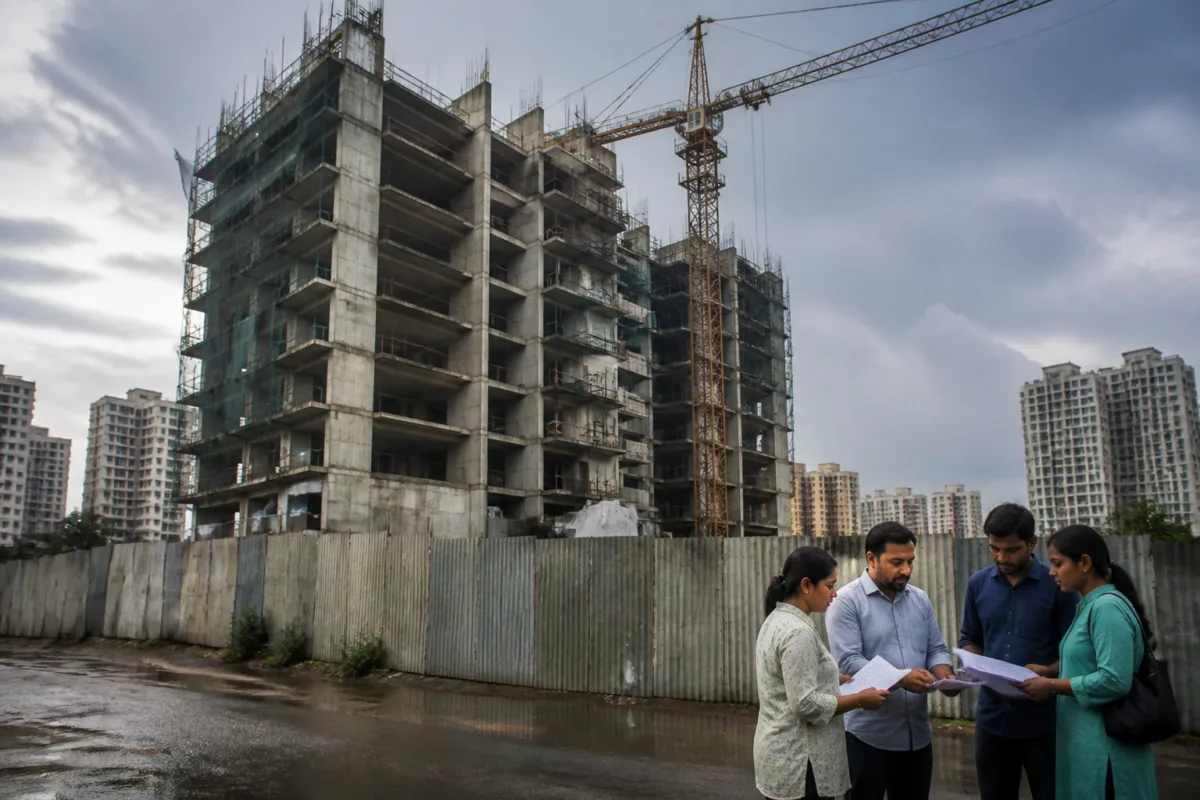
As the Real Estate Regulation and Development Act, 2016 approaches its 10-year milestone, a report by the Forum for Peoples Collective Efforts has reopened a question that sits at the centre of India’s housing market: can a regulatory system protect homebuyers if it can register projects but cannot reliably deliver timely relief when those projects stall?
In a representation to Prime Minister Narendra Modi, FPCE president Abhay Upadhyay has argued that RERA’s original promise remains substantially unfulfilled. The forum wants the law to be replaced with a dedicated Real Estate Homebuyer Protection Act, with greater emphasis on promoter accountability, enforcement and grievance redressal. Its intervention is significant not simply because it asks for amendments, but because it challenges the institutional balance built into the existing law.
FPCE’s 192-page report, titled RERA Extension Abuse: How Regulatory Failure Is Betraying India’s Homebuyers, estimates that Rs 12.44 lakh crore is trapped in delayed housing projects across seven states. The report says the delays affect approximately 27.6 lakh families and that the amount is equivalent to around 3.8 per cent of India’s annual GDP. These are estimates advanced by the forum using official data from Haryana, Karnataka, Maharashtra, Uttar Pradesh, West Bengal, Tamil Nadu and Telangana; they are not presented in the supplied material as a government-wide assessment.
Even with that qualification, the figures describe the scale of the problem in terms that are more meaningful than the number of registered projects. A project can be visible inside a formal regulatory system while a family’s savings remain locked, a promised possession date moves repeatedly and the cost of alternative accommodation continues to accumulate. The central distinction is between regulatory registration and practical protection. FPCE’s argument is that RERA has achieved the first more effectively than the second.
The law’s institutional design is at the heart of the criticism. FPCE says RERA authorities are expected to promote the real estate sector while also regulating it and protecting consumers. In the forum’s view, these responsibilities can pull the regulator in different directions. Promotion encourages the expansion and functioning of the sector; regulation requires scrutiny, sanctions and intervention when promoters default. The report argues that combining both roles in a consumer-facing framework can weaken the priority given to homebuyer relief.
This conflict is also connected to the division of authority around a housing project. According to the report, RERA authorities do not directly control local building approvals, stamp duty or completion certificates. Those functions rest with state-level development agencies, including bodies such as the Mumbai Metropolitan Region Development Authority, NOIDA and the Chennai Metropolitan Development Authority. This division may be administratively familiar, but it creates a practical problem for buyers: the authority that hears a grievance may not control every approval or document needed to complete the project.
For a homebuyer, these institutional boundaries are difficult to navigate. A delayed project may involve the promoter, the RERA authority, the local planning or development agency, the authority responsible for completion certification and, in some cases, the courts. FPCE alleges that this arrangement leaves buyers struggling to obtain refunds, compensation and enforcement of orders. The issue is therefore not only whether a buyer can file a complaint, but whether the complaint can move through the system to a final, enforceable remedy.
FPCE has identified several recurring failures. It alleges the diversion of project funds, violations of construction-linked payment schedules, arbitrary extensions of project deadlines and the handing over of homes without mandatory occupancy certificates. Each allegation points to a different stage of the housing delivery chain. Fund diversion concerns the financial integrity of a project. Payment schedules affect the timing and risk carried by buyers. Extensions change the contractual expectation of delivery. Possession without an occupancy certificate raises questions about whether a building can lawfully and safely be occupied.
Taken together, these issues suggest that the effectiveness of a housing regulator cannot be measured only by the number of projects registered or complaints received. The harder test is whether the system can prevent funds from being used outside the project, identify delays before they become failures, penalise repeated non-compliance and secure a remedy that a buyer can actually use. The supplied report does not provide a consolidated assessment of performance on each of these measures, but its criticism is directed precisely at that gap between formal process and lived outcome.
The forum has also referred to judicial criticism of RERA authorities. It cited observations reportedly made by a Supreme Court Bench comprising Justices Surya Kant and Ujjal Bhuyan in September 2024, describing RERA benches as having become “rehabilitation centers for former bureaucrats who have frustrated the entire scheme of the Act”. FPCE also referred to remarks attributed to Chief Justice of India Surya Kant on February 12, 2026, in State of Himachal Pradesh v Naresh Sharma, which it said questioned whether the institution was providing effective relief to homebuyers.
These references matter because they shift the discussion from the intentions of the statute to the functioning of the institutions created under it. A law may contain protections on paper, but the quality of the authority, the speed of proceedings, the consistency of orders and the ability to enforce them determine what the law means in practice. The report’s use of judicial observations is part of its case that the weaknesses are not limited to individual projects or isolated administrative errors.
The question of extensions illustrates the tension particularly clearly. FPCE has questioned the contrast between extensions granted to developers during the Covid-19 pandemic and the West Asia crisis in 2026, and the delays faced by homebuyers seeking relief. The forum’s concern is not merely that extensions were granted, but that regulatory flexibility may be more accessible to promoters than effective remedies are to consumers. The supplied material does not establish how many extensions were granted, their legal basis or their effect across states. It does, however, identify the issue as a central element of FPCE’s reform argument.
FPCE’s proposed response is structural. It wants the promotion of real estate removed from the consumer-facing regulatory law and placed under development ministries and urban agencies. It has proposed renaming and reenacting RERA as a Real Estate Homebuyer Protection Act, transferring administration from housing bodies to a consumer-protection framework such as the Department of Consumer Affairs, and introducing strict penalties for regulatory authorities and chairpersons who fail to enforce orders, grant routine project extensions or overlook repeated developer defaults.
These proposals would change more than the name of the legislation. They would redefine the purpose of the regulatory framework. Under the existing arrangement described by FPCE, the regulator operates within the housing and real estate system while carrying a consumer-protection responsibility. The proposed model would place the buyer more explicitly at the centre and separate sector development from enforcement. Whether that would improve outcomes would depend on the precise division of powers, funding, staffing, appellate structure and enforcement mechanisms. Those details are not established in the supplied report.
The report also highlights a broader governance problem in urban housing: accountability is fragmented across institutions, while the financial and social consequences of delay are concentrated on households. A buyer may make payments under a construction-linked schedule, but the project’s permissions, land-related issues, financing, construction and certification can involve several authorities. When delivery fails, the buyer experiences one crisis, even if the administration sees multiple separate jurisdictions.
That fragmentation is especially important in cities and metropolitan regions where housing projects depend on overlapping planning, infrastructure and development approvals. The examples cited by FPCE—MMRDA, NOIDA and CMDA—show how real estate regulation is connected to the wider urban administration. Homebuyer protection is not confined to a dispute between a promoter and a purchaser. It also depends on the functioning of planning agencies, certification systems and regulatory bodies that determine whether a project can proceed from approval to lawful occupation.
The economic scale cited by FPCE gives the issue a wider dimension. The forum’s estimate of Rs 12.44 lakh crore trapped in delayed projects across seven states represents capital that households cannot use for other purposes and housing stock that is not delivered when expected. Its estimate of 27.6 lakh affected families also indicates that project delay is not a narrow legal problem. It can affect household finances, rental arrangements, commuting decisions and the ability to plan for education, employment or retirement. The supplied material does not quantify these secondary effects, but the direct exposure of families is clear from the report’s estimate.
At the same time, the figures require careful handling. They are FPCE’s estimates, based on its analysis of official data, and the report’s calculation that the amount represents around 3.8 per cent of annual GDP is likewise attributed to the forum. The Ministry of Housing and Urban Affairs, according to the article, had received the report but had not formally acknowledged it. No government response to the report’s estimates or reform proposals is included in the supplied material.
That absence is itself relevant to the next stage of the debate. A reform discussion needs a clear public account of delayed projects, the value of stalled housing, the number of affected buyers, the status of recovery orders and the time taken to secure relief. It also needs clarity on how project extensions are granted, how regulators are held accountable and how state-level approval authorities coordinate with RERA institutions. FPCE has raised these questions, but the supplied report does not provide a unified official dataset answering them.
RERA’s 10-year milestone therefore arrives with a test that is larger than the law’s registration function. The evidence presented by FPCE points to a regulatory system under pressure from delayed projects, fragmented authority and weak enforcement, while the cited judicial observations add institutional weight to those concerns. What remains to be established is how the government and state regulators respond to the report, whether its estimates are accepted or challenged, and whether any proposed reform addresses the enforcement chain rather than only the statute’s wording.
The immediate next step is the government’s response to FPCE’s representation and report. Until that response and the underlying figures are examined by the relevant authorities, the report should be read as a substantial homebuyer advocacy submission rather than a final official audit. Its central warning, however, is clear: registration can make a housing project visible, but only accountable institutions and enforceable remedies can make homebuyer protection real.

