


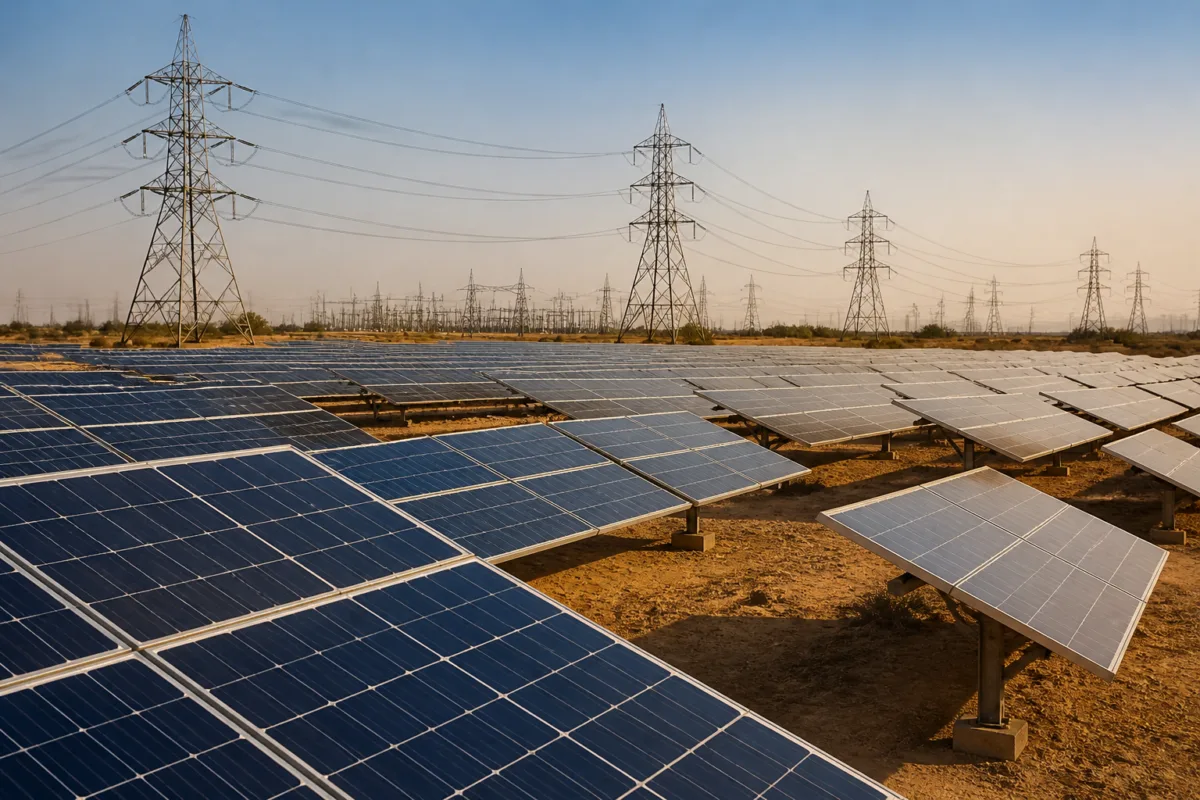
Rajasthan’s latest solar curtailment order is more than a temporary grid-management measure. It exposes a widening gap between the state’s ability to generate renewable electricity during the day and its ability to store, shift or consume that power when demand is lower. The State Load Dispatch Centre has directed renewable-energy producers to cut solar and wind generation by 20% with immediate effect, citing high frequency and heavy underdrawal on the grid, according to a report by The Times of India.
The order follows a pause of nearly two months and renews concerns about how Rajasthan will absorb further renewable capacity. The state has roughly 18,000 MW of operating solar capacity, of which nearly 10,000 MW is reportedly facing curtailment. Industry representatives cited in the report said generation cuts had persisted between April and August, ranging from 20% to 80%.
That pattern changes the meaning of renewable capacity. A solar plant may be available to generate electricity, but its output cannot always be accepted by the grid at the time it is produced. The constraint is not simply a shortage of power. It is a mismatch between when electricity is generated and when consumers require it, combined with a system that has limited ability to move surplus daytime power into the evening.
The institutional trigger is the State Load Dispatch Centre, which manages curtailment directions after assessing the demand-supply position on the grid. In its latest communication, the SLDC cited high frequency and heavy underdrawal. In practical terms, the direction indicates that available generation was exceeding the amount of electricity being drawn from the system at that point.
The problem becomes sharper because Rajasthan’s renewable generation is concentrated in daylight hours, while electricity demand rises at different times. The report identifies evening demand as a key pressure point and says the state has limited battery storage capacity to bridge the gap. Without sufficient storage, surplus solar power cannot easily be retained for later use. The result is a grid that may have excess electricity during one part of the day and a need for additional supply later.
This is also an operational problem created by the existing generation mix. Officials had previously cited the inflexibility of coal-fired thermal plants as one reason for the steep curtailments ordered in April, when renewable projects were asked to reduce production by between 30% and 80% during peak solar hours. Thermal plants cannot be switched off and restarted as flexibly as renewable generation fluctuates, according to the report. Their continued operation can therefore leave less room for solar and wind output when daytime renewable generation is high.
The sequence reveals a system-management challenge rather than a failure of renewable generation itself. Rajasthan has added substantial solar capacity, but generation growth has not been matched by enough storage or flexibility. The infrastructure required to manage renewable electricity is broader than the generation plant: it includes dispatch systems, batteries, flexible conventional generation, transmission capacity and demand that can be shifted to daylight hours.
The financial consequences fall directly on project operators. Curtailment reduces the electricity that a solar or wind project can sell even when its equipment is available and capable of generating. Developers still have fixed operating costs and debt-servicing obligations, the report says. The extent of the financial impact depends on individual power-purchase agreements and on whether compensation provisions apply when generation is curtailed.
That contractual detail is important because a curtailment order can affect the bankability of future renewable projects without changing the headline capacity target. If power cannot be scheduled or sold consistently, the value of installed capacity becomes less predictable. The report does not establish the scale of losses incurred by individual developers, but it makes clear that repeated curtailment has raised concerns over project viability.
The issue also has a seasonal dimension. Stakeholders cited in the report fear higher curtailment during winter months, when daytime electricity demand declines. If solar production remains strong while consumption falls, the system may face greater pressure to reduce renewable output unless storage or flexible demand expands beforehand.
One proposed response is to increase daytime agricultural electricity consumption. Stakeholders have pointed to Gujarat’s model, according to the report, as an example of using daytime agricultural demand to absorb more solar power. The proposal reflects a broader principle of grid management: when electricity cannot yet be stored at the required scale, demand can sometimes be moved towards periods of high renewable generation.
However, demand shifting depends on infrastructure, scheduling and institutional coordination. Agricultural supply patterns, feeder operations and procurement arrangements would have to align with the hours when renewable power is available. The supplied report does not provide details of Gujarat’s model or establish whether a comparable programme has been approved in Rajasthan. What it does show is that the state’s curtailment problem is pushing stakeholders to consider consumption patterns, not only new generation projects.
Battery energy storage is the other central piece of the policy landscape. D D Agarwal, director of the energy-sector NGO Samta Power, said battery energy storage systems could help bridge the mismatch, but delays in commissioning storage capacity had constrained the state’s ability to manage the difference between generation and demand. The statement places storage deployment, rather than renewable generation, at the centre of the immediate infrastructure gap.
This changes the planning question for Rajasthan. The state is no longer dealing only with how much renewable capacity can be built. It must also determine how much of that capacity can be integrated at different times, what storage is available, how thermal generation can operate more flexibly, and which consumers can use additional power during the day. The repeated curtailment orders suggest that these questions have not been resolved at the same pace as capacity expansion.
The figures in the report illustrate the scale of the imbalance. Nearly 10,000 MW of the state’s approximately 18,000 MW of operating solar capacity is reportedly facing curtailment. The reported cuts have ranged from 20% to 80% between April and August, while the latest order sets a 20% reduction across renewable generation at actual running levels. These figures describe not one isolated event but a recurring constraint affecting a substantial share of the renewable fleet.
They also complicate how capacity additions should be measured. A project pipeline can continue to grow while usable output remains constrained during certain hours. Installed megawatts indicate the ability to generate, but not necessarily the electricity that reaches consumers when it is needed. For grid planners, the more relevant question is whether generation, storage, transmission and demand are being developed as one system.
The urban implications are indirect but significant. Electricity supports homes, commercial activity, public services, water systems, transport infrastructure and industry. A grid with abundant daytime renewable power but insufficient evening flexibility must continue managing the cost and reliability implications of that imbalance. The report does not quantify any effect on consumer tariffs or service reliability, so those outcomes cannot be assumed. But it establishes a governance challenge involving dispatch decisions, contractual risk and infrastructure sequencing.
Rajasthan’s curtailment episode therefore raises a structural question for India’s renewable expansion: can generation capacity grow faster than the systems needed to absorb it? The evidence supplied points to a clear limitation. Solar and wind projects are being asked to reduce output because daytime supply is exceeding demand, while storage capacity remains inadequate and existing thermal plants are operationally inflexible.
The next important developments are the commissioning of delayed battery-storage projects, the terms governing compensation for curtailed generation, and any concrete plan to expand daytime demand. Until those elements move in step with new renewable capacity, Rajasthan’s challenge will not be simply producing more clean electricity. It will be ensuring that the electricity already being produced can be accepted, stored and delivered when the state needs it.

