


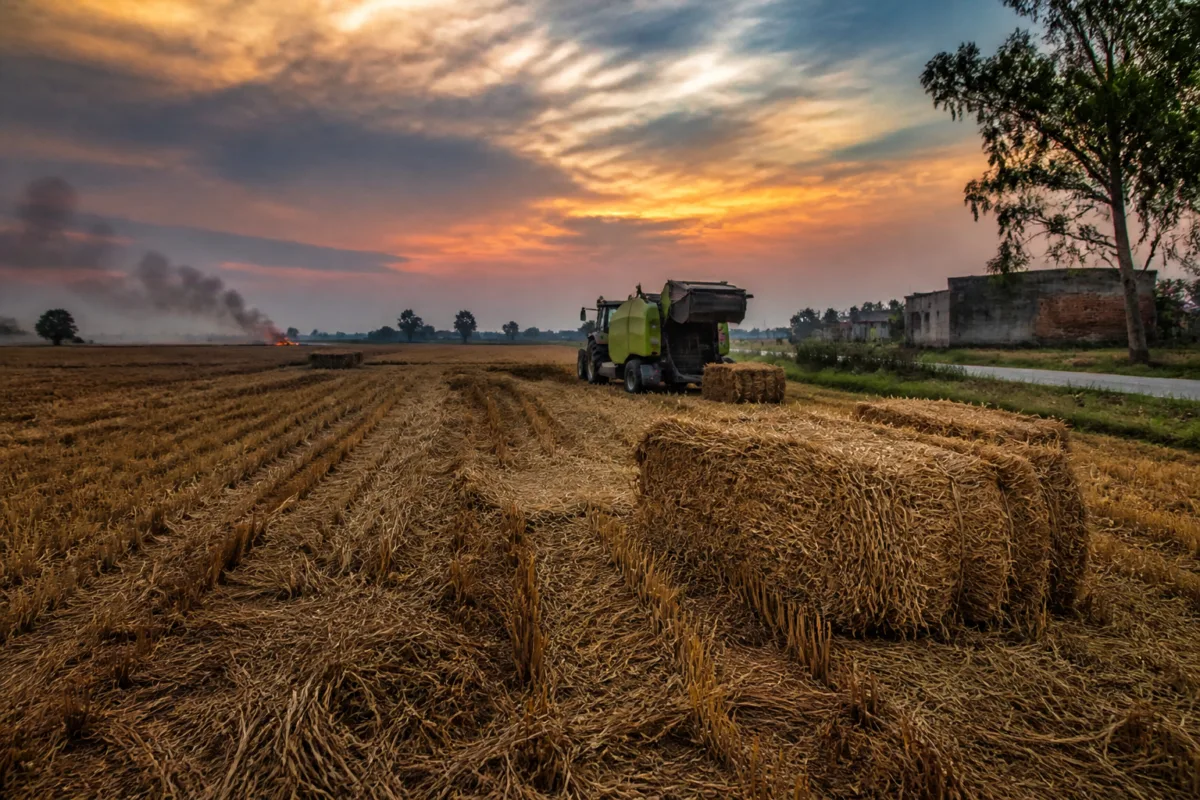
Punjab stubble burning is showing signs of decline as farmers gain access to straw buyers, residue-management machines and stricter enforcement, but the state’s expanding paddy acreage is exposing a structural gap: the market and machinery network still do not reach every field in time.
That gap was visible in an incident near the Wagah border in Amritsar district, where a farmer set fire to a harvested field after waiting 15 days for balers to arrive. The farmer told the Times of India that contractors had not come to his block, leaving him with little option before the next crop cycle. Another farmer in the area said he had been fined Rs 5,000 for burning a field the previous day.
The episode is important because it shows that farm fires are not determined only by awareness, penalties or the availability of machines. They are also shaped by whether a farmer can secure a contractor, clear the residue from a small or scattered plot, and prepare the land before the wheat-sowing window closes. In that sense, stubble burning is increasingly a logistics and service-delivery problem as much as an enforcement problem.
The Times of India reported that its reporting across 10 districts of Punjab, including Patiala, Fatehgarh Sahib, Ludhiana, Jalandhar, Kapurthala, Amritsar, Tarn Taran, Moga, Barnala and Sangrur, found relatively few instances of burning compared with earlier seasons. Farmers, farm-union leaders and agriculture officials interviewed during the visit said fires were down this year. The report also covered parts of Haryana, including Panipat, Karnal, Kaithal and Jind.
The improvement is being supported by the emergence of what the report describes as a green sector around paddy straw. Contractors collect and bale residue for industrial use, including as fuel for power plants. Hoshiarpur-based farmer and Bharatiya Kisan Union Doaba president Manjit Singh Rai said contractors had approached farmers even before harvesting began, with some competition among them for access to straw.
This is the ex situ model of residue management: straw is removed from the field, baled and transported elsewhere. For farmers, however, the service is not always free. The report says most farmers still have to pay contractors for residue removal, making access dependent on the economics of collection as well as on the existence of downstream demand.
The second model is in situ management, where machinery incorporates paddy residue into the soil. Central and state government subsidy schemes have helped more farmers adopt this approach. The method is intended to manage crop waste while improving soil health, but its performance depends on the equipment being available, suitable and used before the next crop must be planted.
These two systems do not serve all farmers equally. The farmers most exposed to burning are often small landholders or those facing greater agrarian stress. Their plots may be too small or too dispersed to attract baling contractors, while the cost of arranging machinery can be difficult to justify. The result is a residue-management network that may work efficiently in some regions but leave gaps in others.
The economics of straw collection remains central to that uneven coverage. Laxit Awla, chief executive officer of green-energy company SAEL, which operates 11 agri-waste power plants in the region, said demand for paddy straw was still insufficient to cover the entire state. He also said his company expected stubble burning to rise in the coming days.
That assessment points to a basic mismatch. Punjab may have more buyers for straw than before, but the available demand is still not large or dependable enough to absorb all the residue produced across the state. A power plant can create a market for biomass, but it cannot automatically make it viable to collect straw from every village, particularly where fields are small, distant or difficult to access.
The volume of residue is also increasing. Punjab’s paddy area for 2026-27 is reported at 32.9 lakh hectares, an all-time high and an increase from 32.8 lakh hectares in 2025-26. The state is also expecting a bumper harvest, which means more paddy straw will need to be managed even if the proportion of farmers burning it declines.
That distinction matters for the urban air-quality debate. A lower incidence of burning does not necessarily mean that the pressure on the residue system has fallen. If the total paddy area and crop yield increase, a smaller share of burning can still produce a substantial number of fires when collection and incorporation systems fail. The absolute volume of residue, rather than only the number of visible fires, remains an important part of the problem.
Harvest timing adds another layer of pressure. More than three-fourths of Punjab’s paddy acreage had reportedly been harvested, but progress varied significantly between districts. Most fields visited in Ludhiana, Jalandhar and Amritsar had been harvested. In Tarn Taran and parts of the central Malwa region, including Moga, Barnala and Sangrur, standing crops remained common and farm fires were also more visible.
The delay compresses the period available before wheat sowing. The report notes that rain in mid-October delayed harvesting. It also says that much of the standing crop was basmati, whose residue is generally used as fodder and is therefore not usually burnt. M L Jat, secretary in the Union government’s Department of Agricultural Research and Education, said this was a reason why the remaining standing crop did not necessarily translate directly into more fires.
The technology used in the field can also shape the outcome. Super Seeders chop paddy residue, incorporate it into the soil and sow the next crop in the same operation. Jat said these machines could not manage the entire residue in one pass, leaving material behind that was sometimes burnt. This creates a technology paradox: a machine promoted as an alternative to burning can reduce the residue burden while still leaving partial-burning risks if its capacity or operating conditions are inadequate.
The Happy Seeder offers a different experience in the report. Vikas Chaudhary, a farmer from Taraori in Haryana, said he had used the machine for 18 years and recorded improvements in soil health, yields and the use of water and fertilisers. He claimed that in years affected by extreme weather, his wheat yields were as much as eight quintals per acre higher than those of other farmers, and two quintals higher in good years. These figures are his account and are not presented in the report as an independent comparative study, but they illustrate why sustained machinery use can matter beyond residue disposal.
The policy landscape therefore combines enforcement with subsidies, machinery adoption and the creation of a biomass market. Enforcement remains strict even as Punjab approaches state assembly elections, according to the report. Fines can deter burning, but the Amritsar incident shows the limits of punishment when collection services fail to reach a field within the farmer’s operational deadline.
The institutional challenge is coordination. Agriculture departments and local administrations must support access to machinery, while private contractors and energy companies must find it commercially viable to collect and transport straw. Farmers, meanwhile, need a system that responds to the short gap between paddy harvesting and wheat sowing. If any one part fails, the cost is transferred back to the farmer and, through air pollution, to urban residents far beyond the field.
This is why Delhi-NCR’s air-quality crisis cannot be understood only through the daily count of fires in Punjab. The region’s exposure to seasonal pollution is connected to decisions made across a wider agricultural and infrastructure network: what crops are planted, when they are harvested, how residue is collected, where it is transported, which machines are available and whether biomass demand remains strong through the season.
The evidence in the report suggests that Punjab and Haryana have made progress in reducing biomass burning. Jat said both states had done a great job in managing stubble and checking fires, and that this progress should be acknowledged. At the same time, the report identifies a persistent risk: more paddy, uneven harvest timing and inadequate coverage by balers or machinery can quickly reopen the gap.
The larger urban question is whether residue management can become a dependable regional service rather than a seasonal emergency. The current system is moving in that direction, but its success will depend on whether demand for straw remains strong, whether contractors can profitably serve smaller and scattered holdings, and whether farmers have enough time and equipment to prepare fields without burning. Those are the conditions that will determine whether the recent decline in fires becomes durable or remains vulnerable to the next shortfall in capacity.

