


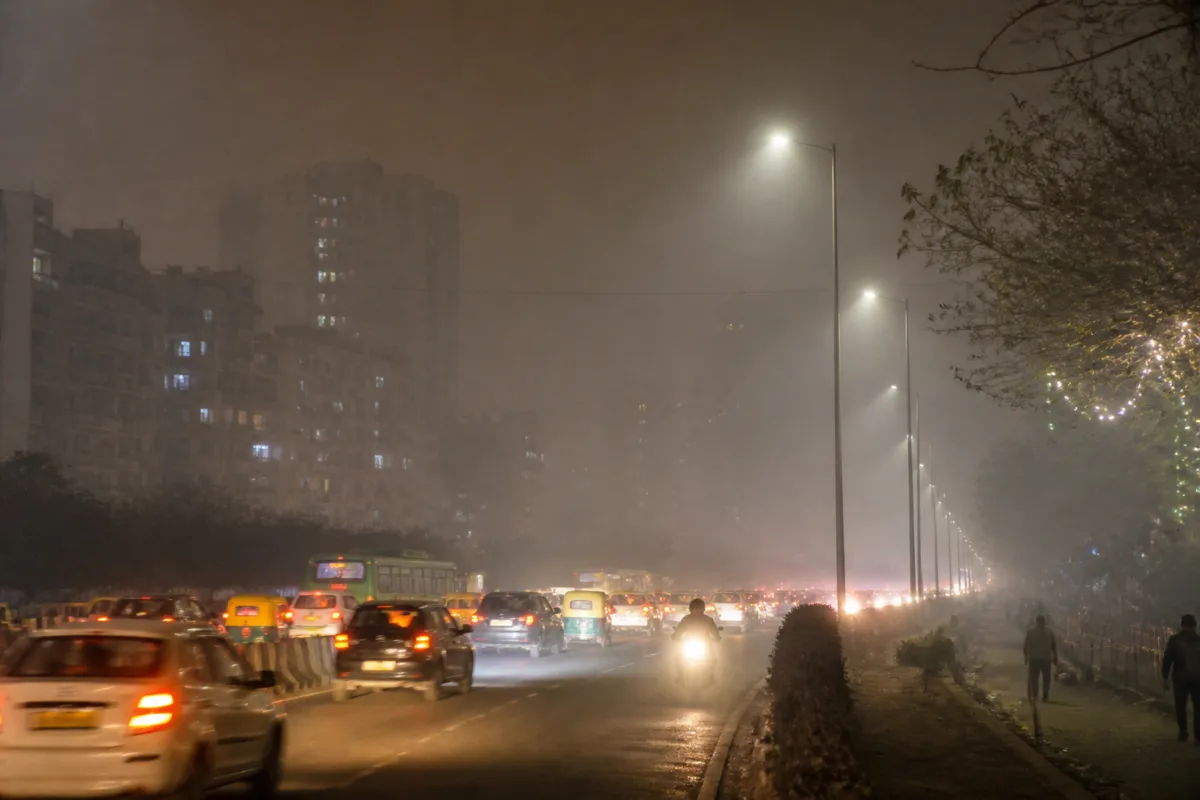
Delhi-NCR’s reported PM2.5 spike above 2,000 micrograms per cubic metre after Diwali fireworks has exposed a more serious urban governance problem: the monitoring record was reportedly unavailable at several locations during part of the period when pollution was at its peak. The episode raises questions not only about hazardous air, but also about whether residents and authorities received a complete picture of the danger in real time.
According to a report by Navbharat Times – Chandigarh, PM2.5 levels crossed 2,000 micrograms per cubic metre at several places in Delhi-NCR after fireworks on Diwali night. The report also said that data from several locations was unavailable between midnight and 2 am. That gap matters because the missing period overlapped with the reported peak of the pollution episode.
PM2.5 refers to fine particulate matter small enough to travel deep into the respiratory system and, according to the report, reach different organs through breathing. The Indian prescribed standard cited in the report is 60 micrograms per cubic metre, while the World Health Organization benchmark cited is 15 micrograms per cubic metre. On the reported readings, pollution at some locations was about 33 times the Indian standard and about 133 times the WHO benchmark.
The numbers are extreme, but the more consequential question for an urban region is how those numbers are generated, transmitted and used. Air-quality monitoring is not simply a technical exercise in placing instruments across a city. It is part of the public warning system. When readings are available, they can inform health advisories and help authorities decide whether emergency measures are required. When readings disappear during a critical window, both public communication and administrative response can be weakened.
Anumita Roychowdhury, executive director of the Centre for Science and Environment, expressed concern over the missing peak-period data. She said Delhi-NCR has the country’s densest monitoring network and that the disappearance of data during the most polluted period was difficult to understand. She also said real-time readings could have been used to issue health-related warnings and take emergency steps.
Her comments point to an institutional distinction that is often lost in daily air-quality coverage. A monitoring network can be large and still fail at the moment of greatest public need. Network density describes how many stations exist and where they are located; it does not, by itself, establish whether every station is producing reliable, continuous and publicly accessible data. The report provides no explanation for why data was unavailable between midnight and 2 am, so the cause of the gap remains unestablished in the supplied material.
The episode also shows why a single headline AQI number can be insufficient for understanding conditions across a metropolitan region. Delhi-NCR is a large and uneven urban area, with different local sources, weather conditions, land uses and population exposures. A reading from one station cannot automatically describe conditions everywhere. At the same time, a missing reading at the height of a pollution event can make it harder to identify how severe the episode was in the affected area.
Radheshyam Sharma, head of the Department of Environmental Studies at Delhi University, attributed differences between government and private-agency AQI readings partly to different measurement and averaging methods. His point is important for interpreting conflicting numbers: a comparison is meaningful only when the location, time period, pollutant measurement and averaging method are clearly stated.
That requirement becomes especially important during short, sharp pollution episodes. If one agency reports a peak value while another publishes an average for a different period, the two figures may appear contradictory even when they describe different conditions. The report does not establish that this explains the missing data, but it does underline the need for every public reading to carry enough technical information for residents and authorities to understand what it represents.
The monitoring question therefore has at least three parts. First, instruments must record pollution continuously and accurately. Second, the data must remain available during periods of extreme pollution. Third, the public must be able to interpret the reading through clearly stated locations, timestamps and measurement methods. A failure at any one of these stages can reduce the practical value of the network.
This is also a governance issue because air-quality data determines how risk is communicated. Residents make decisions about outdoor activity, travel and exposure based on the information available to them. Authorities may use the same information while considering restrictions or emergency actions. If the most severe part of an episode is missing from the public record, the information available to both groups may be incomplete even when the monitoring infrastructure exists.
The report does not identify which monitoring stations lacked data, whether the gap affected all stations or only selected locations, or whether the missing information resulted from equipment failure, transmission problems, data validation or another cause. These details are essential before the episode can be fully assessed. They would also determine whether the problem was isolated or reflected a broader weakness in the monitoring and data-publication system.
The difference between the Indian standard and the WHO benchmark cited in the report adds another layer to public communication. The two figures serve as different reference points, and presenting both without location and time information can still leave readers unsure about the actual exposure they faced. The measurement must therefore be accompanied by context rather than reduced to a single citywide label.
The reported readings also need to be understood as observations from specific monitoring points, not as proof that every part of Delhi-NCR experienced the same concentration. Yet this limitation does not reduce the importance of the reported peak. It makes accurate station-level reporting more important, particularly when the affected area contains dense housing, busy roads, schools, workplaces and other places where large numbers of people may be exposed.
The urban lesson is that pollution control and pollution measurement cannot be treated as separate administrative functions. Controlling emissions addresses the source of the problem, while monitoring establishes the scale and timing of public exposure. During a severe episode, the second function is necessary for deciding whether the first response has been adequate. Without dependable data, the city’s emergency system has less information on which to act.
The Delhi-NCR episode also exposes the difference between having data infrastructure and having data accountability. A network can be described as extensive, but public trust depends on whether readings are continuous, transparent and technically comparable. When a gap appears during a reported pollution peak, the relevant question is not merely how many stations are installed. It is whether the system can demonstrate what happened at every critical point in time and explain any interruption.
Based on the supplied report, the confirmed facts are that PM2.5 crossed 2,000 micrograms per cubic metre at several Delhi-NCR locations after Diwali fireworks, that data was unavailable at several places between midnight and 2 am, and that the Centre for Science and Environment raised concerns about the gap. The reported readings were far above the Indian and WHO benchmarks cited. The reason for the missing data, the stations affected and the administrative response are not established in the available material.
Those unanswered questions should remain central to the next stage of public scrutiny. Authorities and monitoring agencies would need to clarify the affected locations, the duration and cause of the data interruption, the status of the underlying instruments and the method used to calculate and publish the reported readings. Until those details are available, Delhi-NCR’s pollution record for the most hazardous part of the episode remains incomplete.

