


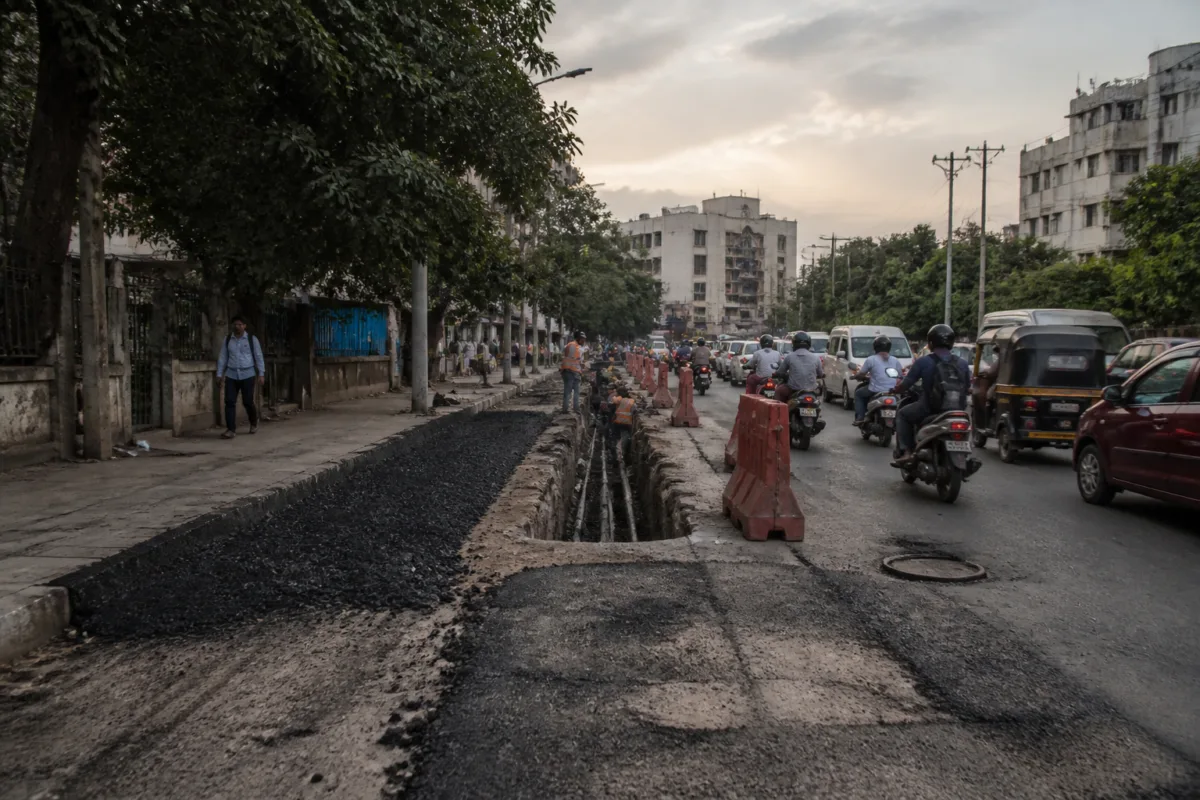
Pune’s road excavation problem is no longer only about potholes appearing after fresh asphalt. Data cited from the Pune Municipal Corporation’s road department shows that the civic body has issued 2,388 permissions since 2017 for laying underground optical fibre cables, involving excavation over a cumulative 1,495 km. The figures reveal the scale of an urban system in which roads are repeatedly opened to accommodate utilities that are planned and managed by different agencies.
The immediate public consequence is visible on the street. Freshly asphalted stretches are sometimes dug up again within days, while restored sections can be left with potholes or uneven surfaces. For motorists, this means slower and less comfortable journeys. For the civic body, it creates a continuing road-maintenance burden. The larger question is whether Pune’s roads are being treated as finished public assets or as repeatedly available corridors for utility installation.
According to the report, underground optical fibre cables account for a substantial part of the permissions recorded by the PMC road department. Roads are also excavated for water pipelines, drainage lines, electricity cables, gas pipelines and other utilities. Each installation may serve a legitimate public or commercial purpose, but the absence of a consolidated record and coordinated schedule means that the same road can become the worksite of multiple agencies at different times.
The PMC permits such work for government, semi-government and private agencies after collecting prescribed charges. The road department generally allows excavation between October 1 and April 30, with agencies expected to complete restoration during the following month. The seasonal arrangement is intended to keep excavation and restoration away from the monsoon period. However, it does not by itself prevent conflicts between road resurfacing plans and utility works.
The PMC has stated that permission is not granted for excavating recently asphalted roads. Reports of roads being dug up within days of asphalting therefore point to a coordination problem rather than simply a lack of rules. The supplied report does not establish how many such cases occurred, which agencies were responsible for them, or whether permissions were issued before the resurfacing work was completed. It does establish that the civic body and utility providers are operating within a system where road construction and underground network expansion can collide.
The charges imposed by the PMC also show that excavation is governed through an administrative and financial framework. Private companies are charged Rs 12,192 per running metre. The electricity board is charged Rs 2,350 per metre, while other government agencies pay Rs 6,096 per metre. Excavation using horizontal directional drilling, or HDD, attracts a charge of Rs 4,000 per metre, and work involving pits is charged at Rs 6,160 per metre.
These rates indicate that the civic body differentiates between the agency undertaking the work and the method used. HDD, which can reduce the need for continuous open trenches, carries a separate rate. But the existence of a charge does not resolve the wider question of restoration quality or the cumulative disruption caused by repeated works. Excavation charges may recover part of the administrative or restoration cost, while the public still experiences damaged surfaces, traffic disruption and the risk of further utility failures.
The records also offer a longer historical view. Before 2017, the PMC had issued 649 permissions for road excavation, all for underground OFC cables. The records mention charges amounting to Rs 485.81 crore for these works. Permissions for overhead cables issued before 2017 were handled by the civic body’s electrical department. Since 2017, the road department has not issued permissions for laying overhead OFC cables, while the electrical department has issued two permissions for overhead cables. Temporary permission has also been granted for cable work related to the disaster management cell.
The movement from overhead to underground networks changes the demands placed on city roads. Underground cables avoid some of the visual and physical problems associated with overhead infrastructure, but they require access to the road space beneath which they are installed. When multiple networks occupy the same underground corridor without a common map, each new excavation carries a greater risk of damaging an existing line or requiring another repair later.
That is the central institutional weakness identified in the report: Pune does not have a consolidated digital map showing the precise location of all underground utility networks. Water pipelines, drainage lines, electricity cables, gas pipelines and internet cables are laid beneath roads by different agencies, but the PMC does not maintain one central record covering them all.
The absence of such a map affects both routine maintenance and major infrastructure work. Officials sometimes need assistance from retired officers to locate old water pipelines before undertaking new work, according to the report. That detail illustrates how institutional memory can become a substitute for a current infrastructure database. It also means that knowledge of the underground city may remain dispersed across departments, agencies and individuals instead of being available through a common system.
Water pipelines are frequently damaged during excavation, causing service disruptions and additional repair costs. This creates a chain of consequences: a road is opened for one utility, another network is damaged, repairs are required, the surface is restored, and the public bears the inconvenience of the resulting disruption. The report does not quantify the number or cost of such incidents, but it identifies the absence of centralised mapping as a factor that complicates excavation planning and increases the risk of damage.
For Pune, the issue is therefore not simply whether a particular road should be dug up. It is whether the city has enough information and coordination to decide when, where and how underground works should take place. The PMC’s permission system provides a formal entry point for excavation, but the figures suggest that permissions alone do not create an integrated utility-management system.
The road department’s seasonal window, restoration expectations and excavation charges are parts of that framework. Other departments continue to hold responsibilities for specific networks and, in some cases, for different categories of cable work. Utility providers may also have their own construction requirements and operational priorities. Without a shared schedule and a common map, the road authority must manage a network whose underground contents are not fully visible to it.
This matters because road resurfacing is itself a planned public intervention. The report says that the civic body undertakes road repairs and asphalting ahead of the monsoon. If utility work is not completed or recorded before resurfacing, the city faces a direct conflict between protecting the new road surface and providing access for essential networks. If a road is opened soon after it is asphalted, the value of the resurfacing work is reduced, even if the excavation is authorised.
The evidence supplied does not establish the total expenditure on resurfacing, the proportion of excavated roads restored to the required standard, or the penalties imposed for poor restoration. It also does not show whether the 2,388 permissions correspond to separate locations or include repeat work on the same corridors. Those gaps matter because permission counts and excavation length reveal scale, but not the full financial impact or the performance of individual agencies.
Even so, the available data shows why repeated excavation has become an urban governance issue. A road is simultaneously a transport surface, a drainage edge and a corridor for essential services. Decisions taken by one agency affect the operating conditions of others. A failure to coordinate underground assets can therefore appear above ground as potholes, uneven surfaces, water interruptions and traffic delays.
The report points towards better coordination among civic departments and utility agencies, alongside comprehensive digital mapping, as ways to reduce repeated excavation and protect existing infrastructure. The effectiveness of such measures would depend on whether the map is complete, regularly updated and used before permissions, resurfacing and new utility works are approved. The supplied material does not indicate whether Pune has a common data standard, a single coordinating authority or a public system for tracking restoration obligations.
What the evidence confirms is more basic but consequential: Pune has a large and expanding underground utility footprint, a formal excavation-permission system, and no single digital map of the networks beneath its roads. Until those three realities are managed together, freshly asphalted roads will remain vulnerable to being reopened, and road maintenance will continue to be linked to the fragmented way the city records and builds its utilities.

