


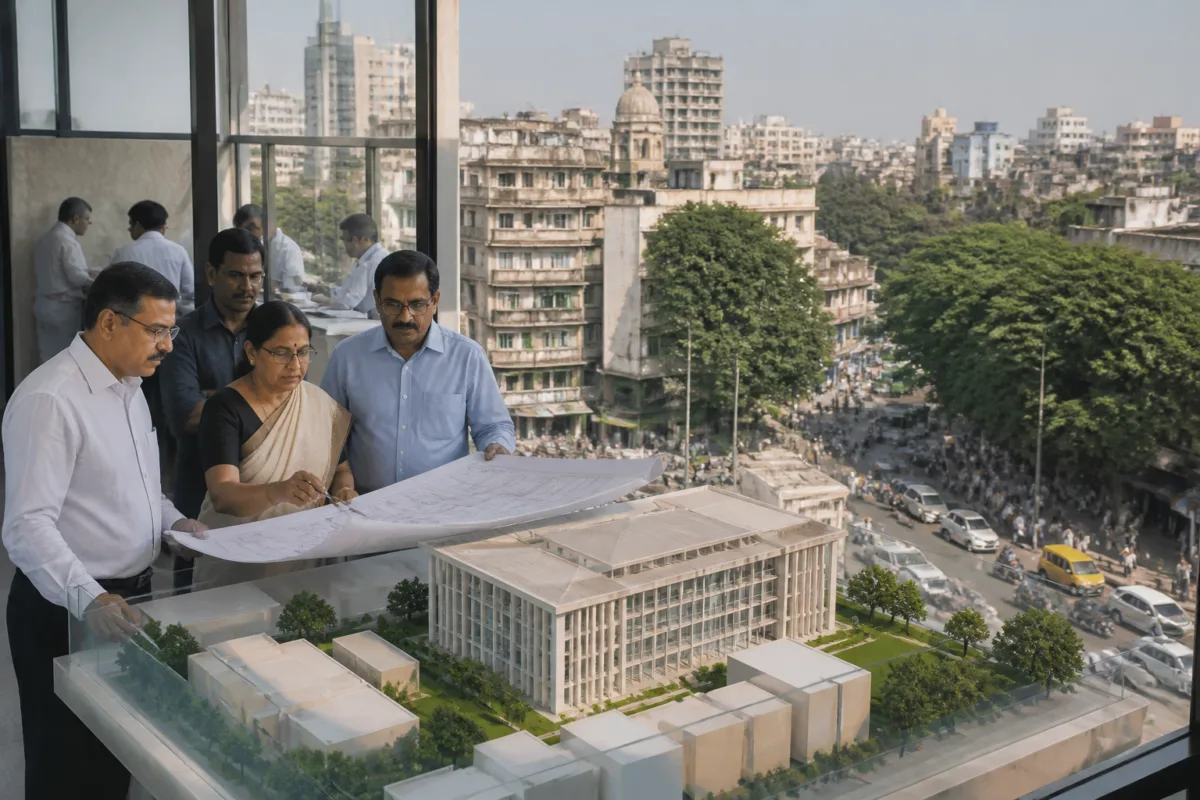
The proposal to build a new Pune Municipal Corporation headquarters in Shivajinagar is more than a question of replacing an ageing office building. It reflects the administrative pressure created by the expansion of the municipal boundary, the dispersion of departments across several buildings and the continuing difficulty of delivering citizen services through a fragmented institutional arrangement.
According to a report by Pudhari, the civic administration is examining the possibility of using about 2.5 acres at the Shivaji Akhada site in Shivajinagar for a new administrative centre. The proposal is still at a preliminary stage. The site is owned by the Pune Municipal Corporation but has been given on a long-term lease. The proposal would require decisions on the relocation of the akhada, possession of the land, the building design and funding before any project can move ahead.
That uncertainty is important. The current proposal is not an approved construction project or a confirmed relocation plan. It is an early institutional response to a problem that has developed over several years: the corporation’s responsibilities have grown, but its administrative space has remained divided between older and newer facilities.
The Pune Municipal Corporation was established in 1950, while its existing headquarters building was constructed around 1966. A separate building for elected representatives was started in 2015 and became operational in 2018. That building created space for corporators and office-bearers, but it did not resolve the shortage of space for the civic administration itself.
Several departments continue to operate from Savarkar Bhavan and other buildings in the surrounding area. The departments identified in the report include property assessment and tax collection, the education board, local body tax and health. As a result, officials and employees must move between different locations for meetings, presentations and routine administrative work.
This arrangement creates a basic coordination problem. A municipal corporation is not simply a collection of independent departments. Tax assessment affects revenue collection; revenue supports civic services; health, education and local administration require coordination; and citizen complaints often involve more than one department. When these functions are distributed across multiple buildings, the physical distance between offices becomes part of the administrative process.
The proposed headquarters is intended to bring the corporation’s departments together in one location. The plan described by Pudhari includes online meeting rooms, larger halls for committees and dedicated facilities for citizen complaints and other public work. The stated objective is to allow citizens to complete more work at a single location and to make administrative operations faster.
The proposal has been associated with Ganesh Bidkar, the corporation’s leader of the house, who has suggested developing a new administrative building. Initial consideration is being given to the Shivaji Akhada site in Shivajinagar. Discussions have reportedly taken place with senior leader Sharad Pawar about shifting the akhada to the Balewadi area, with a positive response said to have encouraged further movement on the proposal.
But a positive response from a stakeholder is not the same as a completed land-transfer process. The site’s existing lease, the terms of relocation, the availability of an alternative site at Balewadi and the formal transfer of possession all remain relevant administrative questions. Until those matters are resolved, the location should be understood as an option under examination rather than a final project site.
The history of the corporation’s buildings also shows why the issue cannot be reduced to a straightforward construction exercise. The 1960s headquarters was built for a smaller administrative system. The separate elected-representatives’ building addressed one part of the space problem, but departments continued to work from multiple locations. A new headquarters would therefore have to address not only floor space but also the relationship between elected representatives, municipal officers, public-facing services and internal departments.
The inclusion of 32 villages in stages has increased the corporation’s administrative workload, according to the report. The expansion has implications for the number of areas to be administered, the volume of public interaction and the range of municipal functions that must be coordinated. The supplied report does not provide staffing numbers, floor-area calculations, service-delivery data or a financial estimate for the proposed building. Those details will be necessary to judge whether the proposal is proportionate to the corporation’s actual requirements.
The same gap applies to the funding question. No final provision has been made for the project, and the source does not identify a cost estimate, financing model or construction timeline. These are not secondary details. A headquarters project would involve land, design, procurement, construction and the future operating cost of a larger facility. Without a public project report or an approved budget provision, the scale and feasibility of the proposal cannot yet be established.
The proposed citizen facilities also raise a practical question about the meaning of centralisation. Bringing departments into one building could make in-person visits easier when a case requires several offices. It could also improve internal meetings if officials no longer have to travel between buildings. However, the supplied material does not establish whether all services would be physically shifted to the new building or which departments would remain elsewhere. It also does not state how the proposed centre would relate to online services or ward-level municipal offices.
That distinction matters because a central headquarters can improve coordination without necessarily making every civic service more accessible. The report identifies the aim of resolving citizens’ work in one place, but the final benefit would depend on the building’s internal design, service counters, departmental authority and the procedures adopted after construction. At the current stage, these remain proposals rather than demonstrated outcomes.
The institutional structure will also require clarity. The report says that a detailed presentation will be made to office-bearers and the municipal commissioner. Further action will be determined after that presentation. This places the proposal within a sequence of administrative decisions: first, agreement on the site and relocation; then control of the land; preparation of a building plan; identification of funding; and finally a decision on implementation. The report does not indicate that any of these later stages has been completed.
The central urban question is whether Pune’s administrative infrastructure has kept pace with the physical expansion of the municipal corporation. The proposed headquarters suggests that the city’s governance system is experiencing the consequences of territorial growth in a very tangible form: offices are spread out, departments have limited space and routine coordination requires movement between buildings.
At the same time, the proposal demonstrates the limits of solving institutional problems through construction alone. A larger building may provide space and shared facilities, but its effect will depend on how departments are reorganised, how citizens are directed, and how responsibilities are coordinated. The available information confirms the administrative need being cited and the broad features under consideration, but it does not yet establish the project’s cost, schedule, final site or implementation model.
The next significant step is the proposed presentation of the plan to municipal office-bearers and the municipal commissioner. Until decisions are taken on the Shivaji Akhada’s relocation, land possession, the building design and funding, Pune’s new municipal headquarters remains a preliminary proposal rather than a sanctioned infrastructure project.

