


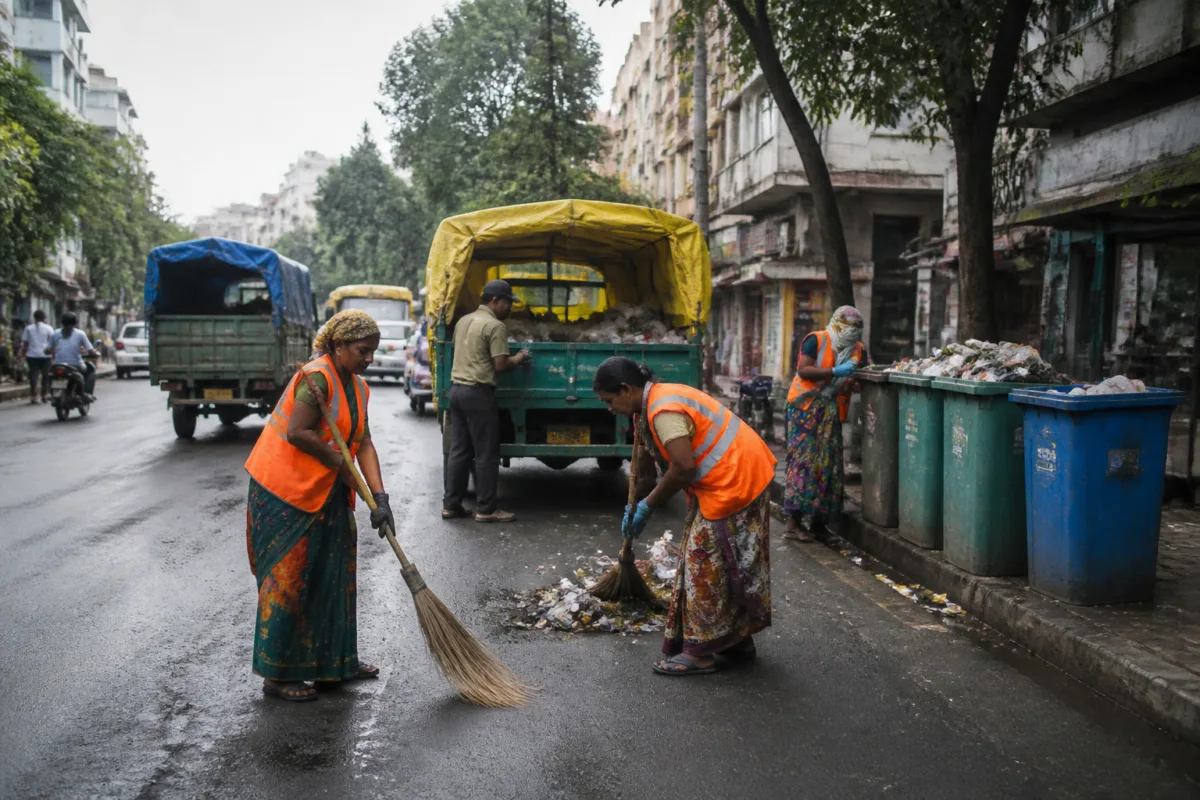
Pune’s fall from eighth to twelfth place in the Swachh Survekshan 2025-26 ranking has turned attention from the city’s public cleanliness score to the way its municipal waste system is organised, staffed and paid for. The criticism reported by Pudhari is aimed not simply at street-level outcomes, but at whether Pune is using its existing workforce effectively before expanding contractor-led operations.
The ranking decline was cited by former Leader of Opposition Suhas Kulkarni, Ujjwal Keskar and former corporator Prashant Badhe, who questioned who should accept responsibility for the setback. They called for the officers and political leadership responsible for the system to accept accountability and for additional responsibilities assigned to certain officers to be withdrawn. Their comments place the ranking within a broader institutional debate about decision-making in the Pune Municipal Corporation’s solid waste management department.
The source report says the department has introduced new experiments for city cleanliness and has spent heavily on a contractual system. Yet the city’s position in the survey has worsened from eighth to twelfth. The available report does not provide the city’s underlying score, the component-wise survey results, or a comparison of the performance of other cities. That means the ranking itself establishes a deterioration in position, but does not by itself identify which operational areas caused the decline.
This distinction is important. A cleanliness ranking is an outcome indicator, while waste management is a chain of daily municipal functions. It includes sweeping, collection, transport, public toilet maintenance, staffing, supervision and tender management. A lower position can therefore trigger questions about several parts of the system, but the supplied evidence does not establish that one particular contract, officer or operational decision caused Pune’s fall.
The criticism reported by Pudhari focuses on the balance between permanent municipal employees and contract workers. The former civic representatives said the municipal corporation has 5,000 permanent employees available, while plans are being made to appoint 9,000 workers through contractors. They argued that the existing workforce should be used to its full capacity and that contractor personnel should be engaged only in areas where staffing is inadequate.
The report separately states that the municipal corporation spends about Rs 25 crore a month on the salaries of permanent employees. It also says that another Rs 13 crore a month is spent on 4,500 contractual workers. On the figures supplied, these two stated monthly outlays together amount to approximately Rs 38 crore. The report does not clarify whether the proposed 9,000-worker plan is an approved deployment, a tender-stage proposal or an internal staffing plan. It also does not explain whether the 4,500 contractual workers mentioned in the existing expenditure figure are the same workforce referred to in the proposed plan.
That ambiguity matters because staffing numbers alone do not reveal service capacity. A municipal waste system needs a clear division of responsibility, area-wise deployment, supervisory control and reliable measurement of completed work. The former representatives’ argument is that Pune should first identify where its permanent employees can meet the requirement and contract additional labour only for genuine gaps. Their stated objective is both better use of municipal staff and lower expenditure.
The report also raises a question about who controls street sweeping. The former representatives said responsibility for sweeping should remain with the department’s DSI, SI and mukadam-level staff rather than being removed from the existing departmental structure. The supplied report does not expand the abbreviations or describe the precise hierarchy of these posts, but it presents them as part of the department’s supervisory and field workforce.
Their position reflects a recurring administrative problem in municipal services: responsibility can become fragmented when a civic body retains a permanent workforce while outsourcing substantial parts of delivery. In such a model, the corporation may continue to carry salary obligations while also paying contractors for additional labour and service packages. The operational question is not simply whether outsourcing is good or bad. It is whether the city can show, area by area, what work is being performed, by whom, at what cost and under whose supervision.
The former representatives have also objected to the conditions in tenders issued for waste collection, public toilet cleaning and labour supply. They alleged that several decisions in the solid waste management department favour contractors. These are allegations made by the named former civic representatives; the supplied report does not include the tender documents, the municipal corporation’s response or an independent examination of the tender conditions. They should therefore be treated as claims requiring documentary and administrative examination, rather than as established findings.
The financial figures make the issue more than a dispute over contracting preferences. The report’s stated monthly cost of about Rs 25 crore for permanent employees and Rs 13 crore for 4,500 contractual workers indicates that solid waste management involves a substantial recurring municipal expenditure. However, the available material does not provide the total solid waste management budget, the cost of vehicles, equipment, processing, disposal, supervisory services or individual contracts. It is therefore not possible from this report alone to calculate the full cost per worker, per ward, per tonne of waste or per service delivered.
Those missing measures are central to judging performance. A city can have more workers and still deliver weaker cleanliness outcomes if deployment is uneven, supervision is weak, attendance is poorly monitored or collection and sweeping schedules do not match local demand. Conversely, a contractor may fill a genuine service gap in a particular area, but the case for that arrangement depends on transparent performance standards and evidence that the additional spending produces better service.
The ranking decline also exposes the limits of treating a survey position as the whole story. The move from eighth to twelfth is a clear public signal, and it has prompted questions about the municipal administration. But the ranking cannot, on the evidence supplied, answer whether the problem lies in sweeping, collection, public toilets, waste processing, citizen-facing cleanliness, documentation, inspection or another survey component. A meaningful administrative response would require the underlying scorecard and the city’s performance against each relevant indicator.
For Pune’s municipal system, the immediate governance challenge is therefore traceability. The public needs to be able to connect a cleanliness outcome with the institution responsible, the contract or workforce assigned, the money spent and the monitoring mechanism used. The allegations reported by Pudhari show that this chain is currently being contested by former civic representatives. The municipal corporation’s position, including its explanation for the ranking decline and its response to the staffing and tender allegations, is not included in the supplied material.
The reported staffing plan also raises an institutional question about the role of permanent municipal employment. If 5,000 permanent employees are available while thousands of contractual workers are being considered or deployed, the corporation must distinguish between sanctioned strength, employees actually available for field duty, vacancies, leave, transfers, specialised assignments and ward-level requirements. The source does not provide those details. Without them, it is not possible to determine whether the gap is one of inadequate staffing, ineffective deployment or a decision to outsource functions that could be performed internally.
The same scrutiny applies to public toilet cleaning and waste collection. These are visible services, but their quality depends on routine supervision and measurable standards rather than only on the number of people hired. Tender clauses can shape who is eligible to bid, how workers are supplied, how performance is recorded and how payments are released. The reported objections make those clauses an important area for review, although the actual provisions are not reproduced in the source.
Pune’s ranking fall thus presents two separate but connected tests. The first is a service test: whether residents are receiving cleaner streets, reliable waste collection and properly maintained public toilets. The second is a governance test: whether the municipal corporation can demonstrate that its workforce, contracts and spending are aligned with those outcomes. The current report provides the trigger for that examination, but not enough evidence to determine the final cause of the decline.
What is established is that Pune has moved from eighth to twelfth in the reported Swachh Survekshan 2025-26 ranking and that named former civic representatives have demanded accountability, a review of staffing decisions and closer examination of tenders. What remains unclear is the city’s detailed scorecard, the official explanation for the fall, the status of the proposed 9,000-worker arrangement and the municipal corporation’s response to the allegations. Those documents and responses will determine whether the episode leads to a change in contracting practice or remains another dispute over responsibility after a poor civic performance signal.

