


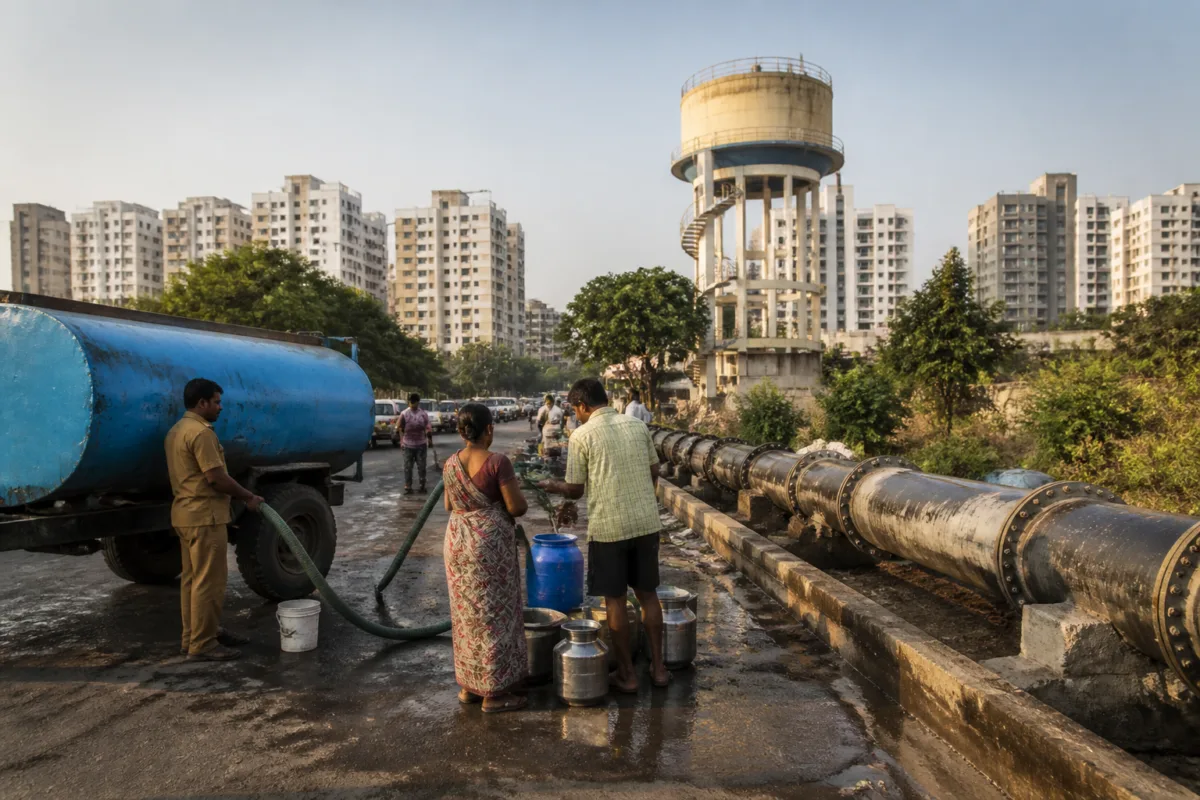
Pune’s water consumption fell by only 20 to 25 million litres a day during the Diwali holiday period, despite thousands of residents leaving the city for their hometowns, according to figures provided by the Pune Municipal Corporation administration. The limited decline highlights the continuing pressure on the city’s water system as its population and built-up area expand.
The municipal administration said Pune lifted 1,718 million litres of water on November 5, the first day of Diwali. The volume fell to 1,700 million litres on the following day, which was Dhantrayodashi. From November 7, the city lifted 1,688 MLD, followed by 1,682 MLD, 1,698 MLD, 1,697 MLD and 1,692 MLD on the subsequent days.
The figures indicate that the reduction in water use was modest even as the city experienced a visible drop in traffic and congestion. Many residents who live in Pune for employment, education, business and other reasons travelled to their native places during the festival, leaving roads less crowded than usual.
However, the lower demand had a direct operational effect on the distribution network. The municipal administration said water pressure improved during the period, leading to a sharp decline in complaints about low-pressure supply and shortages. Officials also said that water reached some areas where it had not been reaching adequately before the temporary reduction in demand.
The difference between the fall in population activity and the relatively small reduction in water withdrawal reflects the scale of Pune’s regular demand. The city has expanded rapidly as people from different parts of Maharashtra and other states have settled there for work, education and commercial opportunities. This growth has increased the demand for water along with the city’s physical expansion.
Pune’s municipal administration has repeatedly sought an increase in the city’s water quota from the state government and the irrigation department. The demand is linked to the city’s rising population and the growing volume of water required to serve established neighbourhoods as well as expanding urban areas.
The Diwali figures also show how even a temporary reduction in demand can affect the experience of residents at the neighbourhood level. Although overall consumption declined only marginally, the municipal administration reported fewer complaints and improved reach in parts of the city. This suggests that pressure and distribution constraints remain important factors in how residents receive water, alongside the total volume lifted by the civic body.
The data does not establish how much water was saved at the household level or how many residents left Pune during the holiday period. It records the quantity lifted by the municipal corporation and the administration’s assessment of supply conditions during the festival. The immediate municipal focus remains on managing demand and distribution while pursuing a higher water quota for the expanding city.

