


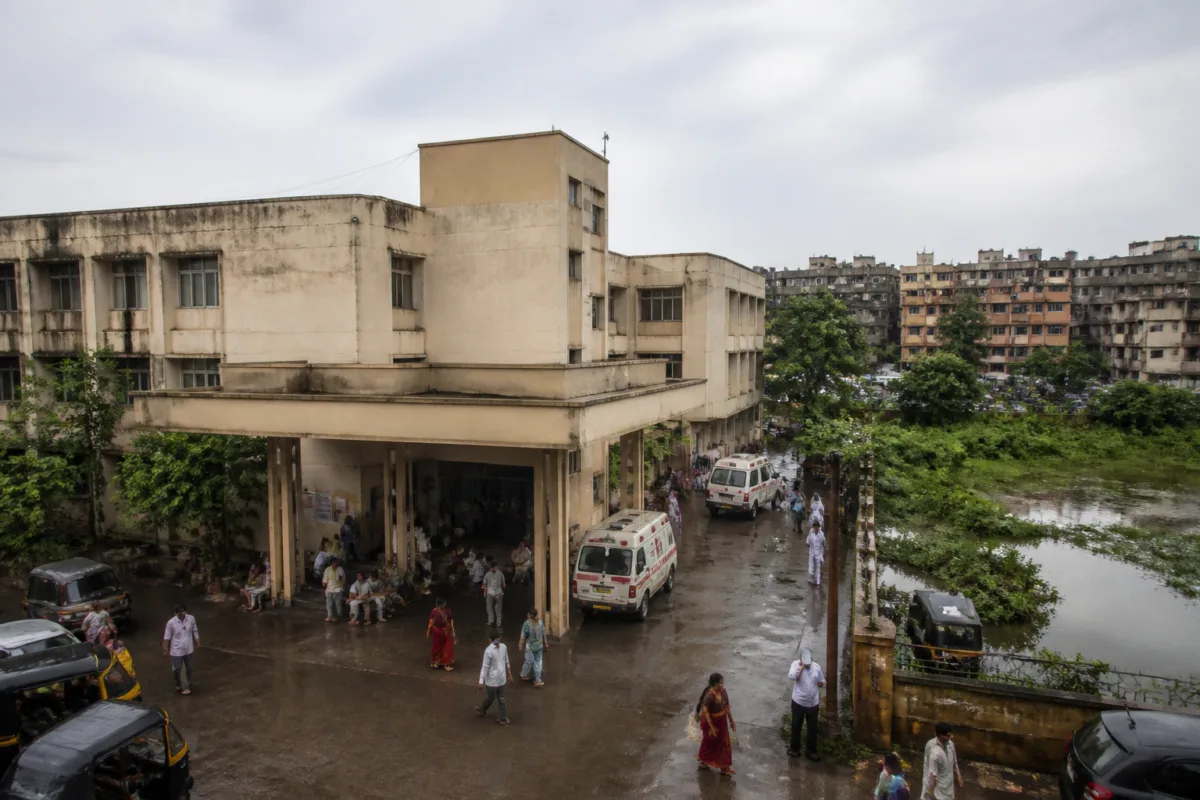
The continuing crisis at Annasaheb Magar Hospital in Hadapsar is not only about an ageing building or a few unusable machines. It reveals a more basic problem in Pune’s public-health network: a municipal hospital is expected to absorb the needs of a rapidly expanding eastern urban belt, while its infrastructure, staffing and clinical capacity remain inadequate.
A report by Lokmat – Pune says the hospital has insufficient medical equipment, a shortage of specialist doctors, non-functional devices and an ageing building. Residents from Hadapsar, Fursungi, Manjari, Mundhwa and nearby informal settlements depend on the facility for affordable treatment. Yet patients are reportedly being directed to Sassoon General Hospital or Kamala Nehru Hospital when the required services are unavailable. For households unable to afford private healthcare, that referral is not a routine administrative step. It can mean additional travel, waiting and expense before treatment even begins.
The hospital’s importance has grown as Pune’s municipal limits have expanded. Villages brought within the Pune Municipal Corporation area have added to the population that relies on civic services, including public healthcare. The report notes that health and wellness centres and Balasaheb Thackeray Aapla Dawakhana facilities have been established for primary care. However, specialist consultations, emergency treatment and inpatient services still require a larger hospital system. In this structure, Annasaheb Magar Hospital is expected to serve as an intermediate and referral facility for a large eastern Pune catchment.
That role cannot be fulfilled by an outpatient centre alone. A hospital serving a growing urban population needs functioning diagnostic equipment, doctors across relevant specialties, trained support staff, medicines, beds and the ability to admit patients when required. The complaints reported from Hadapsar indicate gaps across each of these links. Some patients are said to receive medicines based on symptoms without adequate investigation. Others are reportedly told to approach another hospital because the necessary treatment is not available. The result is a public facility that may exist physically but does not always provide the complete chain of care residents need.
The condition of the building adds a separate safety concern. According to the Lokmat report, the existing structure was built in 1956 and is now considered to have reached the end of its usable life. The hospital campus is lower than the adjoining road, allowing rainwater to enter the premises during the monsoon. The report says water has reached sensitive areas, including the operation theatre, raising questions about the safety and continuity of clinical services. It also cites complaints that the X-ray machine and oxygen plant have remained non-functional for extended periods.
These details matter because hospital capacity is not measured only by the number of beds on paper. A bed without diagnostic support, oxygen availability, doctors, nursing personnel and medicines does not provide the same service as an operational inpatient bed. Similarly, an announced upgrade does not immediately improve access unless funds are converted into tenders, repairs, procurement, staffing and safe operating conditions. The Hadapsar case demonstrates the difference between physical presence and functional capacity in municipal healthcare.
For residents, the consequences are practical and immediate. Hadapsar and the surrounding eastern suburbs include established neighbourhoods, recently urbanised villages and informal settlements. Their populations do not share the same ability to travel across Pune or pay for treatment. When a civic hospital cannot provide a test or procedure, patients with limited income face a choice between navigating another public hospital and entering the private system. The report specifically records concerns that poor residents are being forced to approach private hospitals because the promised facilities at Annasaheb Magar Hospital have not materialised.
The proposed solution has been discussed for several years: converting the hospital into a 200-to-250-bed multispeciality facility. Residents have also suggested using a vacant building adjoining the hospital, previously occupied by a police station, for expansion. The proposal is significant because it points to an available urban land and building resource within an existing healthcare campus. But the report says there has been no firm decision to begin work on this option. The continuing gap between discussion and implementation is therefore central to the story.
A municipal representative, Hemlata Magar, told Lokmat that the hospital is planned to become a super-speciality facility and that Rs 4.5 crore has been provided in the current year for the purpose. She said the effort is intended to make all facilities available to ordinary residents of Hadapsar. The stated allocation is an important administrative step, but the report does not establish what components it will finance, whether it covers capital works or equipment, how much is required for the full expansion, or when construction and commissioning would be completed. Those details will determine whether the allocation produces a functioning hospital or only incremental repairs.
The public-health challenge is therefore one of sequencing as much as funding. Immediate repairs and equipment restoration may be necessary to keep existing services safe and usable. At the same time, structural assessment is required for a building that dates to 1956 and is reportedly vulnerable to rainwater ingress. Specialist recruitment and trained staffing must accompany new equipment. If the hospital is expanded without resolving these operational requirements, additional beds may increase the appearance of capacity without delivering reliable care.
The citizen demands cited in the report reflect this distinction. Residents want a 200-to-250-bed multispeciality hospital, but they are also asking for the restoration of the X-ray machine, oxygen plant and other equipment; more specialist doctors and medical staff; necessary tests, medicines and timely treatment; and a safety assessment followed by repair or reconstruction of the old building. These are not separate demands. Together, they describe the minimum system required for a hospital to function as a dependable public institution.
The report also raises a governance question about accountability for service continuity. A municipal hospital involves several decisions: budget allocation, technical assessment, procurement, maintenance contracts, human-resource deployment and clinical supervision. When equipment remains closed or an oxygen plant is unavailable, the issue is not simply whether a new project has been announced. It is whether the responsible departments can identify the failure, assign funds, complete the repair and monitor the service after restoration. For patients, the distinction between a delayed expansion and a delayed repair is largely irrelevant if treatment remains unavailable.
The experience of Annasaheb Magar Hospital also shows why city-level health planning must follow actual urban growth. New residential areas and villages incorporated into municipal boundaries expand demand faster than older institutions are upgraded. Primary-care centres can reduce pressure for routine consultations, but they cannot replace hospitals capable of diagnostics, emergency care and admission. A public-health network must therefore be planned as a connected hierarchy, with clear referral pathways and sufficient capacity at each level.
The available evidence does not establish the hospital’s current occupancy, the exact number of operational beds, the number of vacant posts, the condition of each machine or the implementation schedule for the proposed upgrade. It also does not provide the project’s total estimated cost beyond the stated Rs 4.5 crore allocation. These are the facts that residents and policymakers will need to track if the promise of modernisation is to be assessed transparently.
What the report does establish is that Annasaheb Magar Hospital remains a critical public facility in eastern Pune, that its building and equipment face serious reported deficiencies, and that the proposed multispeciality expansion has not yet resolved the immediate service gap. The next meaningful milestones are a documented structural and equipment assessment, clarity on the use of the allocated funds, decisions on the vacant adjoining building, recruitment of required personnel and a public timeline for restoring and expanding services. Until those steps are visible, the hospital’s modernisation will remain an intention rather than a completed urban health intervention.

