


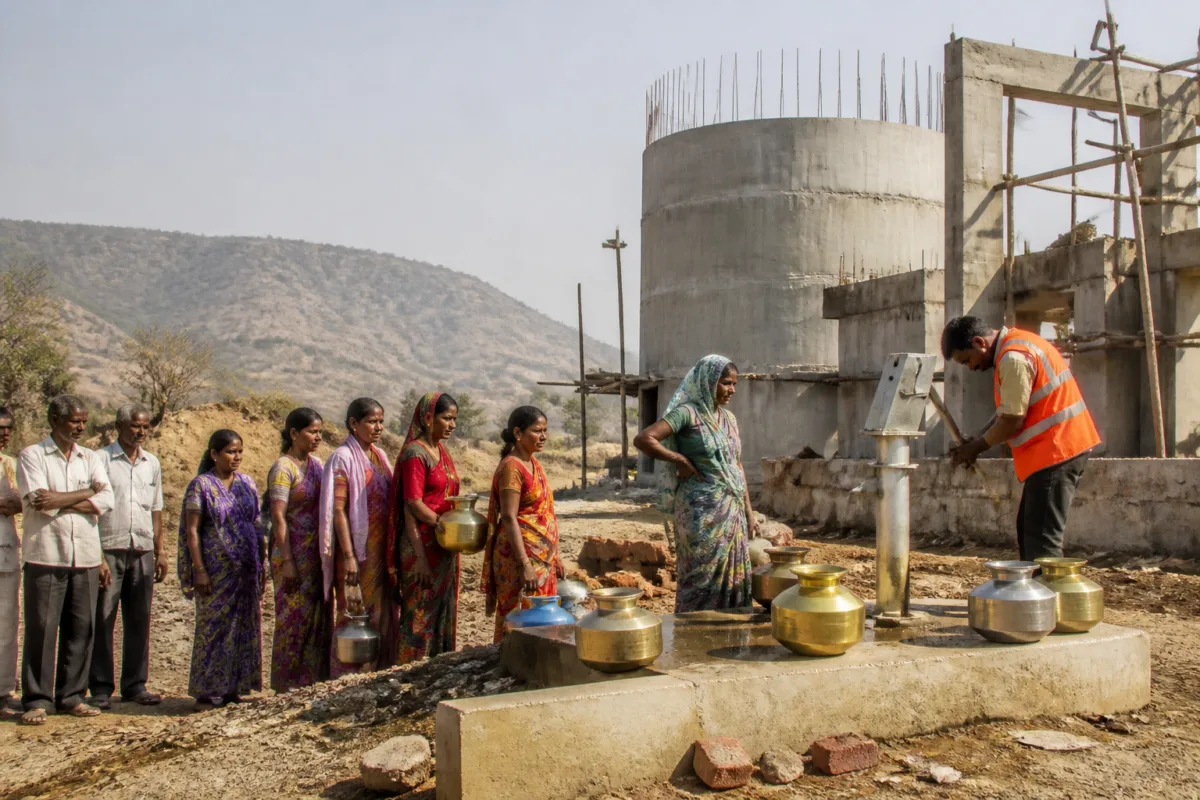
Pune’s water shortage concerns have intensified after the Zilla Parishad reported stalled regional water-supply schemes, villages receiving water only intermittently and a 20% reduction in drinking-water supply from the Khadakwasla dam. Zilla Parishad president Veerdhaval Jagdale directed the Maharashtra Jeevan Pradhikaran and the Zilla Parishad’s water-supply department to complete necessary action within a week and submit a report.
The directions were issued during a general meeting chaired by Jagdale to review the district’s possible water shortage and the proposed mitigation plan. Chief Executive Officer Gajanan Patil, vice-president Vivek Valse-Patil, additional chief executive officer Chandrakant Waghmare and chairpersons of various subject committees attended the meeting.
Officials said the water-shortage plan would be finalised within two to three days and sent to the district collector. The meeting also focused on incomplete work under the Kadus, Mulshi and Belna regional water-supply schemes, which members said had left several villages without reliable access to water despite repeated follow-up with the administration.
Tanुजा Ghanwat raised the issue of incomplete work under the Kadus regional water-supply scheme and said affected villages were not receiving water. Deepti Bhogade said incomplete Maharashtra Jeevan Pradhikaran schemes in the Varude-Baburav area of Khed taluka had contributed to severe water scarcity, including a serious shortage of drinking water for livestock.
The Mulshi regional water-supply scheme’s first and second phases were raised by group leader Shivaji Buchade. Jagdale said a separate meeting would be held to examine the scheme. Smita Kanse said villages supplied through the Belna scheme in Junnar taluka were going without water for as long as eight days at a time. Members also raised shortages in Morachi Chincholi, Kanur Mesai, Satgaon plateau and the eastern parts of Ambegaon taluka.
The discussion also exposed gaps in the maintenance system. Karan Khalate said there were insufficient staff and equipment to repair hand pumps, while Rupali Kunde raised the problem of an incomplete water scheme in the Shivganga valley. Vijay Singh Shinde sought the inclusion of water-stressed villages in Khed taluka in the district’s shortage plan.
Patil informed the meeting that drinking-water supply from Khadakwasla had been reduced by 20%. Water would be released for rabi crops after the kharif season, but no release would be made during summer, he said. The decision places additional pressure on district authorities to complete pending schemes and plan available supplies before the summer period.
The meeting also directed action against gram sevaks in villages where bunds had not been built on time despite water being available in streams and drains. Under the current groundwater rules, borewells can be drilled to a depth of 60 metres. The Zilla Parishad decided to send a proposal to the groundwater survey department seeking an increase in this limit in view of drought conditions. Additional staff will also be made available for borewell repairs, Jagdale said.
The immediate administrative deadlines are the finalisation of the water-shortage plan within two to three days, the submission of a report on stalled schemes within a week and a separate review of the Mulshi project. The effectiveness of these measures will depend on whether incomplete infrastructure, maintenance shortages and village-level water planning are addressed together.

