


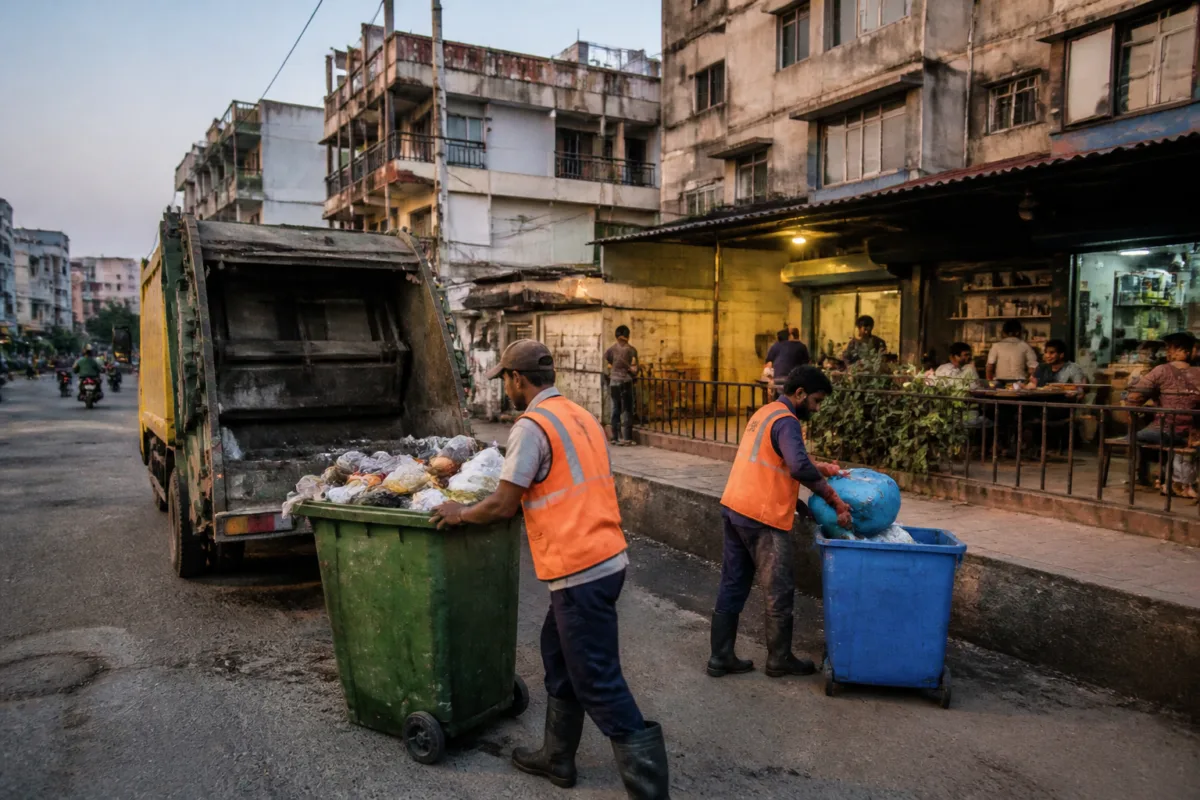
Pune waste collection charges in the Kondhwa-Undri area have come under scrutiny after hotel operators in Ward 40 allegedly reported monthly payments of Rs 3,000 to Rs 4,000 without receiving official receipts. The allegation, reported by Sakal – Pune, concerns payments collected in the name of waste collection even though the Pune Municipal Corporation’s solid waste management department already operates separate vehicles and staff for collecting wet and dry waste.
The report places the issue within the jurisdiction of the Kondhwa-Undri regional office and Ward 40, where it says there are nearly 100 small and large hotels and food businesses. The supplied report does not establish how many businesses allegedly made the payments, how long the practice continued, who collected the money or whether any amount entered the municipal account.
According to Sakal – Pune, one hotel operator spoke on condition of anonymity and alleged that the health department collected money without issuing receipts. The operator questioned whether the payments were deposited with the municipal corporation or transferred elsewhere. No receipt, payment record, named complainant or documentary evidence supporting the allegation was included in the supplied material.
The allegation is significant because the municipal corporation already maintains a waste collection system for wet and dry waste, including vehicles, drivers and sanitation personnel. The report therefore raises a basic administrative question: if additional payments are being collected from food businesses for waste handling, what is the legal or operational basis for those charges, and how are they recorded?
The report also highlights the accountability gap created when payments are made without receipts. A receipt would ordinarily identify the collecting authority, the purpose of the payment, the amount received and the account into which the money is deposited. Without such documentation, it is not possible from the supplied evidence to determine whether the alleged collections were an authorised municipal fee, an informal arrangement, a private service payment or an unauthorised demand.
Raju Dullam, senior health inspector at the Kondhwa-Undri regional office, denied that such a practice was taking place. As quoted by Sakal – Pune, he said that if any such incident had occurred, the concerned parties should submit a complaint and that action would be taken. He also said that if the practice was found to have occurred, it may have been voluntary.
Santosh Warule, the municipal deputy commissioner for solid waste, said that the matter would be examined and appropriate action taken. He added that the concerned parties would need to come forward with a complaint, and that action would be difficult without one, according to the report.
The officials’ responses establish that the municipal administration has been informed of the allegation but do not confirm whether a formal inquiry, audit or disciplinary process has begun. The supplied report also does not state whether the municipal corporation has issued any written order authorising separate hotel waste collection charges in Ward 40.
The matter now depends on verifiable records. A meaningful inquiry would need to establish the number of businesses involved, the period over which payments were allegedly made, the identities and roles of the collectors, whether receipts were issued, and whether any money was deposited into a Pune Municipal Corporation account. It would also need to distinguish municipal charges from privately negotiated waste-handling arrangements.
Until such records or formal complaints are examined, the alleged collections should not be treated as an established municipal irregularity. The available information supports reporting that hotel operators have raised questions and that municipal officials have sought complaints, but it does not independently establish that unauthorised payments were collected or that public funds were diverted.

