


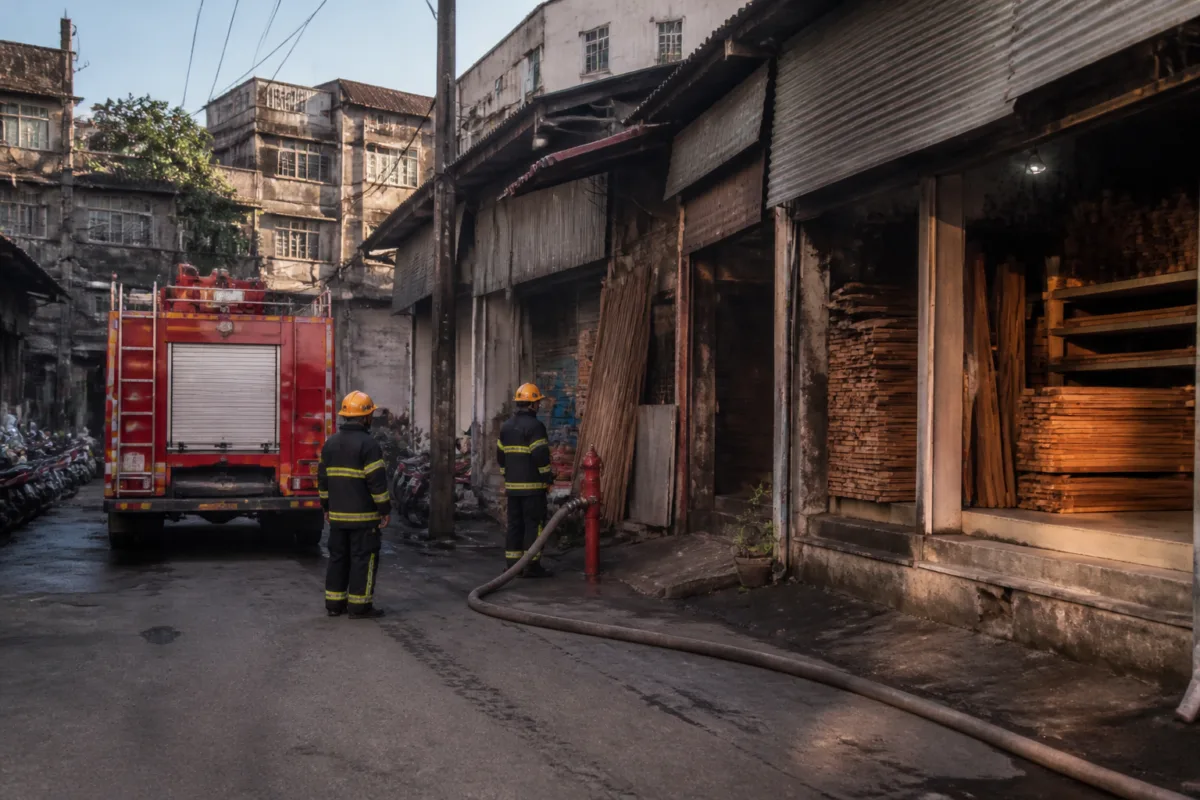
A fire at Pune’s Timber Market in Bhawani Peth has renewed questions about fire-safety enforcement in the city’s dense commercial areas, according to a report by Pudhari. The report links the latest incident to an earlier fire at the same market in 2023, after which the fire brigade had reportedly advised safety audits, water tanks and sprinkler systems.
The extent to which those measures were implemented and regularly inspected remains unclear. Pudhari reported that correspondence had been sent to stakeholders after the earlier incident, but that information on subsequent action has not emerged. The latest fire has therefore brought the gap between written instructions and on-site preparedness back into focus.
The market presents a difficult physical setting for fire protection. Several shops operate from metal-sheet sheds, while limited space can make it difficult to install equipment and maintain clear access. The area also has narrow roads, which can delay fire engines. The report said congestion and uncontrolled vehicle movement around the Lohianagar fire station create additional challenges when emergency vehicles are travelling to the market.
These conditions make prevention and access planning important alongside the availability of firefighting equipment. Pudhari identified fire-safety audits, water storage, automatic sprinklers and functional hydrant points as key measures for the market. It also raised questions about whether hydrant points recorded by the relevant authorities are operational and capable of supplying sufficient water pressure when required.
According to the report, joint inspections of hydrant points had earlier been conducted with water-supply personnel, but such checks appear to have received less attention over time. The report did not provide inspection records or an official response confirming the present condition of the hydrant network. That leaves a central implementation question unresolved: whether the listed emergency infrastructure works in practice at the locations where it is needed.
The report also distinguished between conducting drills and assessing their operational value. Fire-service exercises are held around festivals such as Holi, but their usefulness depends on what they measure, including response time, water availability and the ability to control a fire at a crowded commercial site. Pudhari said large commercial establishments should also conduct regular mock drills.
Equipment maintenance is another part of the safety chain. Fire extinguishers require periodic checks and refilling after the extinguishing agent’s validity expires. The report cautioned that installing equipment for display is not sufficient; its condition, expiry date and performance must be checked regularly. It also noted that inadequate fire-safety arrangements may create difficulties in obtaining insurance protection and urged businesses to take fire-brigade no-objection certificates and required safety systems seriously.
The market’s narrow streets and traffic conditions have a direct bearing on the time available to contain a fire. Pudhari reported that the fire brigade may face difficulty moving through congestion, particularly around the Lohianagar area. The report consequently called for traffic planning that preserves clear routes for emergency vehicles, as well as alternative water arrangements.
The wider governance issue is not limited to the presence of fire extinguishers or the dispatch of fire engines after an incident. It involves maintaining accessible roads, testing hydrants, checking commercial premises, enforcing approved safety measures and assigning responsibility when directions are not implemented. In a market where sheds, limited space and narrow streets complicate retrofitting, inspections must establish whether the prescribed systems are usable under actual operating conditions.
The Pudhari report does not establish which specific safety measures were absent or non-functional during the latest fire, nor does it document an official finding on compliance. It does, however, identify a recurring institutional concern: audits, letters and drills have limited value unless they lead to verified corrective action and continuing maintenance. For Pune’s dense commercial markets, the effectiveness of fire safety will depend on that routine enforcement as much as on emergency response after a fire has already begun.

