


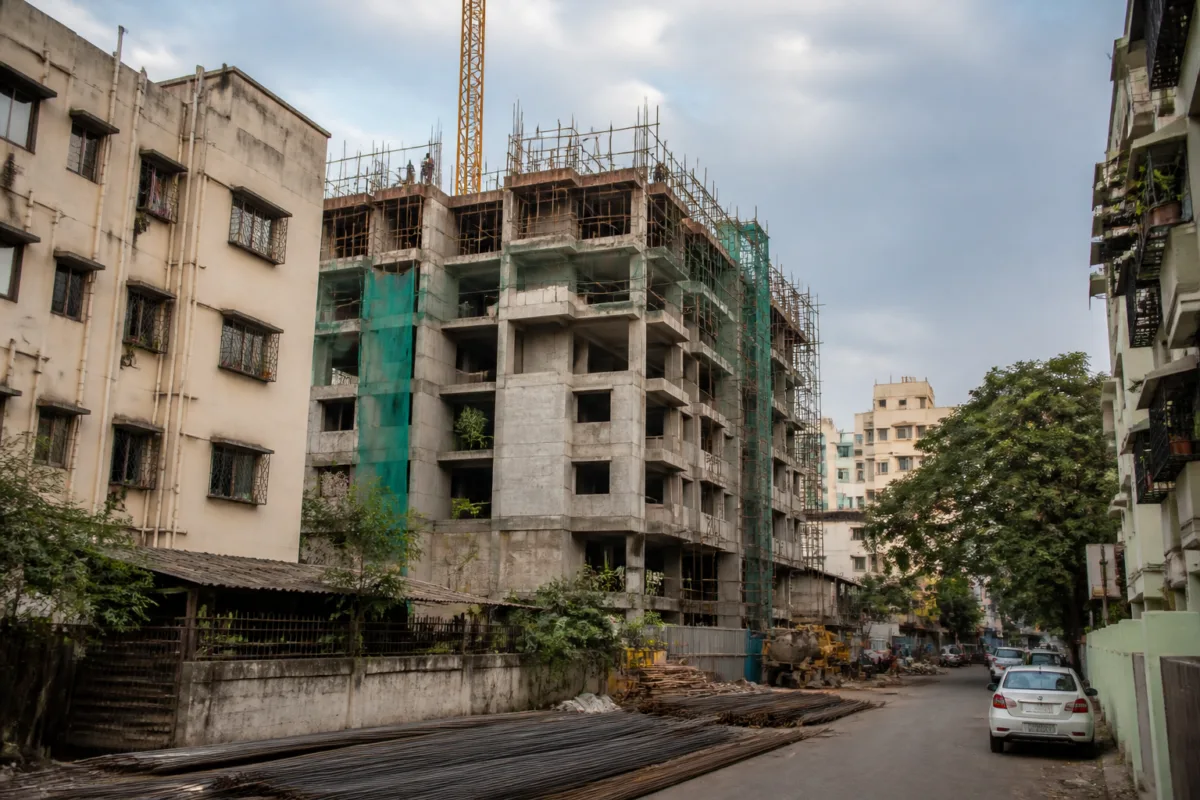
The Bombay High Court’s decision in the Kiara Buildcon redevelopment dispute has reinforced a principle with wide relevance to Pune’s housing projects: a disagreement between business partners cannot automatically bring an entire redevelopment scheme to a halt when society members and flat buyers are already dependent on its completion. The ruling allowed construction and project management to continue under court-supervised safeguards, while leaving the partners’ competing financial claims unresolved.
The case concerns the redevelopment of the Radha Anand Cooperative Housing Society in Erandwane. Sixteen society members had vacated their homes and were living in rented accommodation while waiting for the new apartments promised through the project. Buyers who had entered into agreements for flats in the redevelopment were also waiting for possession. For them, the dispute was not simply a disagreement over partnership accounts. It affected housing, rent obligations, construction progress and the prospect of receiving a home.
That distinction is central to the court’s reasoning. The dispute arose within Kiara Buildcon, the partnership entity undertaking the redevelopment. Akshay Dhumal, who joined the firm as a partner on 24 September 2021, held a 33 per cent share in its profits and losses. Another principal partner held the remaining 67 per cent. The partnership had taken up only one redevelopment project, comprising 47 flats: 18 for existing society members and the balance for sale.
By the time the matter was considered, construction had progressed to approximately 45 per cent in Wing A and 80 per cent in Wing B. The project had therefore moved beyond the stage of a purely internal business arrangement. Physical construction was underway, society members had surrendered possession of their homes, and purchasers had entered into transactions connected with the proposed flats. Any prolonged interruption could have affected several groups that were not responsible for the partners’ disagreement.
The Bombay High Court bench of Justice G. S. Kulkarni and Justice Dr Neela Gokhale dismissed Dhumal’s appeal and declined to interfere with the appointment of another partner as a court receiver. The receiver was permitted to supervise construction, manage the redevelopment and deal with unsold flats under the oversight of the court. The High Court held that appointing the existing partner was not illegal merely because the parties were in dispute.
The court’s intervention reflects a practical problem in redevelopment projects. A society’s agreement with a developer or partnership may create obligations that continue even when the parties managing the project begin to contest ownership, accounts or control. If every such dispute were allowed to stop construction, the immediate consequences would fall on residents who had already vacated their homes and on buyers who had paid or committed money for flats.
The court expressly observed that the consequences of a partnership dispute do not remain confined to the partners. The rights of society members waiting for the redevelopment benefit and those of flat purchasers awaiting possession also have to be considered. In this case, those rights were given weight while the court examined whether the project should continue and who should oversee it.
Dhumal’s appeal was linked to disputes over the partnership’s financial transactions, project management and the sale of three flats. He alleged that agreements for flats numbered 502A, 503A and 702B had been executed below the prevailing market rate. According to the claim placed before the court, the market rate was around Rs 17,000 per square foot. He also alleged that approximately Rs 2 crore remained outstanding from flat buyers, while only Rs 12 lakh had actually been received.
Dhumal sought dissolution of the partnership, an account of its financial transactions and restrictions on the sale of project properties. His counsel argued that appointing a partner accused of financial irregularities as receiver created a serious conflict of interest. The argument was that the receiver could control bank accounts, use partnership funds, supervise construction and sell unsold flats even though the allegations concerning undervalued sales and breach of trust had not been finally determined.
The opposing side disputed this position. Counsel for Kiara Buildcon and the respondents told the court that the partner appointed as receiver had handled project approvals, construction-related work and financial responsibilities. The respondents claimed that this partner had spent Rs 1.82 crore from personal funds on the project, while Dhumal had contributed approximately Rs 19.17 lakh. They also alleged that Dhumal had withdrawn Rs 95 lakh from the company as a loan and that a counterclaim of Rs 7.82 crore had been filed against him.
The High Court did not finally decide these competing financial claims in the appeal. That limitation is important. The ruling was not a finding that one partner’s accounts were correct or that the allegations relating to flat sales had been proved. Instead, the court considered how the project could continue while the commercial dispute remained subject to adjudication.
The decision therefore separates two questions that are often merged during redevelopment conflicts. The first is who is ultimately liable for disputed transactions or partnership accounts. The second is whether construction and obligations to society members and flat purchasers should stop while that dispute is being resolved. In the Erandwane case, the court treated these as distinct issues and prioritised a supervised mechanism for keeping the project operational.
The project’s stage of construction also influenced that approach. A project with substantial work already completed carries commitments that cannot easily be reversed without affecting residents and purchasers. The source report states that members who had vacated their homes continued to depend on rent payments and that responsibilities towards flat buyers were also continuing. Stopping the work would therefore have prolonged uncertainty for people already displaced by the redevelopment process.
At the same time, the court did not leave the receiver with unrestricted control. The Pune district court had imposed safeguards before permitting the receiver to manage the project. Before selling flats, the receiver was required to deposit Rs 2 crore in court. Sale agreements could not be finalised without following the prescribed process and obtaining prior approval from the court. These conditions were intended to protect Dhumal’s interests while allowing construction to proceed.
This arrangement illustrates the administrative problem courts face when a redevelopment project becomes entangled in internal management disputes. A complete injunction may protect one party’s concern about assets but can also harm residents waiting for homes. Unrestricted control by one disputing party may create a different risk. Court supervision becomes a way to keep essential project functions moving while placing financial and transactional decisions under additional scrutiny.
The failed mediation attempts further show the difficulty of resolving such disputes privately. The parties were referred to mediation three times but did not reach a settlement. During subsequent discussions, Dhumal reportedly sought five flats, while the respondents were prepared to offer three. No agreement was reached. The High Court noted that a dispute connected to three flat transactions had placed the entire redevelopment project at risk.
For Pune’s redevelopment landscape, the case highlights the vulnerability created when residents hand over possession before a project is complete. Once members move into rented accommodation, their exposure is no longer limited to the eventual quality of construction. Delays can affect rent payments, temporary housing arrangements and the timing of their return. Flat purchasers face a separate set of risks connected with possession, payments and the validity of transactions made during the dispute.
The ruling does not create a general licence for a developer or partner to continue work regardless of allegations. Its facts point instead to a conditional model: construction may continue when third-party housing interests are at stake, but project management, sale of unsold flats and use of funds can remain subject to judicial safeguards. The court’s reasoning also indicates that the suitability of a receiver depends partly on practical knowledge of the project and its approvals, not only on whether the person is external to the dispute.
The case leaves several matters open. The competing claims over the value of the three flats, outstanding payments, contributions, withdrawals and the counterclaim have not been finally resolved in this appeal. The source also does not establish the project’s final completion date or when the society members and purchasers will receive possession. What the ruling confirms is narrower but significant: the redevelopment will not be stalled solely because the partners are fighting, and its continuation will remain tied to court-ordered controls designed to protect the other people dependent on it.

