


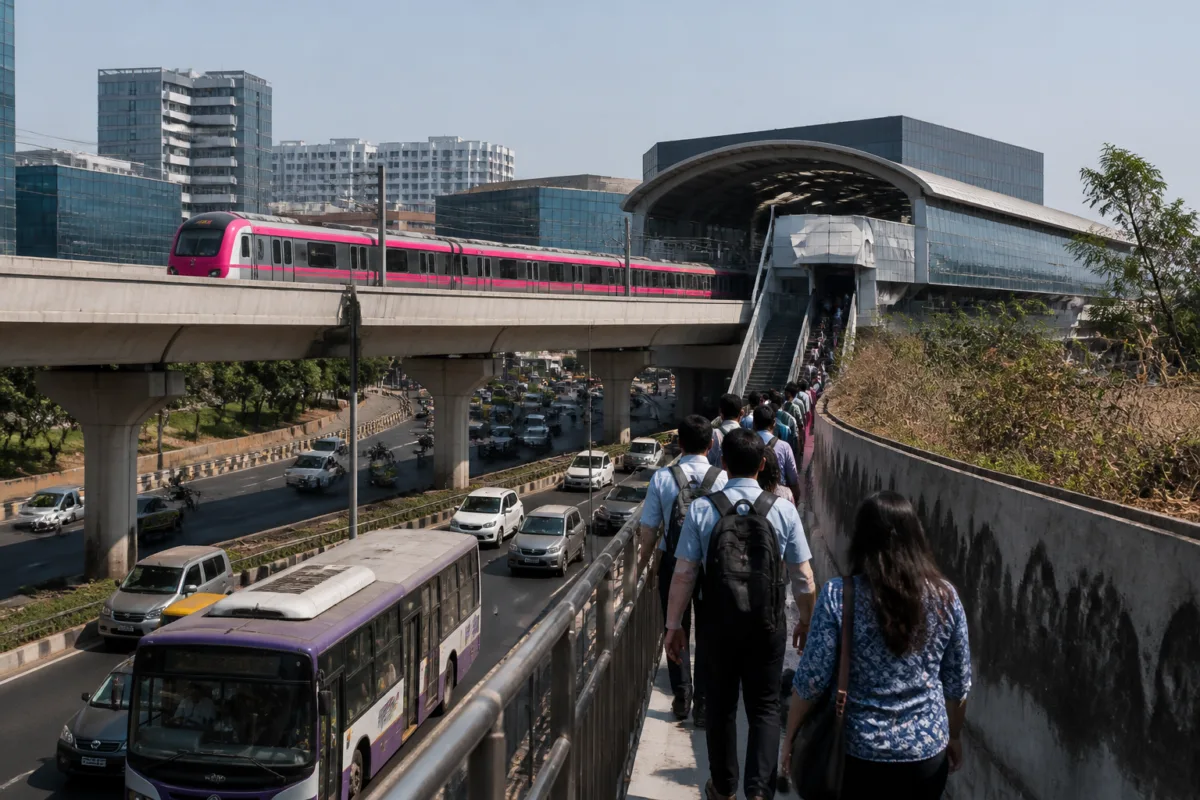
Pune’s Pink Line Metro began public operations on Wednesday, cutting travel time and daily commuting costs for several IT employees, but commuters said the new service still depends on better feeder buses, footpaths and foot overbridges to connect stations with homes and workplaces.
IT professional Anita Jangid travelled from R K Laxman station to Maan in about 20 minutes. She said the Metro removed the stress of driving through traffic, but still had to walk from her home to the station and from Maan station to her workplace. She told the Times of India that shuttle services would have made the journey more convenient.
For Sharanmeet Garcha, the service could reduce daily travel expenses from about Rs180 to approximately Rs90. However, she said improved feeder services were necessary to make the Metro accessible from both ends of the journey. The savings are therefore linked not only to the Metro fare but also to whether commuters can reach stations without relying on additional private transport.
Pavanjit Mane, president of the Forum for IT Employees, said the next priority should be making stations easier to access. He identified feeder services, pedestrian infrastructure and connections to IT hubs as key requirements for increasing ridership. He also said the remaining stations serving important IT areas in Baner would strengthen the line once they become operational.
Balewadi High Street station is expected to become operational in about a month and could serve an estimated 50,000 to 60,000 IT employees in the Baner-Balewadi area, according to Mane. He said work was under way with Pune Mahanagar Parivahan Mahamandal Limited to introduce feeder services linking large residential townships with Metro stations.
PMPML has already started Metro shuttle services on 12 routes. These connect areas including Mahalunge-VTP, Joyville on Maan Road, Blue Ridge, Life Republic, Mahalunge-Sus and PMR-2 with stations and office areas around Shivaji Chowk, Croma, Balewadi Stadium and the Capgemini-Synechron zone.
Mane also said footpath design work was under way, with the district collector expected to review it within two to three weeks. Ground work was expected to begin in the first or second week of December. He said footpaths and foot overbridges would be important for connecting stations safely with IT centres, particularly at critical road junctions.
The Pune Metropolitan Region Development Authority plans to coordinate with PMPML, autorickshaw unions and other transport operators to connect Metro stations with office campuses and residential areas. Three foot overbridges have been provided at Wakad, Balewadi and Civil Court stations, while another is planned at Shivajinagar.
PMRDA and the Maharashtra Industrial Development Corporation have also planned a Rs426-crore last-mile connectivity project for Hinjewadi, with both agencies expected to contribute equally. The district collector has further asked PMPML to assess demand for an intercity bus transit hub at Wakad or MITCON-Balewadi station as part of the comprehensive mobility plan.
The first day of the Pink Line’s public service therefore brought both a shorter alternative to road travel and a clear operational task: ensuring that the trip to and from each station is as usable as the Metro journey itself. The next milestones are the opening of additional Baner stations, the review and construction of pedestrian links, and the expansion of feeder services.

