


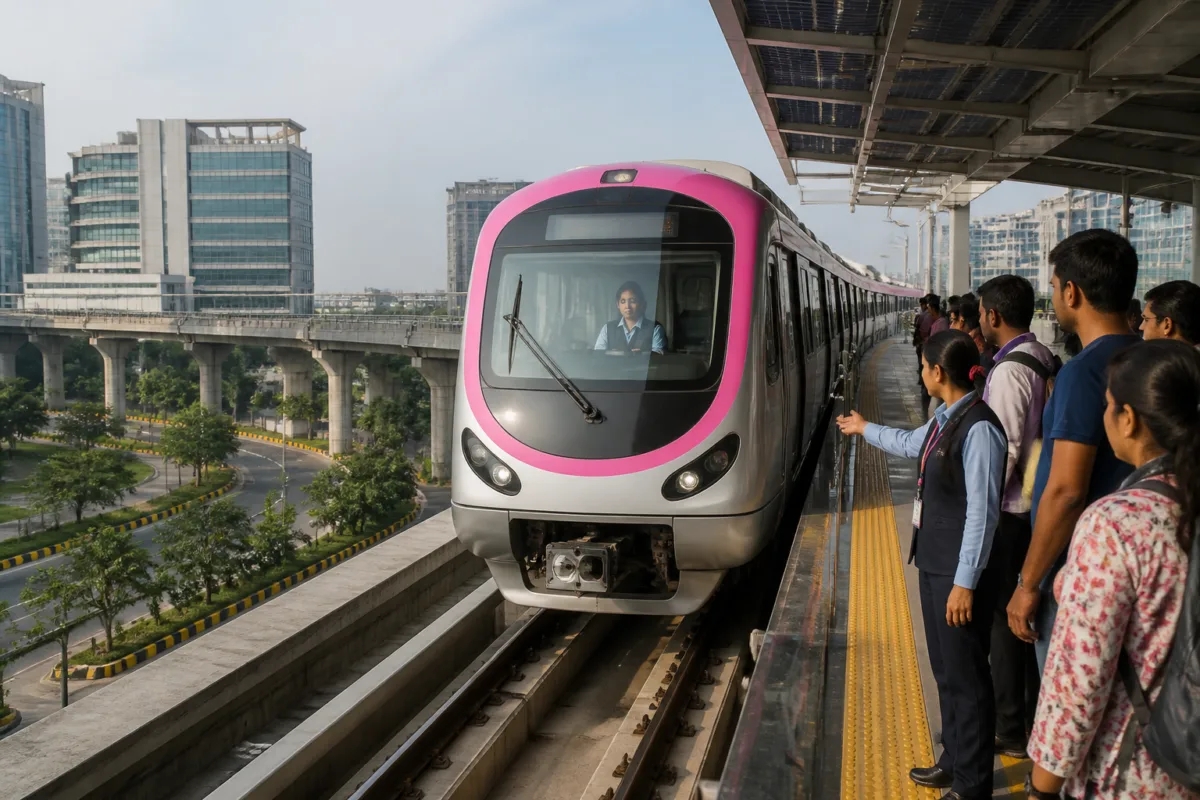
Pune Metro’s Pink Line was inaugurated on Tuesday, November 3, with public services scheduled to begin on Wednesday, November 4, expanding rail connectivity for the city’s residents and linking the Hinjewadi information technology park to the metro network. Prime Minister Narendra Modi inaugurated the line in the presence of Maharashtra Chief Minister Devendra Fadnavis and Deputy Chief Ministers Eknath Shinde and Sunetra Pawar.
After the inauguration, Sunetra Pawar travelled on the Pink Line with Fadnavis and Shinde. Pawar, who is also Pune’s guardian minister according to the report, said the project fulfilled a vision associated with Ajit Pawar. She said he had been directly involved with the line from its approval and preparation of the detailed project report to its construction.
The line is being presented as the country’s first metro line to be operated entirely by women. The report also said women would form the largest share of staff working at its stations. Pawar described the woman metro operator who drove the train as one of “Savitribai Phule’s daughters”, linking the project to Pune’s history as the city where education pioneer Savitribai Phule opened opportunities for girls.
The women-led operating model covers both train operations and station staffing, according to the account. The report did not provide the total number of women employees, the number of stations on the line or the operating frequency planned for the start of public services. Those details will determine how the line performs as a daily transport service after inauguration.
The project connects the Hinjewadi IT park to Pune’s metro system. A future plan also aims to connect the Kharadi IT park, another major employment area. Once these and other projects are completed, Pune’s metro network is expected to extend across more than 100 kilometres, the report said.
The Pink Line has been developed through a public-private partnership model and involves an investment of Rs 8,313 crore. The report described it as the country’s first major project of its kind developed under the National Metro Rail Policy through the PPP route. It did not specify the private concessionaire, the terms of the partnership or the division of responsibilities between public authorities and private operators.
The project also includes 7.60 megawatts of solar-energy capacity. According to the report, the system has been designed to meet about 30% of the line’s electricity requirements through green energy. This makes the line notable not only for its transport role but also for the way energy infrastructure has been incorporated into a metro project.
Public access to the Pink Line is scheduled to begin on November 4. Its immediate significance will depend on the start of regular operations and the line’s ability to provide reliable access to Pune’s employment centres, while the planned Kharadi connection and other projects will determine how quickly the city moves towards a metro network exceeding 100 kilometres.

