


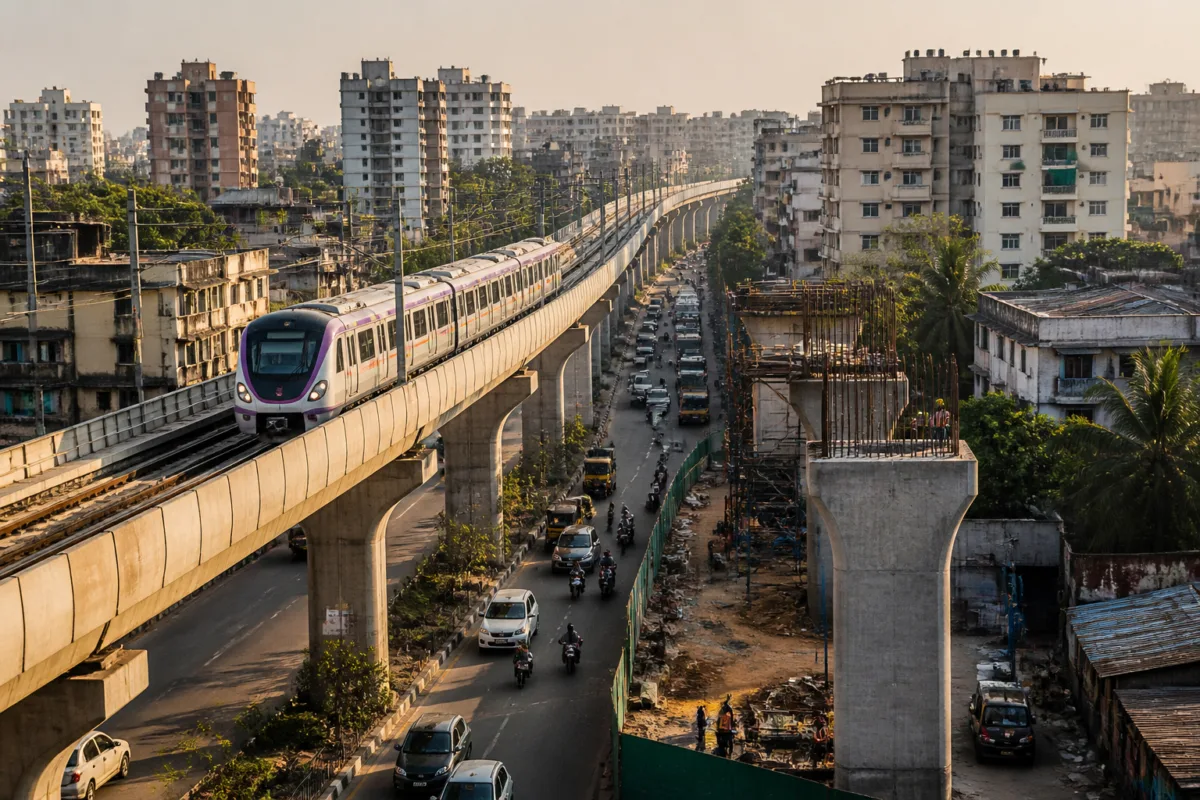
Pune’s operational metro network may expand significantly by 2030, but much of the city’s proposed system remains dependent on approvals, detailed project reports and alignment decisions, according to a Lokmat report.
The city currently has 33.28 km of fully operational metro lines with 29 stations. Of this network, 27.2 km is elevated and 6.08 km is underground. The first phase became fully operational on 29 September 2024.
Construction is under way on four projects totalling about 54.86 km and 50 stations. These include the 4.41-km Pimpri Chinchwad–Nigdi extension with four stations; the 6.06-km Swargate–Katraj line with five stations; the 12.75-km Vanaz–Chandani Chowk and Ramwadi–Wagholi corridors with 13 stations; and the 31.64-km Kharadi–Khadakwasla and Nal Stop–Warje–Manikbaug corridors with 28 stations.
The report said the ongoing works have a target of completion by December 2030. However, about 178 km of additional routes would still be at the approval or DPR stage even after that target, indicating that a citywide metro network will depend on a second layer of planning and execution beyond the projects already under construction.
Two proposed corridors—Hadapsar–Loni Kalbhor, measuring 11.10 km with 10 stations, and Hadapsar–Saswad Road, measuring 5.57 km with four stations—are awaiting central government approval. Their combined estimated cost is Rs 5,605.39 crore.
The 45.29-km Bhakti Shakti–Mukai Chowk–Wakad–Nashik Phata–Vallabhnagar–Chakan corridor, planned with 34 stations, has received DPR approval from the Pimpri-Chinchwad Municipal Corporation. Its estimated cost is Rs 12,937.23 crore.
Other proposals remain at earlier stages. Alignment work is under way for a 3-km Lohgaon airport link and the 20-km District Court–Pulgate–Kondhwa–Yewalewadi corridor, which includes a separate branch from Kondhwa to Undri. DPRs are being prepared for the 45-km Wakad–Katraj–Shewalewadi corridor and the 30-km Pune–Purandar airport route.
The Pimpri-Chinchwad Municipal Corporation has also sought preparation of a DPR for an 18-km ERTS route from Godown Chowk through Kudawadi, Kalewadi Phata and to Jagtap Dairy.
Ridership on the operating network increased during the period cited in the report. Average daily ridership rose from 1,86,141 in March 2026 to 3,11,953 in September, an increase of about 68 per cent. More than 72,000 passengers were added between August and September alone. MahaMetro estimates that the launch of Line 3 could add about one lakh passengers to the system.
These figures suggest that demand is growing on the routes already available, while access to large parts of Pune and its wider urban region remains dependent on projects that have not yet reached construction. The proposed corridors are intended to extend metro access towards the eastern, western and southern parts of the city, as well as major peripheral destinations such as Chakan and the proposed Purandar airport.
The immediate implementation challenge is therefore not only completing the 54.86 km under construction. It is also moving the 178 km pipeline through approvals, DPR finalisation, alignment decisions, funding and construction. Until those stages are completed, metro access will remain concentrated along the existing network and the corridors now being built, rather than serving Pune as a continuous citywide system.

